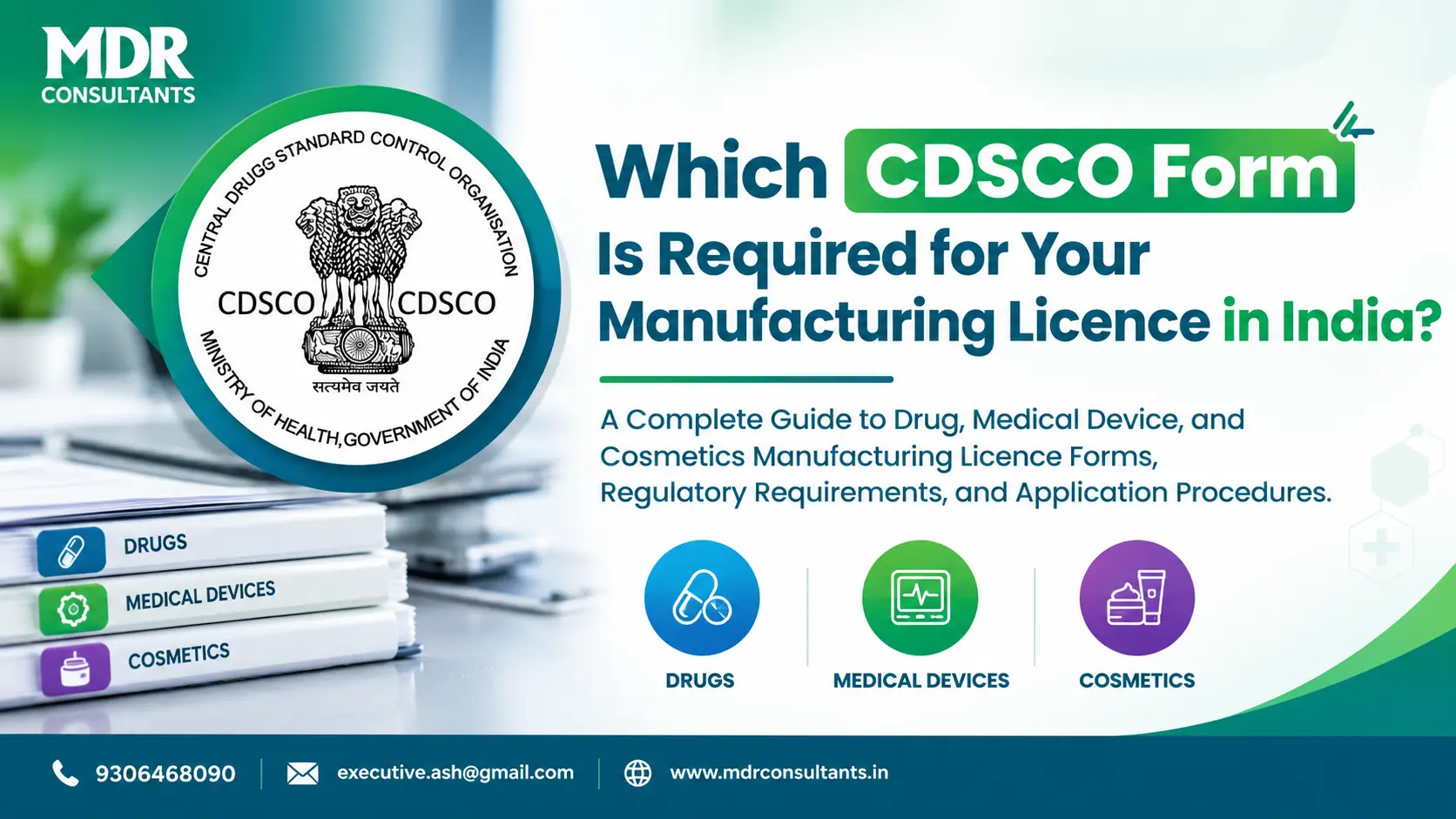
Manufacturing medical devices in India requires compliance with the applicable provisions of the Medical Devices Rules, 2017, framed under the Drugs and Cosmetics Act, 1940, as amended.
Before commencing manufacturing activities for sale or distribution, manufacturers must determine the applicable regulatory pathway, medical device risk classification, licensing authority, and prescribed application form. The requirements differ depending on whether the device falls under Class A, B, C, or D and whether the manufacturer intends to operate at its own facility or use another manufacturer's premises under a loan licence arrangement.
The Central Drugs Standard Control Organisation (CDSCO) performs central regulatory functions, while the State Licensing Authority handles specified manufacturing licence applications under the Rules.
This guide explains the principal CDSCO forms used for medical device manufacturing, the relevant regulatory distinctions, and the documentation manufacturers should prepare before applying.
Under Rules 20 and 21 of the Medical Devices Rules, 2017, the prescribed forms depend on the device's classification and the manufacturing arrangement.
|
Medical device category |
Application form |
Licence form |
Regulatory pathway |
|
Eligible Class A and Class B devices |
MD-3 |
MD-5 |
Regular manufacturing licence |
|
Eligible Class A and Class B devices |
MD-4 |
MD-6 |
Loan manufacturing licence |
|
Class C and Class D devices |
MD-7 |
MD-9 |
Regular manufacturing licence |
|
Class C and Class D devices |
MD-8 |
MD-10 |
Loan manufacturing licence |
Forms MD-3 and MD-4 are submitted to the State Licensing Authority for the relevant Class A and Class B pathways. Forms MD-7 and MD-8 are submitted to the Central Licensing Authority for Class C and Class D devices. The corresponding licence forms are MD-5, MD-6, MD-9, and MD-10, respectively.
Important: The Class A licensing pathway excludes non-sterile and non-measuring Class A devices covered by the applicable exemption. Such devices must be assessed under the separate registration requirements introduced by G.S.R. 777(E), dated 14 October 2022.
These forms should be interpreted alongside the current Rules, applicable amendments, and relevant notifications.
The Medical Devices Rules, 2017, classify medical devices according to risk, taking into account factors such as intended use, duration of contact, invasiveness, and other characteristics specified in the classification rules.
The four risk classes are:
The classification determines the applicable manufacturing regulatory pathway and helps identify the competent licensing authority.
Manufacturers should not select a form based solely on the product's commercial name. They should establish the intended purpose and apply the relevant classification rules under the First Schedule of the Medical Devices Rules, 2017.
Form MD-3 is the prescribed application form for a licence to manufacture eligible Class A and Class B medical devices for sale or distribution.
Under Rule 20, the application is submitted to the State Licensing Authority through the prescribed online portal, accompanied by the applicable fee and documentation specified under the Rules.
Form MD-5 is the corresponding manufacturing licence granted for eligible Class A and Class B medical devices when the licensing authority is satisfied that the applicable requirements have been met.
Applicants should assess the following:
The audit requirements and process can differ according to the device class and applicable provisions. Manufacturers should therefore verify the requirements for their particular device before filing.
A loan licence pathway may apply when a manufacturer proposes to manufacture medical devices using the premises of another manufacturer under the arrangement permitted by the Rules.
Form MD-4 is the application form for a loan licence to manufacture eligible Class A and Class B medical devices for sale or distribution.
Form MD-6 is the corresponding loan licence granted under the applicable provisions.
Applicants should ensure that the proposed manufacturing arrangement, facility, technical responsibilities, and supporting documents comply with the applicable requirements.
A loan licence should not be treated as interchangeable with a regular manufacturing licence. The correct form depends on the actual manufacturing arrangement and the relevant regulatory provisions.
Class C and Class D medical devices follow the manufacturing licensing pathway under Rule 21, which is administered by the Central Licensing Authority.
Form MD-7 is the application form for a licence to manufacture Class C or Class D medical devices for sale or distribution.
The application must be submitted through the prescribed online portal with the applicable fee and documentation required under Rule 21 and the relevant provisions of the Fourth Schedule.
Form MD-9 is the corresponding manufacturing licence issued for Class C and Class D medical devices when the Central Licensing Authority is satisfied that the applicable requirements have been fulfilled.
Depending on the device and applicable requirements, the manufacturer may need to provide:
The precise requirements depend on the product and applicable provisions. Applicants should consult the current official checklist rather than treating this illustrative list as exhaustive.
For eligible Class C and Class D devices manufactured under a loan licence arrangement, the applicable forms are MD-8 and MD-10.
Applications fall under the Central Licensing Authority pathway under Rule 21.
Applicants should confirm that the proposed arrangement, manufacturing facility, technical documentation, and quality management system satisfy the requirements applicable to the devices concerned.
Not every Class A medical device follows the ordinary manufacturing licensing pathway.
Under G.S.R. 777(E), dated 14 October 2022, specified Class A non-sterile and non-measuring medical devices are exempted from the applicable licensing regime, subject to the conditions of the notification.
The notification introduced Chapter IIIB into the Medical Devices Rules, 2017, providing a registration pathway for these devices.
Manufacturers must assess whether their products meet the relevant Class A classification and the specific non-sterile and non-measuring conditions. Where the exemption applies, the manufacturer must follow the prescribed registration requirements rather than automatically applying through Form MD-3.
The exemption should not be interpreted as removing every regulatory obligation. Applicable registration, safety and performance, standards, and other relevant requirements must still be assessed.
The applicable authority depends on the device class and the provisions governing the application.
|
Device category or pathway |
Competent authority |
|
Eligible Class A and Class B regular manufacturing licence |
State Licensing Authority |
|
Eligible Class A and Class B loan licence |
State Licensing Authority |
|
Class C and Class D regular manufacturing licence |
Central Licensing Authority |
|
Class C and Class D loan licence |
Central Licensing Authority |
|
Class A non-sterile and non-measuring devices covered by the exemption |
Applicable registration pathway under Chapter IIIB |
The Central Licensing Authority is the Drugs Controller General of India (DCGI), as defined in the Rules.
Manufacturers should verify the applicable pathway, including any relevant exemption or subsequent amendment, before preparing their application.
The documents required depend on the medical device, risk class, manufacturing arrangement, and applicable provisions of the Rules.
The Fourth Schedule specifies documentation requirements, while the Fifth Schedule addresses the Quality Management System for medical devices and in vitro diagnostic medical devices.
Commonly relevant documents and information may include:
The exact documents must be checked against the relevant parts of the Fourth Schedule, the Fifth Schedule, applicable amendments, and the licensing authority's current checklist.
Establish the product's intended medical purpose, specifications, manufacturing site, and proposed manufacturing activities.
Classify the device under the First Schedule of the Medical Devices Rules, 2017. Consider any applicable special requirements for in vitro diagnostic devices.
Choose between MD-3, MD-4, MD-7, and MD-8 according to the device class and the regular or loan licence arrangement.
Determine whether the application falls under the State Licensing Authority or the Central Licensing Authority.
Compile the relevant technical, site, quality management, personnel, and application documents in accordance with the Fourth and Fifth Schedules and the current checklist.
Submit through the prescribed online portal, pay the applicable fee, and respond to regulatory queries or audit and inspection requirements as applicable.
Once the licence is granted, comply with its conditions and the applicable requirements for manufacturing, quality management, records, labelling, and post-market obligations.
Manufacturers should avoid the following errors:
A device-specific regulatory assessment can help identify the correct application pathway and reduce avoidable delays.
MDR Consultants provides regulatory support to medical device manufacturers seeking to manufacture and market medical devices in India.
Our services may include:
The scope of support depends on the device, manufacturing arrangement, and applicable regulatory requirements.
The correct CDSCO form for a medical device manufacturing licence in India depends on the device's risk class, the manufacturing arrangement, and the applicable provisions of the Medical Devices Rules, 2017.
Forms MD-3 and MD-5 relate to the regular manufacturing licence pathway for eligible Class A and Class B devices. Forms MD-4 and MD-6 relate to the corresponding loan licence pathway. Forms MD-7 and MD-9 cover regular manufacturing licences for Class C and Class D devices, while Forms MD-8 and MD-10 cover the corresponding loan licence pathway.
Class A non-sterile and non-measuring devices covered by G.S.R. 777(E) follow a separate registration pathway subject to the conditions of the notification.
Before applying, manufacturers should confirm the device classification, licensing authority, applicable exemptions, required documents, and current regulatory provisions.
Need assistance with a medical device manufacturing licence in India?
Contact MDR Consultants for regulatory support with medical device classification, manufacturing licence applications, documentation, and CDSCO compliance.
For eligible Class A and Class B devices, Form MD-3 is generally used for a regular manufacturing licence application. For Class C and Class D devices, Form MD-7 is generally used. The corresponding licence forms are MD-5 and MD-9.
Form MD-5 is the manufacturing licence form for eligible Class A and Class B devices. Form MD-9 is the manufacturing licence form for Class C and Class D devices.
Forms MD-4 and MD-6 apply to the eligible Class A and Class B loan licence pathway. Forms MD-8 and MD-10 apply to the Class C and Class D loan licence pathway.
No. Class A non-sterile and non-measuring devices covered by G.S.R. 777(E), dated 14 October 2022, are exempt from the specified licensing regime subject to the notification's conditions and must follow the applicable registration requirements.
The State Licensing Authority generally handles eligible Class A and Class B manufacturing licence applications. The Central Licensing Authority handles Class C and Class D manufacturing licence applications under the applicable provisions.
The Medical Devices Rules, 2017, specify Quality Management System requirements under the Fifth Schedule. The applicable requirements and verification process depend on the relevant regulatory pathway and device category.
The requirements depend on the device and application pathway. They may include applicant and site details, applicable Plant Master File and Device Master File documentation, Quality Management System records, technical documentation, prescribed declarations, and fee records. The current Fourth Schedule and relevant checklist should be consulted.
Refer to the official CDSCO Medical Devices Rules, 2017 page, the applicable amendment notifications, and the current forms and checklists published by CDSCO.
Last Updated : 29 Oct 2026
The Brand That Promises To Turn Your Business Around!
MDR Consultants excels in guiding medical device companies through global regulatory approvals with tailored solutions, clear communication, and efficient delivery. Their mission-driven approach fosters innovation, compliance, and long-term partnerships built on trust and excellence.

As I observed this company maintains a very good and cooperative environment. "MDR" consultancy is equipped with all modern amenities. They guide you the best. I highly recommend this firm. The entire team is very courteous and helpful. Highly Professional team and the owner is very skilled and humble.

Outstanding expertise! They streamlined our regulatory process, saving us immense time and stress. A truly invaluable partner for medical device compliance.

MDR Consultants have been a reliable partner for our CDSCO registration needs. Their efficient processes and in-depth knowledge of the regulations saved us significant time and resources. We are confident about the quality of their services and their commitment to client satisfaction.

MDR team has consistently delivered quality work, meeting deadlines and exceeding our expectations. We really recommend MDR for regulatory support

My experience with MDR consultants is wonderful. They have in-depth and vast knowledge about their work. They have the team of incredible people. Their commitment towards the client is highly appreciable. I highly recommend to have their services.

MDR IS THE BEST SOLUTION FOR MEDICAL DEVICES CONSULTANCIE THEY PROVIDE ALL THE SOLUTIONS AND PROPER GUIDANCE.AND DELIVER THEIR SERVICES ON TIME .

MDR team has consistently delivered high quality work, meeting deadlines and exceeding our expectations.

It was really a nice experience working with MDR consultancy.They guide you properly with their tranparent work ethics.Honestly MDR consultancy helped me a lot in growing my business.

A very friendly bunch of efficient employees in the team of MDR.A very professional approach towards their job and all my work was done hassle free with least follow up from my side.Keep up great work team MDR!!!!👍👍

The services are top notch , highly recommend for Mr Ashish

Best regulatory services..for medical devices…best in the business

Have a rich experience in the field of consultancy.

Extremely helpful and responsive

Very good experience

Good Services

Appreciable work.

True consultant

Medical Device Regulatory Consultants
37-38, 1st Floor, Near Makhan Bhog, G.T. Road,
Kundli Industrial Area, Delhi NCR, 131028