
BIS Certification Consultant in India
In an era where quality and safety standards play a pivotal role in consumer trust and international competitiveness, BIS (Bureau of Indian Standards) certification has become a cornerstone of product regulation in India. The BIS certification mark, popularly known as the ISI mark, is not just a symbol—it is a commitment to compliance, quality, and consumer satisfaction.
What is BIS Certification?
BIS certification is issued by the Bureau of Indian Standards, the national standards body of India. It signifies that a product conforms to the standards laid down by BIS in terms of safety, performance, and quality. For certain products, especially those that directly impact health, safety, and environmental factors (such as electrical appliances, pressure cookers, cement, steel, and medical devices), BIS certification is mandatory under various Quality Control Orders (QCOs) issued by the Ministry of Consumer Affairs and other government bodies.
Why is BIS Certification Important?
BIS ensures that products meet essential safety requirements, which reduces the risk of hazards such as fire, electric shock, or structural failure. The ISI mark is recognized by Indian consumers as a symbol of trustworthy quality.
- For many products, BIS certification is a legal requirement for manufacture, import, or sale in India. Non-compliance can result in fines, confiscation of goods, and legal actions.
- BIS certification is often a prerequisite for government tenders, institutional sales, and large retail distribution. Certified products enjoy better market acceptability and are often preferred by consumers and dealers alike.
- BIS certification enhances the credibility of Indian products in the global market and facilitates mutual recognition with international standards, aiding in smoother exports.
- BIS certification promotes standardization, which in turn ensures consistent product quality across batches and manufacturers. This consistency builds brand reputation and consumer loyalty.
Services:
01
ISI Mark Certification (Product Certification Scheme)
ISI Mark Certification is a product certification scheme operated by the Bureau of
Indian Standards (BIS). It confirms that a product conforms to the relevant Indian
Standard (IS) in terms of quality, safety, and reliability. Products bearing the ISI
mark are tested and approved by BIS-recognized laboratories and undergo periodic
factory inspections to ensure continued compliance.
The ISI mark is mandatory for various products such as electrical appliances,
cement, LPG cylinders, medical equipment, kitchenware, and steel products, as per
government Quality Control Orders (QCOs).
Why is ISI Mark certification compulsory for Manufacturers
- Legal Requirement for Market Access
For many regulated products, ISI
certification is compulsory. Manufacturers cannot sell or distribute such
products in India without the ISI mark, making it essential for legal
compliance.
- Consumer Trust and Brand Image
The ISI mark is a widely recognized
symbol of quality and safety. Products with this mark are more likely to be
trusted by consumers, which improves the manufacturer’s market reputation and
customer loyalty.
- Competitive Advantage
Certified products often stand out in the
market and are preferred by bulk buyers, government agencies, and export houses,
providing a competitive edge over non-certified competitors.
- Product Quality Assurance
The certification process involves regular
testing and inspections, ensuring that the manufacturer maintains consistent
quality and adheres to Indian Standards throughout production.
- Eligibility for Government Tenders
Government and public sector
organizations often require ISI-certified products in their procurement
policies, giving certified manufacturers access to lucrative tender
opportunities.
- Protection Against Legal Penalties
Manufacturing or selling products
without required ISI certification can lead to fines, prosecution, and product
recalls. Certification helps manufacturers avoid legal risks and penalties.
- Export Facilitation
For exporters, having ISI certification enhances
the credibility of products in international markets, especially where Indian
Standards are recognized or mutually accepted.
In summary, ISI Mark Certification is more than just a regulatory requirement—it is a
strategic investment in product quality, consumer trust, and business growth for
manufacturers in India.
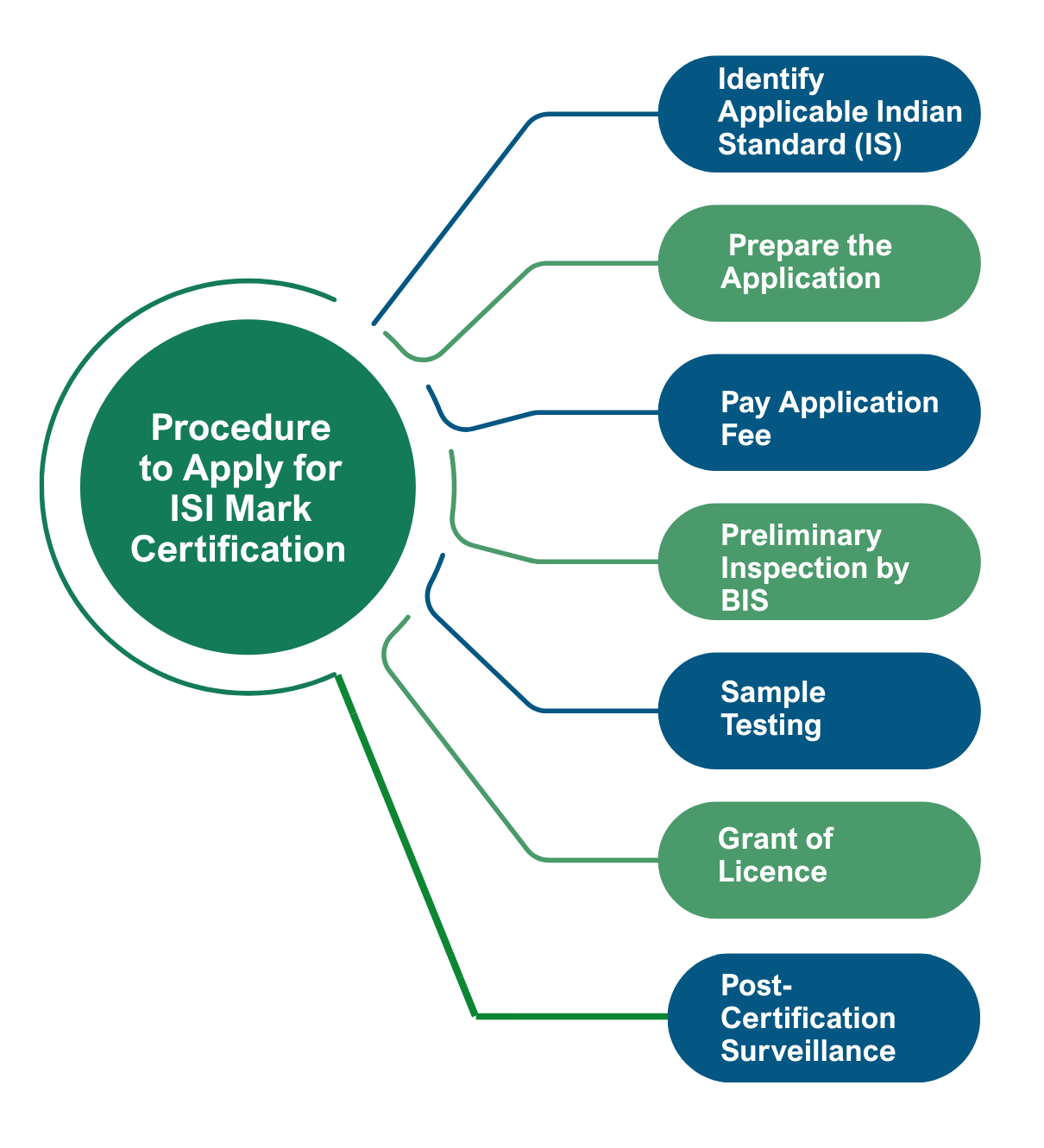
Procedure to Apply for ISI Mark Certification (Product Certification Scheme) –
Domestic Manufacturers
The Bureau of Indian Standards (BIS) follows a structured process to
grant the ISI Mark
Certification under its Product Certification Scheme. Below is a
step-by-step procedure
for Indian (domestic) manufacturers:
Step 1: Identify Applicable Indian Standard (IS)
- Determine the correct Indian Standard (IS number and title)
applicable to your
product.
- Check whether the product falls under mandatory or voluntary
certification.
Step 2: Prepare the Application
- Apply through the BIS Manakonline portal: https://manakonline.in
- Fill Form V online.
- Upload required documents such as:
- Factory license or registration
- Manufacturing process details
- List of machinery and testing equipment
- Quality control measures
- Test reports (if any)
- Organizational structure
Step 3: Pay Application Fee
- Pay the prescribed application fee online.
- Fees include:
- Application fee
- Inspection charges
- Sample testing charges
Step 4: Preliminary Inspection by BIS
- BIS officials schedule a factory inspection.
- During the inspection, they verify:
- Manufacturing facility
- Production process
- Quality control setup
- Availability of in-house or associated testing facilities
- BIS officers also draw product samples for testing in BIS-recognized
labs.
Step 5: Sample Testing
- Samples collected during inspection are sent to BIS-approved
laboratories.
- The product must meet all requirements specified in the relevant
Indian
Standard.
Step 6: Grant of Licence
- If the product passes lab tests and the factory complies with
requirements, BIS
grants an ISI Licence.
- The manufacturer can now affix the ISI mark with licence number on
the product.
Step 7: Post-Certification Surveillance
- BIS conducts regular surveillance audits.
- Market samples may be picked for testing.
- Non-conformance may lead to suspension or cancellation of the
licence.
Processing Time
The time required to obtain ISI Mark Certification depends on the procedure chosen.
Under the normal procedure, the certification process typically takes 60 to 90 days,
considering the time required for application review, factory inspection, and sample
testing. However, under the Simplified Procedure, if the applicant provides
pre-tested samples from a BIS-recognized lab and the factory is ready for
inspection, certification may be granted in as little as 30 days.
List of the documents required to apply for ISI Mark Certification under the BIS
Product Certification Scheme (for Indian manufacturers):
Documents Required for ISI Mark Certification
- Factory Registration Document
- Copy of Factory License, Udyam Registration, or Company Incorporation
Certificate
- Manufacturing Process Flow Chart
- Detailed flow diagram showing each stage of production with quality
checkpoints
- List of Manufacturing Machinery
- Details of plant & machinery used in the production process
- List of Testing Equipment
- In-house or associated laboratory equipment required to test the product
as per relevant Indian Standard (IS)
- Calibration certificates of testing equipment
- Quality Control Documents
- Internal quality assurance protocols
- Records of raw material and finished product inspection
- Product Details
- Technical specifications of the product
- Brochures or catalogues (if available)
- Layout of the Manufacturing Premises
- Factory layout plan indicating production and testing areas
- Details of Authorized Signatory
- ID proof and authorization letter for the person signing the application
- Test Reports (Optional in Some Cases)
- Preliminary product test reports (if available)
- May be required under the Simplified Procedure
- GST Certificate & PAN Card of the Manufacturer
- Utility Bill
- Electricity or water bill for the factory address (proof of operation)
- Declaration/Undertaking
- Self-declaration about compliance with applicable BIS standards
How MDR Consultants Assist Clients in Obtaining ISI Mark Certification
MDR Consultants act as a regulatory partner, helping manufacturers navigate the
complexities of BIS compliance. Here’s how:
- Identifying Applicable Indian Standard (IS Code)
- MDR Consultants analyze your product in detail and identify the correct
IS standard it must comply with.
- They interpret technical specifications and map them to relevant BIS
requirements, removing confusion or misclassification.
- Documentation Support
- Provide clients with a custom checklist tailored to their product and
manufacturing setup.
- Assist in drafting and organizing documents, including:
- Factory layout
- Quality control protocols
- Machinery and test equipment lists
- Manufacturing process flowcharts
- Review all documentation to ensure zero errors that could lead to
application rejection.
- Online Application & Portal Handling
- MDR Consultants register and manage applications on the BIS Manakonline
portal on behalf of the client.
- They handle technical form filling, digital signatures, fee payments,
and submission logistics.
- Pre-Inspection Readiness & Gap Analysis
- Conduct a pre-audit (mock inspection) of the factory to assess readiness
for BIS inspection.
- Identify gaps in compliance, testing, or documentation and help the
client rectify them in advance.
- Provide training to staff on BIS expectations during inspection.
- Sample Testing Coordination
- Coordinate sample collection, packaging, and dispatch to BIS-recognized
labs.
- Track the testing process, communicate with labs, and ensure timely
completion of testing procedures.
- BIS Liaison & Follow-Up
- Serve as the client’s authorized representative in all communication
with BIS officials.
- Handle queries, clarifications, and documentation resubmissions if
required.
- Expedite the process by maintaining active follow-up with BIS
departments.
- Post-Certification Support
- Assist in marking requirements, such as proper use of ISI logo and
licence number.
- Guide clients on surveillance audit preparations.
- Provide alerts for renewal timelines, compliance updates, or changes in
Indian Standards.
Benefits of Working with MDR Consultants
- End-to-end service – from application to certification
- Saves time, cost, and resources
- Reduces risk of rejection or delay
- Highly experienced in dealing with BIS across industries
- Client-focused, transparent, and prompt service
For manufacturers who want to simplify the BIS certification journey, MDR Consultants
offer not just a service—but a strategic partnership that ensures success,
compliance, and peace of mind.
02
What is the Compulsory Registration Scheme (CRS)?
The Compulsory Registration Scheme (CRS) is a certification scheme introduced by the
Ministry of Electronics and Information Technology (MeitY) and operated by the
Bureau of Indian Standards (BIS).
It requires manufacturers (both domestic and foreign) to register specified
electronic and IT products with BIS before selling or importing them into the Indian
market. Products registered under CRS must bear the BIS Standard Mark with a
Registration Number.
Who Needs CRS Registration?
CRS is mandatory for manufacturers of over 75+ product categories (as of 2024),
including:
- LED lights and fixtures
- Mobile phones and tablets
- Power adapters and chargers
- LED televisions
- Laptops, desktops, and monitors
- Microwave ovens
- Set-top boxes
- USB drives
- Smartwatches
- Bluetooth speakers
Any manufacturer (Indian or foreign) that wants to sell or import these products in
India must register under CRS.
Why is CRS Registration Required?
- Legal Requirement:
Without BIS CRS registration, selling or importing
notified products is illegal in India.
- Consumer Safety & Quality:
Ensures that electronic and IT products
conform to Indian safety standards, especially for electrical shock, fire
hazards, and electromagnetic compatibility.
- Avoid Customs Hold-Ups:
Unregistered products are seized at customs,
leading to losses and legal issues.
- Brand Trust:
BIS registration builds consumer confidence and adds
credibility to the product.
Procedure to Obtain CRS Registration
Step 1: Identify Applicable Product Category
- Determine whether the product is under the CRS notification list.
Step 2: Product Testing
- Get the product tested in a BIS-recognized laboratory located in India.
- Testing must be done as per the applicable Indian Standard (IS).
Step 3: Online Application Submission
- Submit the application on the BIS Manakonline Portal with all required
documents.
Step 4: Fee Payment
- Pay the application and processing fees online.
Step 5: Review by BIS
- BIS verifies documents and test reports.
- If compliant, the product is registered, and a unique Registration Number
(R-XXXXXXXX) is issued.
Step 6: Marking Requirements
- The product must display the Standard Mark and Registration Number on packaging
and product label.
Documents Required for BIS CRS Registration
- Business License / Company Incorporation Certificate
- Authorized Indian Representative (AIR) Agreement (for foreign manufacturers)
- Test Report from BIS-recognized Indian Lab
- Technical Specification Sheet / Product Manual
- Brand Authorization Letter (if branding for third party)
- Factory Address Proof
- Undertaking and Affidavit
- PAN, GST, and ID proof of signatory (for Indian manufacturers)
- Photograph of the Product (showing label with marking info)
Processing Timeline
The processing timeline for BIS CRS Registration typically spans 3 to 4 weeks,
provided all documents and test reports are in order. The first stage involves
product testing, which takes approximately 10 to 15 working days, depending on the
nature of the product and the capacity of the BIS-recognized laboratory. Once the
test report is obtained, the BIS registration process usually takes another 7 to 10
working days after successful submission of the application and supporting
documents.
How MDR Consultants Help Clients with BIS CRS Registration
- Product Classification & Standard Identification
MDR Consultants analyze your product in detail and identify:
- If it falls under CRS
- The relevant Indian Standard (IS) and testing requirements
- Complete Documentation Support
They prepare and review all documents needed for CRS including:
- AIR agreements (for foreign clients)
- Brand authorization
- Legal declarations and undertakings
- Product Testing Coordination
- Schedule testing in BIS-recognized labs in India
- Handle logistics, documentation, and communication with labs
- Ensure timely, accurate test report generation
- BIS Portal Application
- Fill and file the online application on Manakonline portal
- Handle fee payments, data entry, and application upload with zero errors
- Follow-Up & Communication
- Regular follow-up with BIS to track progress
- Handle BIS queries, resubmissions, or clarifications if needed
- Post-Registration Compliance
- Guide the client on correct marking of Standard Mark and Registration
Number
- Provide alerts for renewal deadlines, BIS updates, or product additions
- Offer support in case of changes in manufacturing address, brand, or
product model
BIS CRS Registration is essential for any business involved in manufacturing or
importing electronic goods in India. By partnering with MDR Consultants, clients
benefit from expert guidance, regulatory accuracy, and end-to-end management,
ensuring a faster, stress-free approval process and smooth market entry.
03
What is Management System Certification (ISO Standards)?
Management System Certification is a formal process through which an independent
body such as Bureau of Indian Standards (BIS) certifies that an organization’s
management systems conform to international ISO standards. These certifications
assess how well an organization manages quality, environment, safety, information
security, and other critical areas.
Common ISO certifications offered by BIS include:
- ISO 9001 – Quality Management System
- ISO 14001 – Environmental Management System
- ISO 45001 – Occupational Health & Safety Management System
- ISO/IEC 27001 – Information Security Management System
- ISO 22000 – Food Safety Management System
Who Needs ISO Management System Certification?
This certification is suitable for any organization—manufacturers, service providers,
hospitals, schools, logistics companies, IT firms, and government bodies—that aims
to systematize operations, improve credibility, or meet compliance requirements.
It is especially relevant for:
- Companies bidding for government tenders
- Exporters needing international recognition
- Businesses seeking standardized internal processes
- Firms required by clients or regulators to prove management compliance
Why is ISO Certification Important?
- Improves Operational Efficiency
Streamlines processes and reduces waste or duplication of work.
- Enhances Credibility and Market Access
Globally recognized certification that builds trust with customers and
business partners.
- Legal and Contractual Compliance
Often required in public and private
contracts, particularly in quality-sensitive sectors.
- Supports Risk Management
Helps identify and control risks across business
functions (quality, safety, data security).
- Encourages Continuous Improvement
Regular audits drive organizations to
evaluate and upgrade their systems.
Procedure for ISO Management System Certification
- Gap Analysis / Pre-Assessment
Review existing systems against the selected
ISO standard to identify compliance gaps.
- Documentation and Implementation
Prepare required documents such as policy
statements, standard operating procedures (SOPs), manuals, and records.
Implement processes as per the standard.
- Internal Audit
Conduct an internal audit to verify readiness and address any
non-conformities.
- Application to BIS or Other Certification Body
Submit application with
supporting documents and pay the applicable fee.
- Stage 1 Audit (Documentation Review)
The certification body reviews all
submitted documents for conformity.
- Stage 2 Audit (On-Site Audit)
Auditors visit the premises to verify
implementation, interview staff, and evaluate compliance.
- Grant of Certificate
If the audit is successful, the organization is issued
an ISO Certificate valid for three years (subject to surveillance audits).
Documents Required for ISO Certification
- Company Registration Certificate
- Organizational Chart
- Management System Manual
- Quality/Environmental/Safety Policies (as per standard)
- Objectives & Targets (KPI tracking)
- SOPs for key processes
- Records of internal audits and management reviews
- Risk assessment documents
- Employee training records
- Complaint and corrective action logs
Processing Timeline
The typical timeline to achieve ISO Management System Certification is 6 to 8 weeks.
The initial gap analysis and documentation phase usually takes 2 to 3 weeks,
depending on the existing systems in place. Once implementation is done and internal
audits are complete, the organization proceeds to Stage 1 (documentation) and Stage
2 (on-site) audits, which may take another 2 to 3 weeks. After successful completion
of audits and closure of any non-conformities, the ISO certificate is issued within
1 to 2 weeks.
How MDR Consultants Help Clients in ISO Certification
- Standard Selection & Gap Analysis
MDR Consultants help clients select the
most appropriate ISO standard based on their industry and business goals. They
conduct a thorough pre-assessment to identify gaps between the existing system
and ISO requirements.
- Documentation Development
MDR Consultants draft all necessary
documents—manuals, SOPs, policies, forms—tailored to the client’s operations.
This ensures full compliance and audit readiness.
- System Implementation & Training
They assist in implementing new processes,
training staff, and setting up internal controls. This prepares the team for
actual operations and audit interviews.
- Internal Audit Support
They conduct or support mock internal audits, guide on
non-conformity correction, and help in building a sustainable audit response
system.
- BIS Application & Certification Liaison
MDR Consultants manage the
application process, schedule audits with BIS or other certifying bodies, and
coordinate with auditors throughout the process.
- Post-Certification Maintenance
They help maintain compliance through ongoing
surveillance audits, documentation updates, and ensure clients remain
audit-ready throughout the certification cycle.
ISO Management System Certification is a strategic tool for enhancing quality,
compliance, and international competitiveness. With the expertise and support of MDR
Consultants, businesses can achieve certification smoothly, efficiently, and with
long-term sustainability.
04
What is Foreign Manufacturers Certification Scheme (FMCS)?
The Foreign Manufacturers Certification Scheme (FMCS) is a regulatory certification
system implemented by the Bureau of Indian Standards (BIS) that allows foreign
manufacturers to obtain the ISI Mark for products being exported to India. Under
this scheme, overseas manufacturers are permitted to use the ISI mark on their
products, provided they comply with the relevant Indian Standards (IS) and meet all
certification conditions. This scheme ensures that imported goods conform to Indian
safety, quality, and performance standards, just like domestically manufactured
products.
Who Needs FMCS Certification?
Foreign manufacturers must obtain FMCS certification if they intend to export any of
the products listed under mandatory BIS certification to the Indian market. These
include:
- Electrical appliances and equipment
- Steel and cement products
- Pressure cookers and gas cylinders
- Medical devices
- Automotive components
- Plastic and rubber products
If the product falls under the Compulsory Certification List, the foreign
manufacturer cannot export or sell that product in India without FMCS certification
and the ISI mark.
Why is FMCS Certification Required?
- Mandatory for Import
Products covered under BIS Quality Control Orders cannot
be imported into India without FMCS certification.
- Consumer Safety and Quality Assurance
Ensures imported products meet the same
safety and quality standards as Indian-made products.
- Customs Clearance
Without FMCS, goods are held or rejected at Indian ports.
- Market Access and Credibility
Products with the ISI mark are accepted by
Indian consumers and buyers, improving brand image and trust.
Procedure for FMCS Certification
Step 1: Application Submission
- Foreign manufacturer submits an application (Form VI) via the Manakonline
portal.
Step 2: Document Review
- BIS examines the application and supporting documents to ensure eligibility and
completeness.
Step 3: Factory Inspection
- BIS deputes Indian officers to visit the foreign factory for an on-site audit.
- The audit checks compliance with the applicable Indian Standard and quality
assurance system.
Step 4: Sample Collection and Testing
- During inspection, samples are drawn and sent to BIS-recognized Indian
laboratories for testing.
Step 5: Grant of Licence
- If the factory is found compliant and the sample passes lab testing, BIS grants
an FMCS licence with a unique ISI licence number.
Step 6: Marking and Export
- The manufacturer can now mark the ISI logo and licence number on products and
export them to India legally.
Documents Required for FMCS Certification
- Application Form VI (online)
- Factory Registration Certificate / Business License
- Quality Control and Testing Procedures
- Manufacturing Process Flow Chart
- List of Manufacturing and Testing Equipment
- Test Reports (if available)
- Brand Authorization Letter (if applicable)
- Affidavit and Undertaking
- Authorization Letter for Indian Representative
- Nomination of AIR (Authorized Indian Representative)
- Product Specification Sheet / Brochure
- Copy of Power of Attorney
Processing Timeline
The processing time for FMCS certification typically ranges from 4 to 6 months,
depending on the product category and preparedness of the applicant. The initial
stages of application preparation and document review can take 2 to 4 weeks,
followed by coordination for the BIS factory inspection, which may take 4 to 6 weeks
due to visa processing and scheduling. After the inspection, sample testing in
Indian labs takes about 4 to 5 weeks, depending on the complexity of the product.
Once testing is successfully completed and no non-conformities are found, the FMCS
licence is granted within 2 to 3 weeks. However, any delays in document
verification, testing, or product non-compliance may extend the overall timeline.
How MDR Consultants Help Clients with FMCS Certification
- Product Classification and Standard Identification
MDR Consultants help
clients identify whether their product falls under mandatory FMCS scope, and
determine the correct Indian Standard (IS) applicable.
- Documentation Preparation
They provide complete support in preparing,
reviewing, and submitting all necessary documents—technical files, affidavits,
testing protocols, and legal authorizations—ensuring no errors or omissions.
- Factory Audit Readiness
- Conduct pre-inspection audits to assess factory compliance
- Help clients upgrade quality systems and testing infrastructure
- Train staff on BIS expectations during audit
- Sample Testing Coordination
MDR coordinates sample selection and dispatch to
BIS-approved Indian labs, handles communication and follow-up with the lab, and
ensures timely completion of tests.
- Liaison with BIS Authorities
They represent the client in all interactions
with BIS, including:
- Audit scheduling
- Clarification handling
- Licence fee payments
- Registration number issuance
- Post-Certification Guidance
MDR assists with:
- Correct use of the ISI mark
- Renewal applications
- Surveillance audits
- Addition of new products or variants under the same licence
The FMCS certification is critical for any foreign manufacturer intending to sell
regulated products in India. It ensures compliance with Indian safety and quality
standards, and smooths the path for legal import, market entry, and brand
acceptance. With deep regulatory experience and hands-on technical expertise, MDR
Consultants simplify the entire FMCS process—saving time, minimizing risks, and
ensuring full compliance.
05
What is Eco Mark Certification?
The Eco Mark Certification is an environmental labelling scheme initiated by the
Ministry of Environment, Forest and Climate Change (MoEFCC) and implemented by the
Bureau of Indian Standards (BIS). It is awarded to products that meet Indian
Standards and also demonstrate environmental friendliness throughout their lifecycle
— from production to disposal.
Products bearing the Eco Mark are labeled as “environment-friendly” and must conform
to both quality requirements (ISI standards) and additional environmental criteria
specified for that product category.
Who Needs Eco Mark Certification?
Eco Mark is applicable to manufacturers of consumer goods who want to:
- Demonstrate their product’s eco-friendly attributes
- Target environment-conscious consumers
- Differentiate themselves in a competitive market
Product categories include:
- Soaps and detergents
- Paints and coatings
- Packaging materials
- Cosmetics
- Electrical/electronic goods
- Plastics
- Paper and paper products
- Batteries and lubricating oils
Why is Eco Mark Certification Required?
- Environmental Responsibility
It promotes sustainable production and
encourages manufacturers to adopt cleaner technologies.
- Market Differentiation
Enhances consumer trust and appeals to environmentally
aware buyers.
- Export & Institutional Purchase
Helps meet international green procurement
standards and can be a requirement in government tenders.
- Regulatory and Compliance Benefit
Positions the product for potential
regulatory incentives, exemptions, or faster approvals.
Procedure for Eco Mark Certification
- Product Selection
Manufacturer selects a product category that qualifies for
Eco Mark.
- Application Submission
Apply to BIS under the Product Certification Scheme,
specifying intent to obtain Eco Mark.
- Compliance Check
Product must conform to Indian Standards as well as
environmental criteria laid down by the MoEFCC.
- Factory Audit by BIS
BIS conducts an inspection of the manufacturing facility
to verify compliance with both IS and Eco Mark requirements.
- Sample Testing
Product samples are tested in a BIS-recognized lab for quality
and eco-criteria like biodegradability, recyclability, toxicity, etc.
- Grant of Licence
If all requirements are met, BIS grants an ISI licence with
Eco Mark endorsement.
Documents Required for Eco Mark Certification
- Application form with product details
- Factory license and business registration documents
- Manufacturing process flowchart
- Environmental Management Policy (if any)
- List of raw materials and safety data sheets
- Details of packaging and labeling practices
- In-house or third-party test reports (if applicable)
- Proof of waste management system (e.g., recycling, effluent treatment)
- Authorization for BIS to inspect the factory and records
- Undertaking to comply with BIS and MoEFCC guidelines
Processing Timeline
The Eco Mark Certification process generally takes around 8 to 12 weeks from the date
of application submission. The timeline includes initial document review and
scrutiny (1–2 weeks), followed by factory inspection and sampling by BIS officials
(2–3 weeks). The lab testing phase for both quality and eco-criteria may take
another 3–4 weeks, depending on product complexity. If the application and samples
meet all standards, certification is granted within 2–3 weeks. Any delays in testing
or document gaps may extend the process slightly.
How MDR Consultants Help Clients in Eco Mark Certification
- Product Eligibility Assessment
MDR Consultants analyze the product and
identify the correct BIS standard and Eco Mark environmental criteria applicable
to the product.
- Document Preparation and Application Filing
They assist in gathering and
formatting all required documents, ensuring completeness and accuracy for a
smooth approval process.
- Factory Audit Readiness
MDR conducts mock audits, identifies gaps in the
environmental management system, and ensures the facility is ready for BIS
inspection.
- Testing Coordination
MDR manages testing logistics—selecting samples,
preparing documentation, choosing the right BIS-recognized lab, and tracking
testing progress.
- Liaison with BIS and MoEFCC
The consultants handle all communication and
coordination with BIS, making sure the process moves forward without
bureaucratic delays.
- Post-Certification Support
After certification, MDR advises on correct use
of the Eco Mark logo, helps with surveillance audits, and facilitates licence
renewals or expansion for additional product ranges.
Eco Mark Certification
not only enhances the marketability and credibility of a product but also
supports environmental sustainability and compliance. With its structured
approach and expert knowledge, MDR Consultants provide end-to-end support to
manufacturers—streamlining the certification journey, avoiding costly mistakes,
and helping brands lead in green innovation.
ISI Mark Certification (Product Certification Scheme)
ISI Mark Certification is a product certification scheme operated by the Bureau of
Indian Standards (BIS). It confirms that a product conforms to the relevant Indian
Standard (IS) in terms of quality, safety, and reliability. Products bearing the ISI
mark are tested and approved by BIS-recognized laboratories and undergo periodic
factory inspections to ensure continued compliance.
The ISI mark is mandatory for various products such as electrical appliances,
cement, LPG cylinders, medical equipment, kitchenware, and steel products, as per
government Quality Control Orders (QCOs).
Why is ISI Mark certification compulsory for Manufacturers
- Legal Requirement for Market Access
For many regulated products, ISI certification is compulsory. Manufacturers cannot sell or distribute such products in India without the ISI mark, making it essential for legal compliance. - Consumer Trust and Brand Image
The ISI mark is a widely recognized symbol of quality and safety. Products with this mark are more likely to be trusted by consumers, which improves the manufacturer’s market reputation and customer loyalty. - Competitive Advantage
Certified products often stand out in the market and are preferred by bulk buyers, government agencies, and export houses, providing a competitive edge over non-certified competitors. - Product Quality Assurance
The certification process involves regular testing and inspections, ensuring that the manufacturer maintains consistent quality and adheres to Indian Standards throughout production. - Eligibility for Government Tenders
Government and public sector organizations often require ISI-certified products in their procurement policies, giving certified manufacturers access to lucrative tender opportunities. - Protection Against Legal Penalties
Manufacturing or selling products without required ISI certification can lead to fines, prosecution, and product recalls. Certification helps manufacturers avoid legal risks and penalties. - Export Facilitation
For exporters, having ISI certification enhances the credibility of products in international markets, especially where Indian Standards are recognized or mutually accepted.
Procedure to Apply for ISI Mark Certification (Product Certification Scheme) – Domestic Manufacturers
The Bureau of Indian Standards (BIS) follows a structured process to grant the ISI Mark Certification under its Product Certification Scheme. Below is a step-by-step procedure for Indian (domestic) manufacturers:
Step 1: Identify Applicable Indian Standard (IS)
- Determine the correct Indian Standard (IS number and title) applicable to your product.
- Check whether the product falls under mandatory or voluntary certification.
- Apply through the BIS Manakonline portal: https://manakonline.in
- Fill Form V online.
- Upload required documents such as:
- Factory license or registration
- Manufacturing process details
- List of machinery and testing equipment
- Quality control measures
- Test reports (if any)
- Organizational structure
- Pay the prescribed application fee online.
- Fees include:
- Application fee
- Inspection charges
- Sample testing charges
- BIS officials schedule a factory inspection.
- During the inspection, they verify:
- Manufacturing facility
- Production process
- Quality control setup
- Availability of in-house or associated testing facilities
- BIS officers also draw product samples for testing in BIS-recognized labs.
- Samples collected during inspection are sent to BIS-approved laboratories.
- The product must meet all requirements specified in the relevant Indian Standard.
- If the product passes lab tests and the factory complies with requirements, BIS grants an ISI Licence.
- The manufacturer can now affix the ISI mark with licence number on the product.
- BIS conducts regular surveillance audits.
- Market samples may be picked for testing.
- Non-conformance may lead to suspension or cancellation of the licence.
Processing Time
The time required to obtain ISI Mark Certification depends on the procedure chosen.
Under the normal procedure, the certification process typically takes 60 to 90 days,
considering the time required for application review, factory inspection, and sample
testing. However, under the Simplified Procedure, if the applicant provides
pre-tested samples from a BIS-recognized lab and the factory is ready for
inspection, certification may be granted in as little as 30 days.
List of the documents required to apply for ISI Mark Certification under the BIS
Product Certification Scheme (for Indian manufacturers):
Documents Required for ISI Mark Certification
- Factory Registration Document
- Copy of Factory License, Udyam Registration, or Company Incorporation Certificate
- Manufacturing Process Flow Chart
- Detailed flow diagram showing each stage of production with quality checkpoints
- List of Manufacturing Machinery
- Details of plant & machinery used in the production process
- List of Testing Equipment
- In-house or associated laboratory equipment required to test the product as per relevant Indian Standard (IS)
- Calibration certificates of testing equipment
- Quality Control Documents
- Internal quality assurance protocols
- Records of raw material and finished product inspection
- Product Details
- Technical specifications of the product
- Brochures or catalogues (if available)
- Layout of the Manufacturing Premises
- Factory layout plan indicating production and testing areas
- Details of Authorized Signatory
- ID proof and authorization letter for the person signing the application
- Test Reports (Optional in Some Cases)
- Preliminary product test reports (if available)
- May be required under the Simplified Procedure
- GST Certificate & PAN Card of the Manufacturer
- Utility Bill
- Electricity or water bill for the factory address (proof of operation)
- Declaration/Undertaking
- Self-declaration about compliance with applicable BIS standards
How MDR Consultants Assist Clients in Obtaining ISI Mark Certification
MDR Consultants act as a regulatory partner, helping manufacturers navigate the complexities of BIS compliance. Here’s how:
- Identifying Applicable Indian Standard (IS Code)
- MDR Consultants analyze your product in detail and identify the correct IS standard it must comply with.
- They interpret technical specifications and map them to relevant BIS requirements, removing confusion or misclassification.
- Documentation Support
- Provide clients with a custom checklist tailored to their product and manufacturing setup.
- Assist in drafting and organizing documents, including:
- Factory layout
- Quality control protocols
- Machinery and test equipment lists
- Manufacturing process flowcharts
- Review all documentation to ensure zero errors that could lead to application rejection.
- Online Application & Portal Handling
- MDR Consultants register and manage applications on the BIS Manakonline portal on behalf of the client.
- They handle technical form filling, digital signatures, fee payments, and submission logistics.
- Pre-Inspection Readiness & Gap Analysis
- Conduct a pre-audit (mock inspection) of the factory to assess readiness for BIS inspection.
- Identify gaps in compliance, testing, or documentation and help the client rectify them in advance.
- Provide training to staff on BIS expectations during inspection.
- Sample Testing Coordination
- Coordinate sample collection, packaging, and dispatch to BIS-recognized labs.
- Track the testing process, communicate with labs, and ensure timely completion of testing procedures.
- BIS Liaison & Follow-Up
- Serve as the client’s authorized representative in all communication with BIS officials.
- Handle queries, clarifications, and documentation resubmissions if required.
- Expedite the process by maintaining active follow-up with BIS departments.
- Post-Certification Support
- Assist in marking requirements, such as proper use of ISI logo and licence number.
- Guide clients on surveillance audit preparations.
- Provide alerts for renewal timelines, compliance updates, or changes in Indian Standards.
Benefits of Working with MDR Consultants
- End-to-end service – from application to certification
- Saves time, cost, and resources
- Reduces risk of rejection or delay
- Highly experienced in dealing with BIS across industries
- Client-focused, transparent, and prompt service
For manufacturers who want to simplify the BIS certification journey, MDR Consultants offer not just a service—but a strategic partnership that ensures success, compliance, and peace of mind.
What is the Compulsory Registration Scheme (CRS)?
The Compulsory Registration Scheme (CRS) is a certification scheme introduced by the
Ministry of Electronics and Information Technology (MeitY) and operated by the
Bureau of Indian Standards (BIS).
It requires manufacturers (both domestic and foreign) to register specified
electronic and IT products with BIS before selling or importing them into the Indian
market. Products registered under CRS must bear the BIS Standard Mark with a
Registration Number.
Who Needs CRS Registration?
CRS is mandatory for manufacturers of over 75+ product categories (as of 2024),
including:
- LED lights and fixtures
- Mobile phones and tablets
- Power adapters and chargers
- LED televisions
- Laptops, desktops, and monitors
- Microwave ovens
- Set-top boxes
- USB drives
- Smartwatches
- Bluetooth speakers
Why is CRS Registration Required?
- Legal Requirement:
Without BIS CRS registration, selling or importing notified products is illegal in India. - Consumer Safety & Quality:
Ensures that electronic and IT products conform to Indian safety standards, especially for electrical shock, fire hazards, and electromagnetic compatibility. - Avoid Customs Hold-Ups:
Unregistered products are seized at customs, leading to losses and legal issues. - Brand Trust:
BIS registration builds consumer confidence and adds credibility to the product.
Procedure to Obtain CRS Registration
Step 1: Identify Applicable Product Category
- Determine whether the product is under the CRS notification list.
- Get the product tested in a BIS-recognized laboratory located in India.
- Testing must be done as per the applicable Indian Standard (IS).
- Submit the application on the BIS Manakonline Portal with all required documents.
- Pay the application and processing fees online.
- BIS verifies documents and test reports.
- If compliant, the product is registered, and a unique Registration Number (R-XXXXXXXX) is issued.
- The product must display the Standard Mark and Registration Number on packaging and product label.
Documents Required for BIS CRS Registration
- Business License / Company Incorporation Certificate
- Authorized Indian Representative (AIR) Agreement (for foreign manufacturers)
- Test Report from BIS-recognized Indian Lab
- Technical Specification Sheet / Product Manual
- Brand Authorization Letter (if branding for third party)
- Factory Address Proof
- Undertaking and Affidavit
- PAN, GST, and ID proof of signatory (for Indian manufacturers)
- Photograph of the Product (showing label with marking info)
Processing Timeline
The processing timeline for BIS CRS Registration typically spans 3 to 4 weeks, provided all documents and test reports are in order. The first stage involves product testing, which takes approximately 10 to 15 working days, depending on the nature of the product and the capacity of the BIS-recognized laboratory. Once the test report is obtained, the BIS registration process usually takes another 7 to 10 working days after successful submission of the application and supporting documents.
How MDR Consultants Help Clients with BIS CRS Registration
- Product Classification & Standard Identification
MDR Consultants analyze your product in detail and identify:- If it falls under CRS
- The relevant Indian Standard (IS) and testing requirements
- Complete Documentation Support
They prepare and review all documents needed for CRS including:- AIR agreements (for foreign clients)
- Brand authorization
- Legal declarations and undertakings
- Product Testing Coordination
- Schedule testing in BIS-recognized labs in India
- Handle logistics, documentation, and communication with labs
- Ensure timely, accurate test report generation
- BIS Portal Application
- Fill and file the online application on Manakonline portal
- Handle fee payments, data entry, and application upload with zero errors
- Follow-Up & Communication
- Regular follow-up with BIS to track progress
- Handle BIS queries, resubmissions, or clarifications if needed
- Post-Registration Compliance
- Guide the client on correct marking of Standard Mark and Registration Number
- Provide alerts for renewal deadlines, BIS updates, or product additions
- Offer support in case of changes in manufacturing address, brand, or product model
BIS CRS Registration is essential for any business involved in manufacturing or importing electronic goods in India. By partnering with MDR Consultants, clients benefit from expert guidance, regulatory accuracy, and end-to-end management, ensuring a faster, stress-free approval process and smooth market entry.
What is Management System Certification (ISO Standards)?
Management System Certification is a formal process through which an independent
body such as Bureau of Indian Standards (BIS) certifies that an organization’s
management systems conform to international ISO standards. These certifications
assess how well an organization manages quality, environment, safety, information
security, and other critical areas.
Common ISO certifications offered by BIS include:
- ISO 9001 – Quality Management System
- ISO 14001 – Environmental Management System
- ISO 45001 – Occupational Health & Safety Management System
- ISO/IEC 27001 – Information Security Management System
- ISO 22000 – Food Safety Management System
Who Needs ISO Management System Certification?
This certification is suitable for any organization—manufacturers, service providers,
hospitals, schools, logistics companies, IT firms, and government bodies—that aims
to systematize operations, improve credibility, or meet compliance requirements.
It is especially relevant for:
- Companies bidding for government tenders
- Exporters needing international recognition
- Businesses seeking standardized internal processes
- Firms required by clients or regulators to prove management compliance
Why is ISO Certification Important?
- Improves Operational Efficiency
Streamlines processes and reduces waste or duplication of work. - Enhances Credibility and Market Access
Globally recognized certification that builds trust with customers and business partners. - Legal and Contractual Compliance
Often required in public and private contracts, particularly in quality-sensitive sectors. - Supports Risk Management
Helps identify and control risks across business functions (quality, safety, data security). - Encourages Continuous Improvement
Regular audits drive organizations to evaluate and upgrade their systems.
Procedure for ISO Management System Certification
- Gap Analysis / Pre-Assessment
Review existing systems against the selected ISO standard to identify compliance gaps. - Documentation and Implementation
Prepare required documents such as policy statements, standard operating procedures (SOPs), manuals, and records. Implement processes as per the standard. - Internal Audit
Conduct an internal audit to verify readiness and address any non-conformities. - Application to BIS or Other Certification Body
Submit application with supporting documents and pay the applicable fee. - Stage 1 Audit (Documentation Review)
The certification body reviews all submitted documents for conformity. - Stage 2 Audit (On-Site Audit)
Auditors visit the premises to verify implementation, interview staff, and evaluate compliance. - Grant of Certificate
If the audit is successful, the organization is issued an ISO Certificate valid for three years (subject to surveillance audits).
Documents Required for ISO Certification
- Company Registration Certificate
- Organizational Chart
- Management System Manual
- Quality/Environmental/Safety Policies (as per standard)
- Objectives & Targets (KPI tracking)
- SOPs for key processes
- Records of internal audits and management reviews
- Risk assessment documents
- Employee training records
- Complaint and corrective action logs
Processing Timeline
The typical timeline to achieve ISO Management System Certification is 6 to 8 weeks. The initial gap analysis and documentation phase usually takes 2 to 3 weeks, depending on the existing systems in place. Once implementation is done and internal audits are complete, the organization proceeds to Stage 1 (documentation) and Stage 2 (on-site) audits, which may take another 2 to 3 weeks. After successful completion of audits and closure of any non-conformities, the ISO certificate is issued within 1 to 2 weeks.
How MDR Consultants Help Clients in ISO Certification
- Standard Selection & Gap Analysis
MDR Consultants help clients select the most appropriate ISO standard based on their industry and business goals. They conduct a thorough pre-assessment to identify gaps between the existing system and ISO requirements. - Documentation Development
MDR Consultants draft all necessary documents—manuals, SOPs, policies, forms—tailored to the client’s operations. This ensures full compliance and audit readiness. - System Implementation & Training
They assist in implementing new processes, training staff, and setting up internal controls. This prepares the team for actual operations and audit interviews. - Internal Audit Support
They conduct or support mock internal audits, guide on non-conformity correction, and help in building a sustainable audit response system. - BIS Application & Certification Liaison
MDR Consultants manage the application process, schedule audits with BIS or other certifying bodies, and coordinate with auditors throughout the process. - Post-Certification Maintenance
They help maintain compliance through ongoing surveillance audits, documentation updates, and ensure clients remain audit-ready throughout the certification cycle.
ISO Management System Certification is a strategic tool for enhancing quality, compliance, and international competitiveness. With the expertise and support of MDR Consultants, businesses can achieve certification smoothly, efficiently, and with long-term sustainability.
What is Foreign Manufacturers Certification Scheme (FMCS)?
The Foreign Manufacturers Certification Scheme (FMCS) is a regulatory certification system implemented by the Bureau of Indian Standards (BIS) that allows foreign manufacturers to obtain the ISI Mark for products being exported to India. Under this scheme, overseas manufacturers are permitted to use the ISI mark on their products, provided they comply with the relevant Indian Standards (IS) and meet all certification conditions. This scheme ensures that imported goods conform to Indian safety, quality, and performance standards, just like domestically manufactured products.
Who Needs FMCS Certification?
Foreign manufacturers must obtain FMCS certification if they intend to export any of the products listed under mandatory BIS certification to the Indian market. These include:
- Electrical appliances and equipment
- Steel and cement products
- Pressure cookers and gas cylinders
- Medical devices
- Automotive components
- Plastic and rubber products
If the product falls under the Compulsory Certification List, the foreign manufacturer cannot export or sell that product in India without FMCS certification and the ISI mark.
Why is FMCS Certification Required?
- Mandatory for Import
Products covered under BIS Quality Control Orders cannot be imported into India without FMCS certification. - Consumer Safety and Quality Assurance
Ensures imported products meet the same safety and quality standards as Indian-made products. - Customs Clearance
Without FMCS, goods are held or rejected at Indian ports. - Market Access and Credibility
Products with the ISI mark are accepted by Indian consumers and buyers, improving brand image and trust.
Procedure for FMCS Certification
Step 1: Application Submission
- Foreign manufacturer submits an application (Form VI) via the Manakonline portal.
Step 2: Document Review
- BIS examines the application and supporting documents to ensure eligibility and completeness.
Step 3: Factory Inspection
- BIS deputes Indian officers to visit the foreign factory for an on-site audit.
- The audit checks compliance with the applicable Indian Standard and quality assurance system.
Step 4: Sample Collection and Testing
- During inspection, samples are drawn and sent to BIS-recognized Indian laboratories for testing.
Step 5: Grant of Licence
- If the factory is found compliant and the sample passes lab testing, BIS grants an FMCS licence with a unique ISI licence number.
Step 6: Marking and Export
- The manufacturer can now mark the ISI logo and licence number on products and export them to India legally.
Documents Required for FMCS Certification
- Application Form VI (online)
- Factory Registration Certificate / Business License
- Quality Control and Testing Procedures
- Manufacturing Process Flow Chart
- List of Manufacturing and Testing Equipment
- Test Reports (if available)
- Brand Authorization Letter (if applicable)
- Affidavit and Undertaking
- Authorization Letter for Indian Representative
- Nomination of AIR (Authorized Indian Representative)
- Product Specification Sheet / Brochure
- Copy of Power of Attorney
Processing Timeline
The processing time for FMCS certification typically ranges from 4 to 6 months, depending on the product category and preparedness of the applicant. The initial stages of application preparation and document review can take 2 to 4 weeks, followed by coordination for the BIS factory inspection, which may take 4 to 6 weeks due to visa processing and scheduling. After the inspection, sample testing in Indian labs takes about 4 to 5 weeks, depending on the complexity of the product. Once testing is successfully completed and no non-conformities are found, the FMCS licence is granted within 2 to 3 weeks. However, any delays in document verification, testing, or product non-compliance may extend the overall timeline.
How MDR Consultants Help Clients with FMCS Certification
- Product Classification and Standard Identification
MDR Consultants help clients identify whether their product falls under mandatory FMCS scope, and determine the correct Indian Standard (IS) applicable. - Documentation Preparation
They provide complete support in preparing, reviewing, and submitting all necessary documents—technical files, affidavits, testing protocols, and legal authorizations—ensuring no errors or omissions. - Factory Audit Readiness
- Conduct pre-inspection audits to assess factory compliance
- Help clients upgrade quality systems and testing infrastructure
- Train staff on BIS expectations during audit
- Sample Testing Coordination
MDR coordinates sample selection and dispatch to BIS-approved Indian labs, handles communication and follow-up with the lab, and ensures timely completion of tests. - Liaison with BIS Authorities
They represent the client in all interactions with BIS, including:- Audit scheduling
- Clarification handling
- Licence fee payments
- Registration number issuance
- Post-Certification Guidance
MDR assists with:- Correct use of the ISI mark
- Renewal applications
- Surveillance audits
- Addition of new products or variants under the same licence
The FMCS certification is critical for any foreign manufacturer intending to sell regulated products in India. It ensures compliance with Indian safety and quality standards, and smooths the path for legal import, market entry, and brand acceptance. With deep regulatory experience and hands-on technical expertise, MDR Consultants simplify the entire FMCS process—saving time, minimizing risks, and ensuring full compliance.
What is Eco Mark Certification?
The Eco Mark Certification is an environmental labelling scheme initiated by the
Ministry of Environment, Forest and Climate Change (MoEFCC) and implemented by the
Bureau of Indian Standards (BIS). It is awarded to products that meet Indian
Standards and also demonstrate environmental friendliness throughout their lifecycle
— from production to disposal.
Products bearing the Eco Mark are labeled as “environment-friendly” and must conform
to both quality requirements (ISI standards) and additional environmental criteria
specified for that product category.
Who Needs Eco Mark Certification?
Eco Mark is applicable to manufacturers of consumer goods who want to:
- Demonstrate their product’s eco-friendly attributes
- Target environment-conscious consumers
- Differentiate themselves in a competitive market
Product categories include:
- Soaps and detergents
- Paints and coatings
- Packaging materials
- Cosmetics
- Electrical/electronic goods
- Plastics
- Paper and paper products
- Batteries and lubricating oils
Why is Eco Mark Certification Required?
- Environmental Responsibility
It promotes sustainable production and encourages manufacturers to adopt cleaner technologies. - Market Differentiation
Enhances consumer trust and appeals to environmentally aware buyers. - Export & Institutional Purchase
Helps meet international green procurement standards and can be a requirement in government tenders. - Regulatory and Compliance Benefit
Positions the product for potential regulatory incentives, exemptions, or faster approvals.
Procedure for Eco Mark Certification
- Product Selection
Manufacturer selects a product category that qualifies for Eco Mark. - Application Submission
Apply to BIS under the Product Certification Scheme, specifying intent to obtain Eco Mark. - Compliance Check
Product must conform to Indian Standards as well as environmental criteria laid down by the MoEFCC. - Factory Audit by BIS
BIS conducts an inspection of the manufacturing facility to verify compliance with both IS and Eco Mark requirements. - Sample Testing
Product samples are tested in a BIS-recognized lab for quality and eco-criteria like biodegradability, recyclability, toxicity, etc. - Grant of Licence
If all requirements are met, BIS grants an ISI licence with Eco Mark endorsement.
Documents Required for Eco Mark Certification
- Application form with product details
- Factory license and business registration documents
- Manufacturing process flowchart
- Environmental Management Policy (if any)
- List of raw materials and safety data sheets
- Details of packaging and labeling practices
- In-house or third-party test reports (if applicable)
- Proof of waste management system (e.g., recycling, effluent treatment)
- Authorization for BIS to inspect the factory and records
- Undertaking to comply with BIS and MoEFCC guidelines
Processing Timeline
The Eco Mark Certification process generally takes around 8 to 12 weeks from the date of application submission. The timeline includes initial document review and scrutiny (1–2 weeks), followed by factory inspection and sampling by BIS officials (2–3 weeks). The lab testing phase for both quality and eco-criteria may take another 3–4 weeks, depending on product complexity. If the application and samples meet all standards, certification is granted within 2–3 weeks. Any delays in testing or document gaps may extend the process slightly.
How MDR Consultants Help Clients in Eco Mark Certification
- Product Eligibility Assessment
MDR Consultants analyze the product and identify the correct BIS standard and Eco Mark environmental criteria applicable to the product. - Document Preparation and Application Filing
They assist in gathering and formatting all required documents, ensuring completeness and accuracy for a smooth approval process. - Factory Audit Readiness
MDR conducts mock audits, identifies gaps in the environmental management system, and ensures the facility is ready for BIS inspection. - Testing Coordination
MDR manages testing logistics—selecting samples, preparing documentation, choosing the right BIS-recognized lab, and tracking testing progress. - Liaison with BIS and MoEFCC
The consultants handle all communication and coordination with BIS, making sure the process moves forward without bureaucratic delays. - Post-Certification Support
After certification, MDR advises on correct use of the Eco Mark logo, helps with surveillance audits, and facilitates licence renewals or expansion for additional product ranges.
Eco Mark Certification not only enhances the marketability and credibility of a product but also supports environmental sustainability and compliance. With its structured approach and expert knowledge, MDR Consultants provide end-to-end support to manufacturers—streamlining the certification journey, avoiding costly mistakes, and helping brands lead in green innovation.