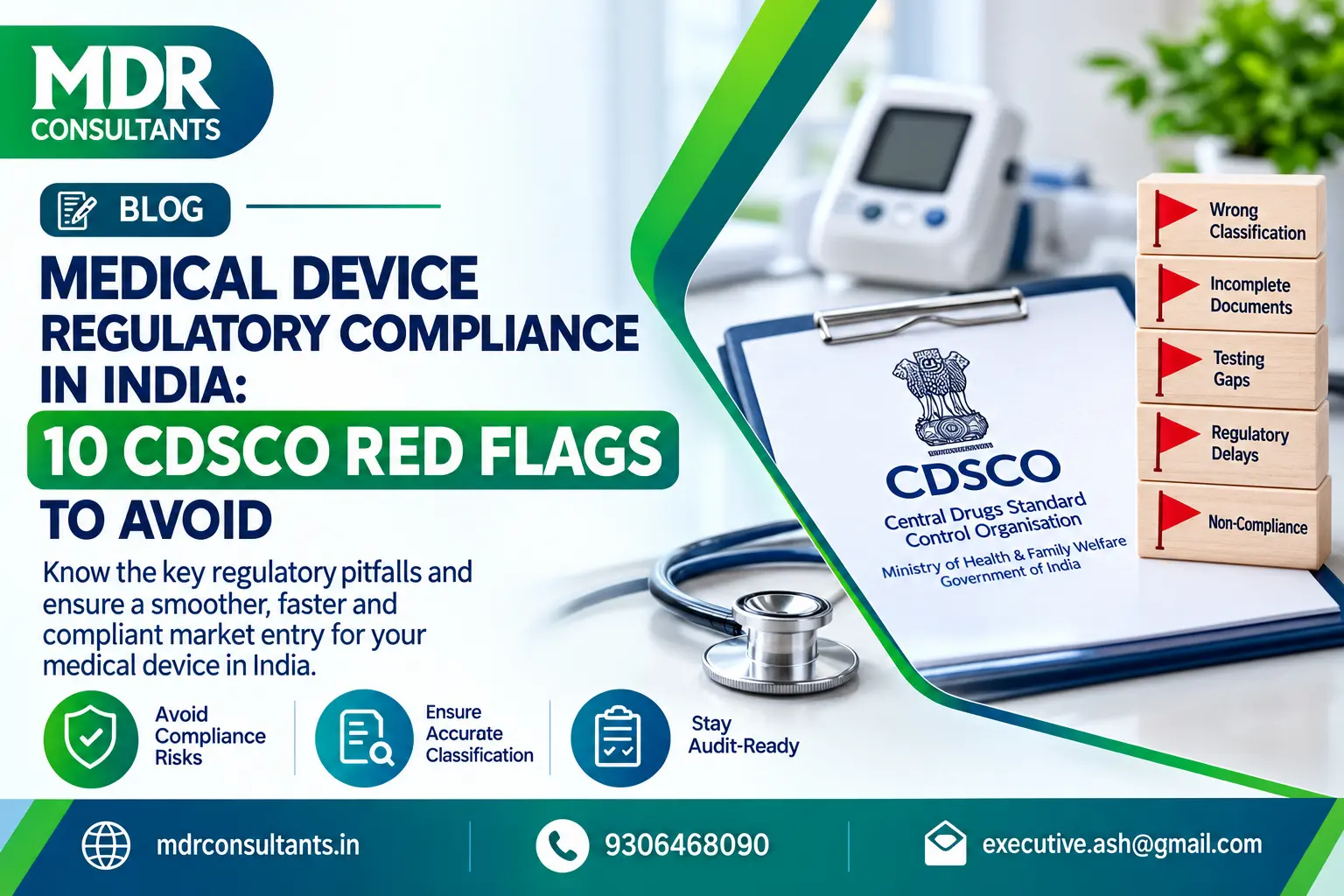
Launching a medical device in India involves much more than developing a technically sound product. Manufacturers and importers must navigate regulatory requirements covering device classification, licensing, technical documentation, quality management systems, testing, clinical evidence, labelling and post-market compliance under the Medical Devices Rules, 2017 (MDR 2017).
The regulatory pathway depends on factors such as the device's intended purpose, risk classification, manufacturing or import route, technical documentation, quality management system, testing requirements and, where applicable, clinical evidence.
Under MDR 2017, medical devices are risk-classified into Class A, Class B, Class C and Class D, ranging from low risk to high risk. CDSCO also maintains published risk-classification lists, which are dynamic and may be revised from time to time. Therefore, manufacturers should verify the latest applicable classification before finalising their regulatory strategy.
For companies planning to manufacture, import or market medical devices in India, identifying regulatory gaps early can help prevent avoidable rework, regulatory queries and launch delays.
Here are 10 CDSCO regulatory red flags that can put your medical device launch at risk.
One of the first and most important regulatory decisions is determining the correct classification of your medical device in India.
Under MDR 2017, medical devices are classified according to risk parameters specified in the First Schedule as:
The applicable classification is determined using the Indian regulatory framework and the relevant risk-classification criteria.
A common mistake is assuming that a device's classification in another jurisdiction—such as the European Union or United States—automatically determines its classification in India.
It does not.
The Indian classification must be assessed according to MDR 2017 and the applicable CDSCO classification framework. CDSCO's classification lists are dynamic and may be updated, including through device- or category-specific classifications.
An incorrect classification may result in:
Determine the Indian regulatory classification and applicable regulatory pathway before finalising your submission strategy.
One of the most common regulatory mistakes is treating compliance as something to address after product development has been completed.
Regulatory requirements should be considered throughout the product lifecycle—not only when the product is ready for commercialisation.
Your regulatory strategy can influence:
If regulatory gaps are discovered at the end of product development, the manufacturer may need to:
These activities can significantly affect a planned launch date.
Create a regulatory roadmap at the beginning of the product development lifecycle and update it as the product evolves.
Technical documentation is a fundamental part of a medical device regulatory submission.
Depending on the device and applicable pathway, documentation may include information relating to:
For higher-risk manufacturing applications, CDSCO documentation requirements can include items such as the Plant Master File, Quality Management System documentation and Device Master File, along with other prescribed information.
A technically strong device can still face regulatory questions if documents are:
For example, if the intended use stated in the application differs from the intended use described in the IFU or clinical evidence, the regulator may require clarification or additional information.
Prepare a regulatory document matrix before submission.
Map each applicable requirement to the document, test report, certificate or other evidence demonstrating compliance.
A compliant medical device requires more than a well-designed product. Manufacturers also need appropriate processes to consistently produce and control the device.
MDR 2017 includes requirements relating to quality management systems, while CDSCO manufacturing documentation addresses areas such as quality manuals, document control, records, management responsibility, resource management, production controls, internal audits, non-conforming products and corrective and preventive action.
If the quality management system is not adequately implemented, gaps may become apparent during regulatory review, inspection or ongoing compliance activities.
Treat QMS implementation and regulatory readiness as one integrated project, not as separate activities.
Medical device testing should not be treated as a last-minute regulatory formality.
Your testing and validation strategy should demonstrate that the device meets applicable safety and performance requirements and supports the claims made for the product.
Depending on the device, testing may involve areas such as:
CDSCO also maintains information on medical device testing laboratories and has issued regulatory communications concerning testing and evaluation of medical devices.
Problems can arise when testing is:
Prepare a regulatory testing matrix at an early stage.
Link every test to a specific requirement arising from safety and performance, risk management, product specifications or the applicable regulatory pathway.
Clinical evidence is another important area that can create regulatory challenges.
The device's intended purpose, indications, risk profile, clinical evidence and product claims should form a consistent regulatory story.
Depending on the device and applicable regulatory pathway, clinical investigation or additional clinical evidence may be required.
A common problem
A manufacturer may have clinical evidence supporting a specific intended use but make broader claims in its Indian product documentation.
For example:
Clinical evidence supports a specific patient population, while marketing material claims effectiveness for a substantially broader population.
This creates a potential evidence gap.
Regulatory authorities may request additional justification or evidence where claims are not adequately supported.
Align these four elements from the beginning:
Intended Purpose → Risk Management → Clinical Evidence → Product Claims
Marketing claims should not move beyond what the available scientific and clinical evidence can support.
Medical device labelling is a regulatory requirement—not simply a marketing activity.
Applicable MDR 2017 requirements prescribe information to be provided on medical device labels, with requirements varying according to the device and circumstances.
Depending on the product, relevant information may include:
Regulatory inconsistencies frequently occur between:
Review the label, packaging and IFU together with the technical documentation before submitting the regulatory application.
Do not leave final labelling review until the end of the regulatory process.
A regulatory submission is not only about the medical device itself.
The manufacturing facility must also have the appropriate infrastructure, processes and controls to consistently manufacture a device meeting the specified requirements.
Depending on the applicable pathway, regulatory readiness can involve:
If the facility is not ready for regulatory review or inspection, corrective actions may be required before the regulatory process can progress.
Conduct an internal regulatory readiness audit before submitting your application.
Review the actual facility—not just the documents—to ensure that the processes, equipment, records and personnel arrangements correspond with the information submitted to the regulator.
The regulatory pathway depends on factors including the device's risk classification and whether the activity involves manufacturing, import, sale or distribution.
For example, CDSCO states that applications for import licences are made in Form MD-14, with the import licence issued in Form MD-15.
For manufacturing, different forms and authorities apply depending on the risk class and applicable pathway.
CDSCO's current information identifies the Central Licensing Authority as responsible for import licensing for medical devices and for manufacturing licences for Class C and Class D devices, while manufacturing licensing for Class A and Class B devices is handled through the applicable State Licensing Authorities.
Certain Class A non-sterile and non-measuring devices are subject to specific provisions under MDR 2017 concerning exemption from licensing requirements and registration. The applicable CDSCO notification and current classification should always be checked for the specific device.
Choosing the wrong pathway can result in:
Determine the complete regulatory pathway before committing to a commercial launch timeline.
Regulatory compliance does not end when the medical device licence is granted.
Once a device enters the Indian market, manufacturers and other responsible parties need processes to manage applicable post-market obligations, including:
CDSCO maintains medical-device adverse-event reporting resources and has published materials relating to medical-device safety surveillance.
If complaint handling, vigilance and CAPA processes are not established before commercialisation, responding to field issues can become unnecessarily difficult.
Establish your complaint handling, vigilance, CAPA and post-market surveillance processes before commercial launch and ensure responsibilities are clearly assigned.
Before launching your medical device in India, ask:
☐ Is the device correctly classified under the current Indian regulatory framework?
☐ Have we identified the correct licensing authority and regulatory pathway?
☐ Is our technical documentation complete and internally consistent?
☐ Is the manufacturing facility regulatory-ready?
☐ Is the QMS implemented and supported by appropriate records?
☐ Have all applicable testing and validation activities been completed?
☐ Is the clinical evidence appropriate for the intended purpose and claims?
☐ Are the label, packaging and IFU compliant and consistent?
☐ Have all applicable manufacturing, import, sale and distribution requirements been addressed?
☐ Do we have appropriate complaint handling, vigilance and post-market surveillance processes in place?
If the answer to any of these questions is "No", consider resolving the gap before committing to a commercial launch date.
Medical device regulatory compliance is not a single approval step. It is a connected process involving classification, regulatory strategy, documentation, testing, quality systems, licensing, clinical evidence, labelling and post-market compliance.
An experienced MDR consultant can help manufacturers and importers:
For companies entering or expanding in the Indian medical device market, early regulatory planning can help reduce avoidable rework and improve regulatory readiness.
A medical device launch can be delayed by something as fundamental as an incorrect classification or as detailed as an inconsistency between the product label and technical documentation.
The good news is that many regulatory gaps can be identified before submission.
The key is to treat regulatory compliance as part of product development and business strategy, rather than as the final step before commercialisation.
For medical device manufacturers and importers planning to enter or expand in India, an early regulatory assessment can help identify the applicable pathway, documentation requirements, testing needs and compliance gaps before they affect the launch timeline.
Successful medical device commercialisation in India requires more than a technically sound product.
Manufacturers and importers need a regulatory strategy that connects:
Classification → Regulatory Pathway → Technical Documentation → QMS → Testing → Clinical Evidence → Labelling → Licensing → Post-Market Compliance
Identifying regulatory red flags early can help reduce unnecessary rework, improve submission readiness and create a more predictable path toward market entry.
Planning the regulatory pathway early isn't just about compliance. It's about launching with confidence.
Regulatory requirements, CDSCO classification lists, notifications and applicable licensing procedures may change over time. Always verify the latest Medical Devices Rules, CDSCO notifications, classification lists, forms and applicable requirements before submitting a regulatory application.
Last Updated : 07 Oct 2026
The Brand That Promises To Turn Your Business Around!
MDR Consultants excels in guiding medical device companies through global regulatory approvals with tailored solutions, clear communication, and efficient delivery. Their mission-driven approach fosters innovation, compliance, and long-term partnerships built on trust and excellence.

As I observed this company maintains a very good and cooperative environment. "MDR" consultancy is equipped with all modern amenities. They guide you the best. I highly recommend this firm. The entire team is very courteous and helpful. Highly Professional team and the owner is very skilled and humble.

Outstanding expertise! They streamlined our regulatory process, saving us immense time and stress. A truly invaluable partner for medical device compliance.

MDR Consultants have been a reliable partner for our CDSCO registration needs. Their efficient processes and in-depth knowledge of the regulations saved us significant time and resources. We are confident about the quality of their services and their commitment to client satisfaction.

MDR team has consistently delivered quality work, meeting deadlines and exceeding our expectations. We really recommend MDR for regulatory support

My experience with MDR consultants is wonderful. They have in-depth and vast knowledge about their work. They have the team of incredible people. Their commitment towards the client is highly appreciable. I highly recommend to have their services.

MDR IS THE BEST SOLUTION FOR MEDICAL DEVICES CONSULTANCIE THEY PROVIDE ALL THE SOLUTIONS AND PROPER GUIDANCE.AND DELIVER THEIR SERVICES ON TIME .

MDR team has consistently delivered high quality work, meeting deadlines and exceeding our expectations.

It was really a nice experience working with MDR consultancy.They guide you properly with their tranparent work ethics.Honestly MDR consultancy helped me a lot in growing my business.

A very friendly bunch of efficient employees in the team of MDR.A very professional approach towards their job and all my work was done hassle free with least follow up from my side.Keep up great work team MDR!!!!👍👍

The services are top notch , highly recommend for Mr Ashish

Best regulatory services..for medical devices…best in the business

Have a rich experience in the field of consultancy.

Extremely helpful and responsive

Very good experience

Good Services

Appreciable work.

True consultant

Medical Device Regulatory Consultants
37-38, 1st Floor, Near Makhan Bhog, G.T. Road,
Kundli Industrial Area, Delhi NCR, 131028