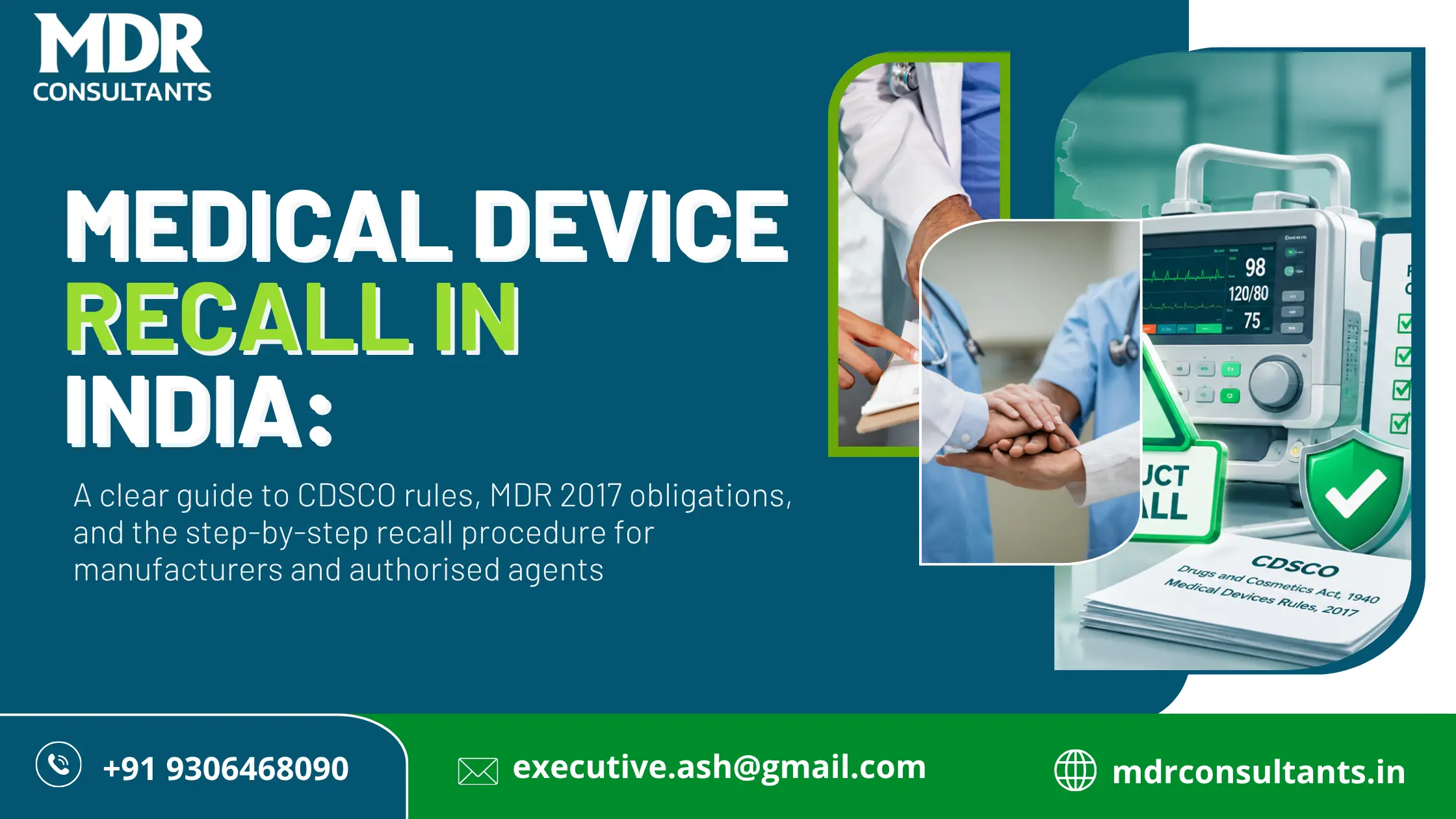
Medical device recalls are an important component of post-market surveillance and patient safety in India. They may become necessary when a medical device poses a potential risk to patients or users, fails to meet applicable quality, safety or performance requirements, or otherwise does not comply with relevant provisions of the Drugs and Cosmetics Act, 1940 and the Medical Devices Rules, 2017 (MDR 2017).
India's regulatory framework for medical devices is administered by the Central Drugs Standard Control Organisation (CDSCO), with medical device adverse-event monitoring supported through the Materiovigilance Programme of India (MvPI). Together, these mechanisms support the identification, assessment and management of risks associated with medical devices already placed on the market.
The Medical Devices Rules, 2017 define a recall as an action taken by the manufacturer, authorised agent or supplier to remove a medical device from the market or retrieve it from any person to whom it has been supplied.
A recall may become necessary where a device:
presents, or is likely to present, a risk to health;
does not conform to the manufacturer's claims regarding quality, safety or performance; or
fails to comply with applicable legal or regulatory requirements.
Depending on the nature of the risk and the circumstances involved, corrective action may range from the retrieval of affected products to modification, replacement, relabelling, software correction or other field-level risk-control measures.
The responsibility to take appropriate action applies to both domestically manufactured and imported medical devices placed on the Indian market.
Rule 89 of the Medical Devices Rules, 2017 establishes important obligations relating to medical devices that may pose a risk to the health of patients or users.
Where a manufacturer or authorised agent considers, or has reason to believe, that a medical device that has been manufactured, imported, sold or distributed may be unsafe during use, appropriate action must be initiated without delay.
The responsible party is expected to:
Initiate appropriate procedures for withdrawal of the affected medical device from the market and, where applicable, from patients or users.
Identify and communicate the reasons for the withdrawal.
Inform the relevant competent authority, including the Central Licensing Authority or State Licensing Authority, as applicable.
Cooperate with regulatory authorities in actions intended to prevent, reduce or eliminate risks to patients and users.
The regulatory obligation under Rule 89 places primary responsibility on the manufacturer or its authorised representative to act promptly when a potential safety concern is identified. The nature and extent of regulatory communication and corrective action may depend on the device, the severity of the risk, the extent of distribution and directions issued by the competent authority.
MDR 2017 does not itself establish statutory numerical recall classes such as Class I, Class II or Class III. However, risk-based approaches to determining the urgency and extent of corrective actions are widely used in medical device vigilance and recall systems internationally.
A documented health-hazard or risk assessment should consider factors such as:
the severity of potential harm;
the probability of occurrence;
the number of patients or users potentially affected;
whether the device remains in use;
the ability to identify and trace affected products; and
the effectiveness of proposed corrective actions.
Depending on the applicable guidance and the nature of the safety concern, manufacturers may use risk categories to determine the urgency of communication, the scope of product retrieval and the level of regulatory follow-up required.
Manufacturers should ensure that any classification or categorisation used in a recall is supported by a documented risk assessment and is consistent with applicable CDSCO directions and current materiovigilance requirements.
An effective recall or Field Safety Corrective Action (FSCA) process should follow a structured and well-documented approach.
A potential safety concern may arise from:
customer complaints;
adverse-event reports;
internal quality investigations;
post-market surveillance activities;
service and maintenance data;
post-market clinical follow-up;
trend analysis;
overseas regulatory actions; or
Field Safety Notices issued in other markets.
The manufacturer should promptly assess the available information, investigate the issue and determine the potential impact on patients, users and other stakeholders.
Where appropriate, root-cause analysis and risk assessment should be initiated to determine whether a recall, FSCA or another corrective measure is necessary.
Where the assessment identifies a potential risk requiring market intervention, the manufacturer or authorised agent should initiate appropriate corrective measures without undue delay.
Depending on the nature of the issue, actions may include:
withdrawal or retrieval of affected products;
product replacement;
repair or modification;
software updates;
changes to labelling;
revision of instructions for use;
additional warnings or safety information;
inspection or servicing of affected devices; or
controlled destruction or disposal of affected stock.
The selected action should be proportionate to the identified risk and supported by documented justification.
The manufacturer or authorised agent should inform the appropriate competent authority in accordance with applicable provisions of MDR 2017, licence conditions, materiovigilance requirements and any directions issued by CDSCO or the relevant licensing authority.
Relevant reporting and Field Safety Corrective Action resources are available through India's materiovigilance framework.
Regulatory communication should clearly identify:
the medical device concerned;
model or catalogue numbers;
batch, lot or serial numbers, where applicable;
details of the safety concern;
the reason for the corrective action;
results of the risk assessment;
the population or distribution chain potentially affected;
proposed corrective actions; and
the planned communication and implementation strategy.
Manufacturers should retain evidence of all regulatory submissions and communications.
Effective communication is essential to a successful recall.
Depending on the nature and seriousness of the issue, affected parties may include:
distributors;
importers;
hospitals and healthcare institutions;
healthcare professionals;
service organisations; and
patients or users, where appropriate.
A Field Safety Notice or other appropriate communication should clearly explain:
the affected product;
the identified issue;
the potential risk;
actions required from the recipient;
instructions regarding continued use, return, correction or disposal; and
appropriate contact details.
Communication should be timely, clear and traceable.
Affected products should be identified, controlled and managed according to the approved recall or corrective-action strategy.
This may involve:
quarantine of available stock;
suspension of further distribution;
retrieval of affected products;
correction or modification of devices in the field;
replacement of affected products; and
appropriate disposition of recovered stock.
Accurate distribution and traceability records are critical to effective recall execution. Manufacturers should be able to identify the movement of affected products through the supply chain and determine whether the required communication and corrective actions have reached the intended recipients.
Effectiveness checks should be performed to assess whether the recall or corrective action has achieved its intended objective.
The manufacturer should maintain complete documentation throughout the recall or corrective-action process.
Records should include, where applicable:
the initial complaint or safety signal;
investigation findings;
root-cause analysis;
risk assessment;
regulatory notifications;
Field Safety Notices and other communications;
distribution and traceability records;
quantities of affected products;
recovery or correction status;
effectiveness checks;
corrective and preventive actions; and
residual-risk assessment.
Progress reports or additional information may be required by the competent authority depending on the nature and seriousness of the issue.
A recall should not be considered complete merely because affected stock has been retrieved. The manufacturer should evaluate the effectiveness of the action, address the underlying cause and implement appropriate corrective and preventive measures to prevent recurrence.
The Materiovigilance Programme of India (MvPI) supports the monitoring and analysis of adverse events associated with medical devices. The programme contributes to the identification of safety signals and supports regulatory decision-making concerning medical devices in the Indian market.
For manufacturers, an effective post-market system should integrate:
complaint handling;
adverse-event monitoring;
trend reporting and analysis;
risk management;
post-market surveillance;
corrective and preventive action (CAPA);
Field Safety Corrective Actions; and
recall management.
Manufacturers should also maintain an appropriate Quality Management System in accordance with applicable requirements under MDR 2017. Robust procedures for traceability, complaint investigation, risk management and corrective action are essential components of an effective post-market compliance system.
International standards such as ISO 13485 and ISO 14971 may provide useful frameworks for establishing quality management and risk-management processes, where applicable to the manufacturer's regulatory and quality system obligations.
Organisations operating in the Indian medical device market should consider the following measures:
Maintain accurate and up-to-date distribution and traceability records.
Establish a documented recall and Field Safety Corrective Action procedure.
Form a cross-functional recall team with clearly defined responsibilities.
Conduct periodic mock recalls to test the effectiveness of the system.
Maintain documented procedures for health-hazard and risk assessments.
Ensure clear escalation pathways for complaints and potential adverse events.
Prepare communication templates for distributors, hospitals and users.
Coordinate closely with the Indian authorised agent in the case of imported devices.
Assess overseas recalls, safety notices and regulatory actions for their potential impact on devices marketed in India.
Maintain complete records of regulatory communication and corrective actions.
Verify current CDSCO, licensing authority and materiovigilance reporting requirements whenever a safety issue arises.
Medical device recalls in India are an essential component of post-market surveillance and patient safety. The Medical Devices Rules, 2017, particularly Rule 89, establish important obligations for manufacturers and authorised agents when a medical device may pose a risk to patients or users.
An effective recall system requires more than product retrieval. It requires timely risk assessment, clear decision-making, regulatory communication, supply-chain traceability, effective Field Safety Corrective Actions and thorough documentation.
As regulatory expectations and post-market surveillance practices continue to evolve, medical device manufacturers and importers should maintain robust internal procedures and regularly review applicable CDSCO requirements and materiovigilance guidance.
For organisations operating in the Indian medical device market, a well-designed recall and corrective-action system is not simply a regulatory compliance requirement—it is a critical mechanism for protecting patients, maintaining product confidence and demonstrating responsible lifecycle management.
MDR Consultants can assist manufacturers, importers and authorised representatives in developing recall and post-market surveillance procedures, strengthening FSCA processes, supporting regulatory documentation and navigating medical device compliance requirements in India.
Last Updated : 03 Sep 2026
The Brand That Promises To Turn Your Business Around!
MDR Consultants excels in guiding medical device companies through global regulatory approvals with tailored solutions, clear communication, and efficient delivery. Their mission-driven approach fosters innovation, compliance, and long-term partnerships built on trust and excellence.

As I observed this company maintains a very good and cooperative environment. "MDR" consultancy is equipped with all modern amenities. They guide you the best. I highly recommend this firm. The entire team is very courteous and helpful. Highly Professional team and the owner is very skilled and humble.

Outstanding expertise! They streamlined our regulatory process, saving us immense time and stress. A truly invaluable partner for medical device compliance.

MDR Consultants have been a reliable partner for our CDSCO registration needs. Their efficient processes and in-depth knowledge of the regulations saved us significant time and resources. We are confident about the quality of their services and their commitment to client satisfaction.

MDR team has consistently delivered quality work, meeting deadlines and exceeding our expectations. We really recommend MDR for regulatory support

My experience with MDR consultants is wonderful. They have in-depth and vast knowledge about their work. They have the team of incredible people. Their commitment towards the client is highly appreciable. I highly recommend to have their services.

MDR IS THE BEST SOLUTION FOR MEDICAL DEVICES CONSULTANCIE THEY PROVIDE ALL THE SOLUTIONS AND PROPER GUIDANCE.AND DELIVER THEIR SERVICES ON TIME .

MDR team has consistently delivered high quality work, meeting deadlines and exceeding our expectations.

It was really a nice experience working with MDR consultancy.They guide you properly with their tranparent work ethics.Honestly MDR consultancy helped me a lot in growing my business.

A very friendly bunch of efficient employees in the team of MDR.A very professional approach towards their job and all my work was done hassle free with least follow up from my side.Keep up great work team MDR!!!!👍👍

The services are top notch , highly recommend for Mr Ashish

Best regulatory services..for medical devices…best in the business

Have a rich experience in the field of consultancy.

Extremely helpful and responsive

Very good experience

Good Services

Appreciable work.

True consultant

Medical Device Regulatory Consultants
37-38, 1st Floor, Near Makhan Bhog, G.T. Road,
Kundli Industrial Area, Delhi NCR, 131028