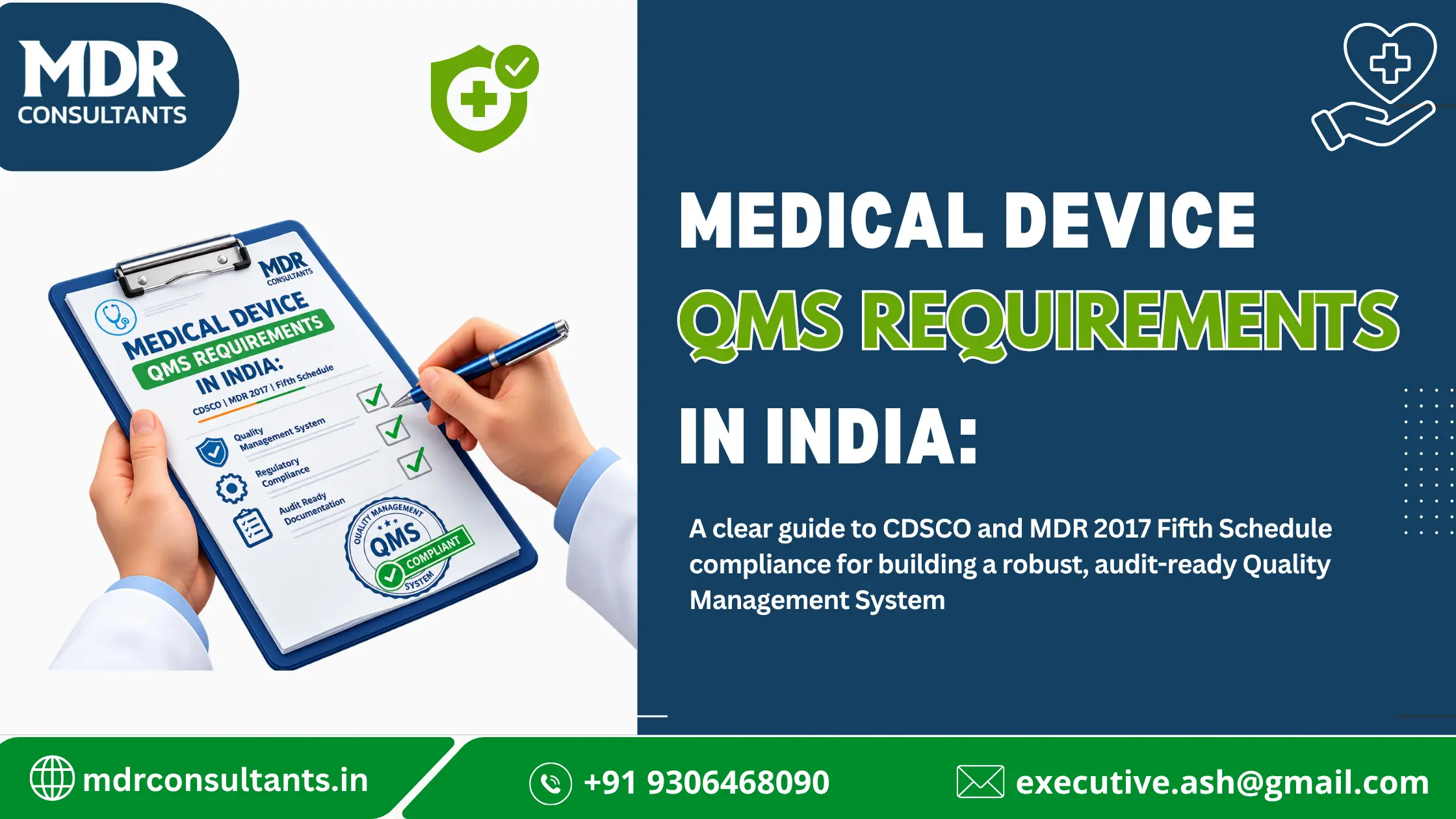
For medical device manufacturers operating in or targeting India, a robust Quality Management System (QMS) is not optional—it is a core regulatory obligation under the Medical Devices Rules, 2017 (MDR 2017), enforced by the Central Drugs Standard Control Organisation (CDSCO). The Fifth Schedule of MDR 2017 sets out the specific QMS requirements that manufacturers must establish, document, implement, and maintain. These requirements apply across the product lifecycle, from design and development through manufacture, packaging, labelling, testing, installation, and servicing.
Why QMS Matters under MDR 2017?
MDR 2017 shifted India’s medical device regulation from a limited notified-list approach to a comprehensive, risk-based framework covering all medical devices and in-vitro diagnostic (IVD) medical devices. Devices are classified into Class A (low risk), Class B (low-moderate risk), Class C (moderate-high risk), and Class D (high risk).
A compliant QMS under the Fifth Schedule is mandatory for manufacturing licences. Applicants must submit an undertaking confirming that the manufacturing site complies with the Fifth Schedule. Non-compliance can result in licence refusal, suspension, or cancellation. The QMS also supports Essential Principles of Safety and Performance and helps demonstrate that devices are consistently safe and effective.
While MDR 2017 does not explicitly mandate third-party ISO 13485 certification for every class, the Fifth Schedule is closely aligned with ISO 13485:2016 principles. In practice, ISO 13485 certification from an accredited body is widely accepted as strong evidence of QMS compliance, particularly for Class B, C, and D devices, and is often expected during inspections or audits.
Core Requirements of the Fifth Schedule QMS
The Fifth Schedule requires manufacturers to establish a documented QMS that covers all applicable processes. Key elements include:
General and documentation requirements Manufacturers must identify QMS processes, determine their sequence and interactions, set criteria and methods for effective operation and control, ensure availability of resources and information, monitor and measure processes, and take actions to achieve planned results and maintain effectiveness.
Documentation must include a quality policy and objectives, a quality manual, documented procedures required by the Schedule, documents needed for effective planning, operation and control of processes, and records required by the Schedule. The quality manual must describe the scope of the QMS (including any exclusions or non-applicable requirements, with justification), documented procedures or references to them, and a description of the interaction between QMS processes.
Management responsibility Top management must demonstrate commitment to the QMS, establish a quality policy, ensure quality objectives are set, conduct management reviews, and ensure the availability of resources. Customer focus, planning, responsibility and authority, and internal communication are also required.
Resource management This covers provision of resources, human resources (competence, awareness, and training), infrastructure, and work environment appropriate to the device and operations. Environmental controls (cleanrooms, temperature, humidity, etc.) must meet the requirements linked to the device type, as referenced in Annexure A of the Fifth Schedule where applicable.
Product realisation This is a major section covering planning of product realisation, customer-related processes, design and development (if performed by the manufacturer), purchasing, production and service provision, and control of monitoring and measuring equipment.
If the manufacturer does not perform design and development, this must be clearly recorded and justified in the QMS. Design controls, verification, validation, design transfer, and design changes are critical where applicable. Purchasing controls, including evaluation and monitoring of suppliers, are essential. Production controls address process validation (especially for special processes such as sterilisation), identification and traceability, customer property, and preservation of product. Control of nonconforming product is mandatory.
Measurement, analysis, and improvement Manufacturers must plan and implement monitoring, measurement, analysis, and improvement processes. This includes monitoring and measurement of processes and product, control of nonconforming product, analysis of data, and continual improvement through corrective and preventive action (CAPA). Internal audits and management review feed into this cycle. Feedback systems, including post-market information, support improvement.
The Schedule emphasises that the manufacturer remains responsible for any outsourced processes that affect product conformity and must exercise appropriate control over them.
Class-Specific Application and Audits
Notified Bodies (accredited by the National Accreditation Body and registered with CDSCO) conduct QMS audits for lower-risk classes and may play roles in higher classes. Plant Master Files and Device Master Files submitted with applications further document the QMS and product-related controls.
Practical Steps for Manufacturers
For software as a medical device (SaMD) or medical device software, additional expectations around software lifecycle processes, configuration management, verification/validation, cybersecurity, and risk management apply, still under the umbrella of Fifth Schedule QMS compliance.
Benefits Beyond Compliance
A well-implemented QMS reduces the risk of nonconformities during CDSCO inspections or Notified Body audits, supports smoother licence grants and renewals, facilitates export readiness (many overseas markets require ISO 13485), strengthens supply-chain partnerships, and ultimately protects patients by ensuring consistent device quality and performance.
How MDR Consultants Can Support You
At MDR Consultants, we specialise in helping manufacturers interpret and implement CDSCO and MDR 2017 requirements. Our services include QMS gap analysis against the Fifth Schedule, development of quality manuals and procedures, preparation for Notified Body audits and CDSCO inspections, Plant Master File / Device Master File support, and end-to-end guidance for manufacturing and import licensing.
Building a compliant QMS is an investment in regulatory success, product quality, and patient safety. Manufacturers who treat the Fifth Schedule requirements as the foundation of their operations—not merely a checklist—position themselves for sustainable growth in India’s expanding medical device market.
For tailored advice on implementing or upgrading your QMS under MDR 2017, contact MDR Consultants. Stay compliant, stay competitive.
Last Updated : 31 Aug 2026
The Brand That Promises To Turn Your Business Around!
MDR Consultants excels in guiding medical device companies through global regulatory approvals with tailored solutions, clear communication, and efficient delivery. Their mission-driven approach fosters innovation, compliance, and long-term partnerships built on trust and excellence.

As I observed this company maintains a very good and cooperative environment. "MDR" consultancy is equipped with all modern amenities. They guide you the best. I highly recommend this firm. The entire team is very courteous and helpful. Highly Professional team and the owner is very skilled and humble.

Outstanding expertise! They streamlined our regulatory process, saving us immense time and stress. A truly invaluable partner for medical device compliance.

MDR Consultants have been a reliable partner for our CDSCO registration needs. Their efficient processes and in-depth knowledge of the regulations saved us significant time and resources. We are confident about the quality of their services and their commitment to client satisfaction.

MDR team has consistently delivered quality work, meeting deadlines and exceeding our expectations. We really recommend MDR for regulatory support

My experience with MDR consultants is wonderful. They have in-depth and vast knowledge about their work. They have the team of incredible people. Their commitment towards the client is highly appreciable. I highly recommend to have their services.

MDR IS THE BEST SOLUTION FOR MEDICAL DEVICES CONSULTANCIE THEY PROVIDE ALL THE SOLUTIONS AND PROPER GUIDANCE.AND DELIVER THEIR SERVICES ON TIME .

MDR team has consistently delivered high quality work, meeting deadlines and exceeding our expectations.

It was really a nice experience working with MDR consultancy.They guide you properly with their tranparent work ethics.Honestly MDR consultancy helped me a lot in growing my business.

A very friendly bunch of efficient employees in the team of MDR.A very professional approach towards their job and all my work was done hassle free with least follow up from my side.Keep up great work team MDR!!!!👍👍

The services are top notch , highly recommend for Mr Ashish

Best regulatory services..for medical devices…best in the business

Have a rich experience in the field of consultancy.

Extremely helpful and responsive

Very good experience

Good Services

Appreciable work.

True consultant

Medical Device Regulatory Consultants
37-38, 1st Floor, Near Makhan Bhog, G.T. Road,
Kundli Industrial Area, Delhi NCR, 131028