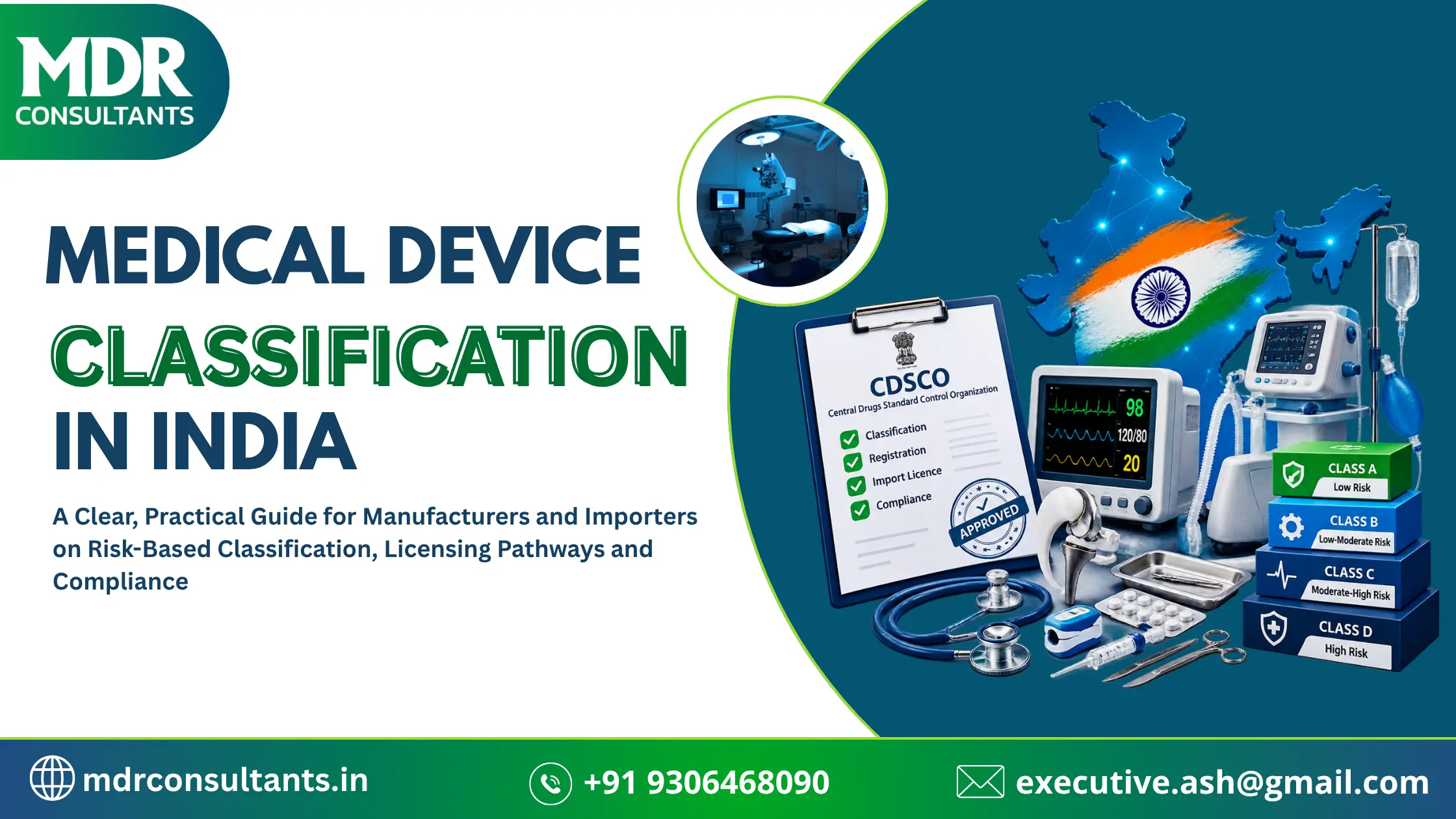
In India, every medical device must be correctly classified before it can be manufactured, imported or sold. Wrong classification leads to delayed approvals, rejected applications or compliance issues. The Medical Devices Rules, 2017 (MDR 2017), enforced by the Central Drugs Standard Control Organisation (CDSCO), provide a clear risk-based classification system that places devices into Class A, Class B, Class C or Class D.
Understanding the Regulatory Framework under MDR 2017
The Medical Devices Rules, 2017 came into force on 1 January 2018. Rule 4 of the Rules states that medical devices (other than in-vitro diagnostic devices) are classified on the basis of parameters given in Part I of the First Schedule. In-vitro diagnostic medical devices follow Part II of the same Schedule.
The four classes reflect increasing levels of risk to the patient or user:
The Central Licensing Authority (CLA), i.e., CDSCO, is the final authority that classifies devices based on intended use and the parameters in the First Schedule. CDSCO periodically publishes official risk classification lists on its website. Manufacturers and importers are expected to refer to these lists. Where a device is not yet listed, the classification rules in the First Schedule must be applied carefully.
Key Factors That Decide the Class
Classification is not arbitrary. The First Schedule examines several practical factors:
If more than one rule applies, the strictest rule that results in the higher class is followed.
Class A – Low Risk Medical Devices
Class A devices pose the lowest risk. Typical examples include simple non-invasive items such as bandages, examination gloves, tongue depressors, basic surgical instruments (non-powered), and many non-sterile, non-measuring devices.
Many Class A (non-sterile and non-measuring) devices enjoy simplified requirements. They are exempt from certain chapters of the Rules provided the manufacturer or importer registers them under the applicable provisions. The State Licensing Authority (SLA) is responsible for issuing manufacturing licences for Class A medical devices.
Prior inspection is generally not required before grant of manufacturing licence for pure Class A devices.
Class B – Low-Moderate Risk Medical Devices
Class B devices carry a moderate level of risk. Common examples include hypodermic needles, syringes, blood pressure monitors, pulse oximeters, digital thermometers, and certain reusable surgical instruments.
The manufacturing of Class B devices is likewise overseen by the State Licensing Authority (SLA). A Notified Body registered with CDSCO usually audits the Quality Management System. Import of Class B devices still requires approval from the Central Licensing Authority.
Class C – Moderate-High Risk Medical Devices
Class C devices present higher risk and include more complex or critical products. Examples include lung ventilators, bone fixation plates, dialysis machines, CT and MRI equipment, defibrillators, and many orthopaedic implants that are not Class D.
Both manufacturing and import of Class C devices fall under the Central Licensing Authority. Technical documentation is more extensive, and site inspection or Notified Body involvement is common.
Class D – High Risk Medical Devices
Class D covers the highest-risk devices. These typically include cardiac stents, heart valves, implantable pacemakers, hip and knee implants, and devices that come into direct contact with the central circulatory system or central nervous system for long-term use.
All regulatory activities for Class D devices are controlled by the Central Licensing Authority. Clinical data, detailed risk management files and rigorous post-market surveillance expectations apply.
How to Determine the Correct Class – Practical Steps
Incorrect self-classification is one of the most frequent reasons for queries and delays in CDSCO applications.
Regulatory Implications of Each Class
Why Choose a Specialised Regulatory Partner Like MDR Consultants
Navigating CDSCO requirements, keeping track of frequently updated classification lists, preparing accurate technical files and coordinating with Notified Bodies demands specialised knowledge. Many companies lose months because of incomplete documentation or wrong class selection.
MDR Consultants focuses exclusively on medical device and IVD regulatory affairs in India. We help clients:
Working with an experienced team reduces risk, shortens timelines and gives manufacturers and importers confidence that their classification and submissions are correct the first time.
Conclusion
Correct medical device classification under the Medical Devices Rules, 2017 is the foundation of successful regulatory compliance in India. Understanding whether a product falls under Class A, Class B, Class C or Class D determines the licensing authority, the depth of documentation required and the overall compliance burden. Always refer to the latest CDSCO classification lists and the First Schedule parameters. When the rules appear complex or the device is novel, professional guidance saves time and prevents costly mistakes.
If you need support in classifying your medical device or preparing a CDSCO application, reach out to the team at MDR Consultants. Accurate classification today leads to smoother market access tomorrow.
Last Updated : 04 Sep 2026
The Brand That Promises To Turn Your Business Around!
MDR Consultants excels in guiding medical device companies through global regulatory approvals with tailored solutions, clear communication, and efficient delivery. Their mission-driven approach fosters innovation, compliance, and long-term partnerships built on trust and excellence.

As I observed this company maintains a very good and cooperative environment. "MDR" consultancy is equipped with all modern amenities. They guide you the best. I highly recommend this firm. The entire team is very courteous and helpful. Highly Professional team and the owner is very skilled and humble.

Outstanding expertise! They streamlined our regulatory process, saving us immense time and stress. A truly invaluable partner for medical device compliance.

MDR Consultants have been a reliable partner for our CDSCO registration needs. Their efficient processes and in-depth knowledge of the regulations saved us significant time and resources. We are confident about the quality of their services and their commitment to client satisfaction.

MDR team has consistently delivered quality work, meeting deadlines and exceeding our expectations. We really recommend MDR for regulatory support

My experience with MDR consultants is wonderful. They have in-depth and vast knowledge about their work. They have the team of incredible people. Their commitment towards the client is highly appreciable. I highly recommend to have their services.

MDR IS THE BEST SOLUTION FOR MEDICAL DEVICES CONSULTANCIE THEY PROVIDE ALL THE SOLUTIONS AND PROPER GUIDANCE.AND DELIVER THEIR SERVICES ON TIME .

MDR team has consistently delivered high quality work, meeting deadlines and exceeding our expectations.

It was really a nice experience working with MDR consultancy.They guide you properly with their tranparent work ethics.Honestly MDR consultancy helped me a lot in growing my business.

A very friendly bunch of efficient employees in the team of MDR.A very professional approach towards their job and all my work was done hassle free with least follow up from my side.Keep up great work team MDR!!!!👍👍

The services are top notch , highly recommend for Mr Ashish

Best regulatory services..for medical devices…best in the business

Have a rich experience in the field of consultancy.

Extremely helpful and responsive

Very good experience

Good Services

Appreciable work.

True consultant

Medical Device Regulatory Consultants
37-38, 1st Floor, Near Makhan Bhog, G.T. Road,
Kundli Industrial Area, Delhi NCR, 131028