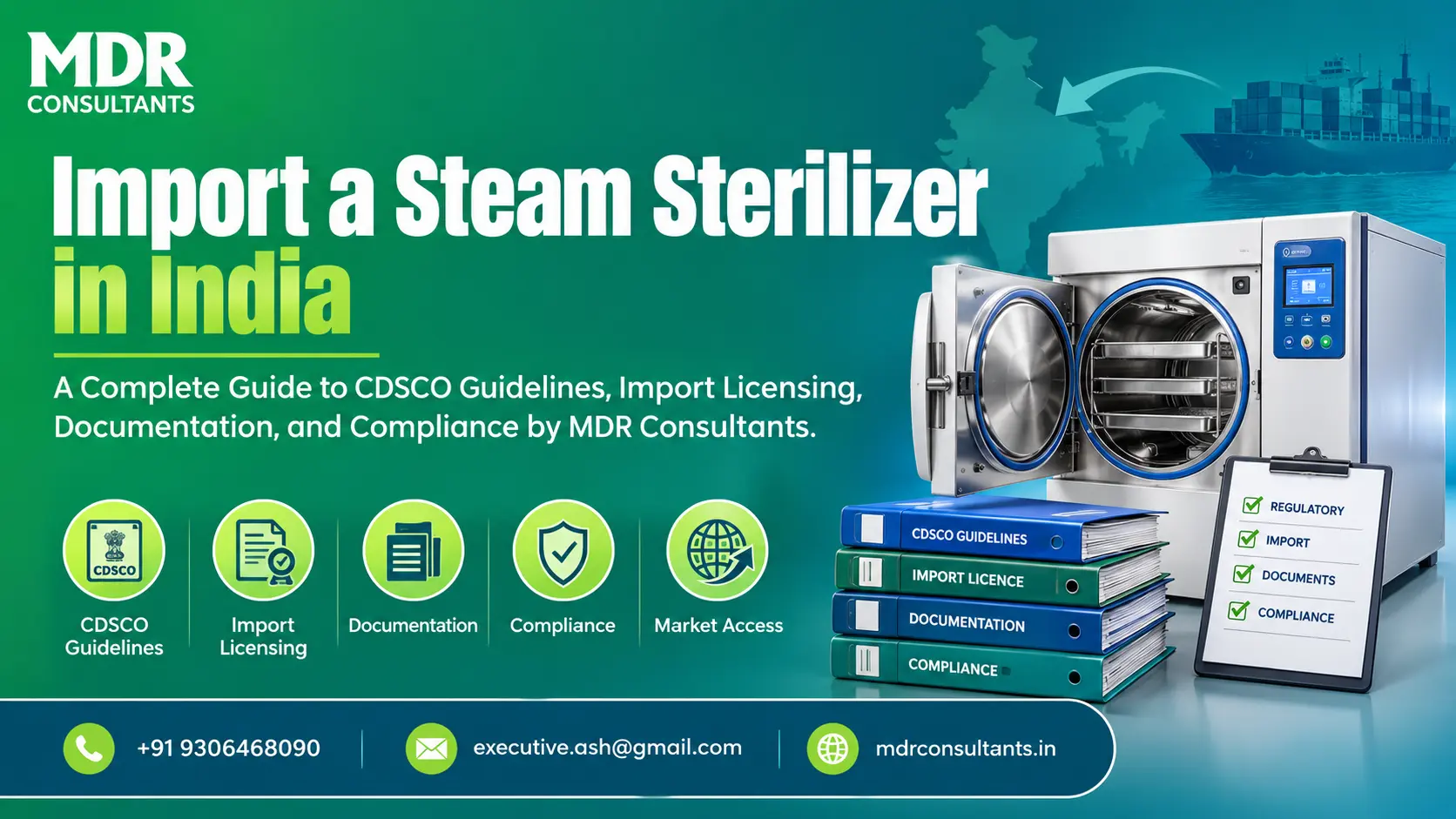
Steam sterilizers are essential pieces of equipment in hospitals, diagnostic laboratories, dental clinics, and healthcare facilities where the effective sterilization of reusable medical instruments is necessary. These devices use saturated steam under controlled pressure and temperature conditions to eliminate microorganisms from compatible instruments and materials.
India's growing healthcare infrastructure has created opportunities for international manufacturers and Indian distributors to introduce advanced sterilization equipment into the market. However, importing a steam sterilizer for medical use involves more than selecting a suitable supplier and arranging international shipping. Importers must first understand the applicable regulatory requirements, documentation, and licensing procedures.
The Central Drugs Standard Control Organization (CDSCO) regulates medical devices in India under the Medical Devices Rules, 2017, as amended from time to time. Depending on the intended purpose and regulatory classification of the equipment, the importer may need to obtain an appropriate import licence before marketing or distributing the product in India.
The first step is to determine whether the proposed steam sterilizer falls within the definition of a medical device under Indian law.
Equipment specifically intended for sterilizing medical devices or instruments may fall within the medical device regulatory framework. The intended use, manufacturer's product description, technical specifications, and applicable classification entries must be reviewed before proceeding.
The principal regulatory framework includes:
CDSCO provides a risk-based classification system with four categories: Class A, Class B, Class C, and Class D. The applicable class determines the regulatory requirements for the device.
For medical devices imported for commercial distribution in India, the applicable licensing route generally involves an application to CDSCO through the prescribed online system.
The standard import licensing process under the Medical Devices Rules, 2017, uses the following forms:
The application must be submitted by an eligible Indian authorised agent in accordance with the applicable rules and documentation requirements.
Before filing, the applicant should confirm that the overseas manufacturer, manufacturing site, device description, model numbers, and proposed importer details are consistent across the supporting documents.
An import licence should not be treated as a general approval covering every product manufactured by a supplier. The scope of the licence and the devices included in it must be checked carefully.
An overseas manufacturer planning to enter the Indian market will generally need an eligible authorised agent in India to manage the relevant regulatory process.
The authorised agent acts as the local representative for the import application and associated compliance responsibilities.
The importer and overseas manufacturer should establish a clear agreement covering:
The authorised agent must hold the applicable licence or registration documentation required under the Medical Devices Rules, 2017, for the proposed activity.
Choosing an experienced regulatory representative can help prevent inconsistencies and unnecessary delays during application preparation.
Documentation is one of the most important parts of the import licensing process. CDSCO reviews the application and its supporting records to assess the product, manufacturer, manufacturing facility, and relevant evidence of quality and safety.
The exact document set depends on the product and the current regulatory requirements. The applicable CDSCO checklist should therefore be reviewed before submission.
Common documents include the following.
Depending on the applicable checklist and circumstances, supporting evidence may include:
The technical dossier should accurately describe the steam sterilizer and demonstrate its safety and performance.
Relevant documents may include:
The precise contents must be aligned with the Fourth Schedule of the Medical Devices Rules, 2017, and the current application checklist.
A steam sterilizer requires careful technical assessment because its performance directly affects the effectiveness of medical instrument reprocessing.
The technical dossier should clearly explain how the equipment operates and how its performance is verified.
Key technical information to address
Product description: Provide the model name, catalogue number, chamber capacity, operating configuration, and intended application.
Operating principle: Describe the steam-generation method, air-removal mechanism, pressure control, temperature monitoring, and sterilization cycle.
Performance validation: Provide relevant evidence demonstrating that the sterilization process achieves its claimed performance under specified operating conditions.
Safety features: Document applicable safeguards, such as door interlocks, pressure protection, temperature controls, alarms, and cycle monitoring.
Quality and risk management: Include appropriate risk assessments, design verification, manufacturing controls, and quality management evidence.
User information: Ensure that operating instructions, warnings, maintenance requirements, and cycle limitations are clear and consistent with the device's intended use.
Relevant standards may include ISO 17665 for moist-heat sterilization process development, validation, and routine control, as well as applicable electrical safety and electromagnetic compatibility standards. Their applicability should be determined for the particular product and regulatory submission.
Certification to an international standard can support a technical assessment, but it does not independently replace a mandatory Indian import licence.
Once the required documents have been assembled, the authorised agent can prepare the import application through the applicable CDSCO online licensing system, commonly referred to as the SUGAM portal.
A typical submission process includes:
Before final submission, review the application for discrepancies in product names, model numbers, addresses, certificates, and intended-use statements.
Even small inconsistencies between the application form and the supporting dossier may result in clarification requests.
Following submission, the application may undergo a regulatory review. CDSCO may seek clarification or additional evidence if information is incomplete, unclear, or inconsistent.
For a steam sterilizer, potential areas requiring clarification include:
The applicant should respond within the prescribed timeline and provide complete, traceable supporting information.
A well-organised dossier can simplify the review process, although the overall approval timeline depends on the individual application, regulatory assessment, and any additional requirements.
Where the application is approved, CDSCO issues the import licence in Form MD-15 under the standard import licensing pathway.
Before arranging commercial shipments, the importer should verify that:
Do not rely solely on CE marking, US FDA clearance, or a Free Sale Certificate as permission to market a medical device in India. These documents may support the regulatory assessment but do not replace the applicable Indian authorisation.
CDSCO licensing and customs clearance are related but distinct parts of the import process.
After the required regulatory authorisation is in place, the importer should coordinate with its customs broker or logistics provider to confirm the applicable import procedures and documentation.
Common commercial documents include:
The correct customs tariff classification, duty rate, and any applicable trade-policy conditions should be verified against the actual product specifications and import circumstances.
Where the sterilizer contains pressure-bearing components or other regulated equipment, assess whether additional requirements under the relevant Indian laws or technical regulations apply. Such requirements should not be assumed to apply to every model without checking the equipment's design and configuration.
Regulatory compliance does not end when the equipment clears customs.
Importers and distributors should maintain appropriate records and ensure that the device continues to comply with the applicable conditions of its licence.
Key responsibilities may include:
Importers should also review the current requirements governing sale and distribution of medical devices, including any applicable registration of premises and other state-level obligations.
Businesses entering the Indian medical device market may encounter several avoidable difficulties.
Incorrect risk classification: Selecting a class without checking the applicable CDSCO classification can result in an unsuitable regulatory pathway.
Incomplete technical documentation: Missing validation reports, quality certificates, or product information can lead to additional queries.
Inconsistent manufacturer details: Differences in addresses, legal names, or manufacturing-site information may complicate the assessment.
Unclear product claims: Marketing statements that exceed the evidence presented in the dossier can create regulatory concerns.
Premature shipment planning: Arranging a commercial shipment before confirming the necessary authorisation may create customs and compliance risks.
Overlooking post-market obligations: Failing to establish complaint handling, traceability, and safety reporting processes can create problems after market entry.
The best approach is to conduct a regulatory gap assessment before finalising the application or committing to a commercial launch date.
MDR Consultants supports businesses seeking to navigate India's medical device regulatory requirements with a structured and documentation-focused approach.
For companies planning to import steam sterilizers, regulatory support may include:
The scope of assistance depends on the product, the manufacturer's available documentation, and the applicable regulatory requirements.
By addressing documentation and classification questions early, businesses can make better-informed decisions about their Indian market-entry strategy.
1. Is a CDSCO licence required to import a steam sterilizer into India?
If the product is regulated as a medical device and is being imported for commercial marketing or distribution, the applicable CDSCO import licensing requirements must generally be met. The precise pathway depends on the device's regulatory status and classification.
2. Which forms are used to obtain a CDSCO import licence?
The standard pathway uses Form MD-14 for the application and Form MD-15 for the import licence issued upon approval, subject to the applicable rules and any relevant exemptions.
3. How is the risk class of a steam sterilizer determined?
Classification should be established by reviewing the device's intended purpose, design, relevant CDSCO classification entries, and applicable provisions of the Medical Devices Rules, 2017. The class should not be assumed solely from the product name.
4. Can a steam sterilizer be imported using only a CE certificate?
A CE certificate alone does not generally replace the Indian import authorisation required for a regulated medical device. Relevant overseas certifications may form part of the supporting documentation, depending on the applicable requirements.
5. What documents are required for the application?
Documents commonly include the application form, authorisation documents, manufacturer and manufacturing-site details, regulatory certificates, quality management evidence, and the required technical dossier. The final list should be confirmed against the current CDSCO checklist.
6. How long does CDSCO approval take?
The timeline depends on the completeness of the submission, the product's regulatory pathway, the technical review, and whether additional information is requested. Importers should avoid relying on an unverified fixed approval timeline.
7. Can an importer begin selling immediately after placing an order with the manufacturer?
No. Placing an order does not constitute regulatory approval. The importer must verify the applicable licensing requirements and ensure the necessary authorisation is in place before undertaking regulated commercial import and distribution activities.
Importing a steam sterilizer into India requires coordinated planning across regulatory licensing, technical documentation, quality assurance, customs procedures, and post-market compliance.
A successful market-entry strategy begins with identifying the correct device classification, establishing the appropriate authorised-agent arrangement, preparing a complete technical dossier, and following the applicable CDSCO import licensing process. Attention to these details can help reduce avoidable delays and support a more predictable regulatory submission.
MDR Consultants can assist businesses in understanding the regulatory pathway and preparing for the documentation and compliance steps involved in bringing medical equipment to the Indian market.
Contact MDR Consultants to discuss your steam sterilizer and identify the regulatory requirements applicable to your proposed import.
Last Updated : 28 Oct 2026
The Brand That Promises To Turn Your Business Around!
MDR Consultants excels in guiding medical device companies through global regulatory approvals with tailored solutions, clear communication, and efficient delivery. Their mission-driven approach fosters innovation, compliance, and long-term partnerships built on trust and excellence.

As I observed this company maintains a very good and cooperative environment. "MDR" consultancy is equipped with all modern amenities. They guide you the best. I highly recommend this firm. The entire team is very courteous and helpful. Highly Professional team and the owner is very skilled and humble.

Outstanding expertise! They streamlined our regulatory process, saving us immense time and stress. A truly invaluable partner for medical device compliance.

MDR Consultants have been a reliable partner for our CDSCO registration needs. Their efficient processes and in-depth knowledge of the regulations saved us significant time and resources. We are confident about the quality of their services and their commitment to client satisfaction.

MDR team has consistently delivered quality work, meeting deadlines and exceeding our expectations. We really recommend MDR for regulatory support

My experience with MDR consultants is wonderful. They have in-depth and vast knowledge about their work. They have the team of incredible people. Their commitment towards the client is highly appreciable. I highly recommend to have their services.

MDR IS THE BEST SOLUTION FOR MEDICAL DEVICES CONSULTANCIE THEY PROVIDE ALL THE SOLUTIONS AND PROPER GUIDANCE.AND DELIVER THEIR SERVICES ON TIME .

MDR team has consistently delivered high quality work, meeting deadlines and exceeding our expectations.

It was really a nice experience working with MDR consultancy.They guide you properly with their tranparent work ethics.Honestly MDR consultancy helped me a lot in growing my business.

A very friendly bunch of efficient employees in the team of MDR.A very professional approach towards their job and all my work was done hassle free with least follow up from my side.Keep up great work team MDR!!!!👍👍

The services are top notch , highly recommend for Mr Ashish

Best regulatory services..for medical devices…best in the business

Have a rich experience in the field of consultancy.

Extremely helpful and responsive

Very good experience

Good Services

Appreciable work.

True consultant

Medical Device Regulatory Consultants
37-38, 1st Floor, Near Makhan Bhog, G.T. Road,
Kundli Industrial Area, Delhi NCR, 131028