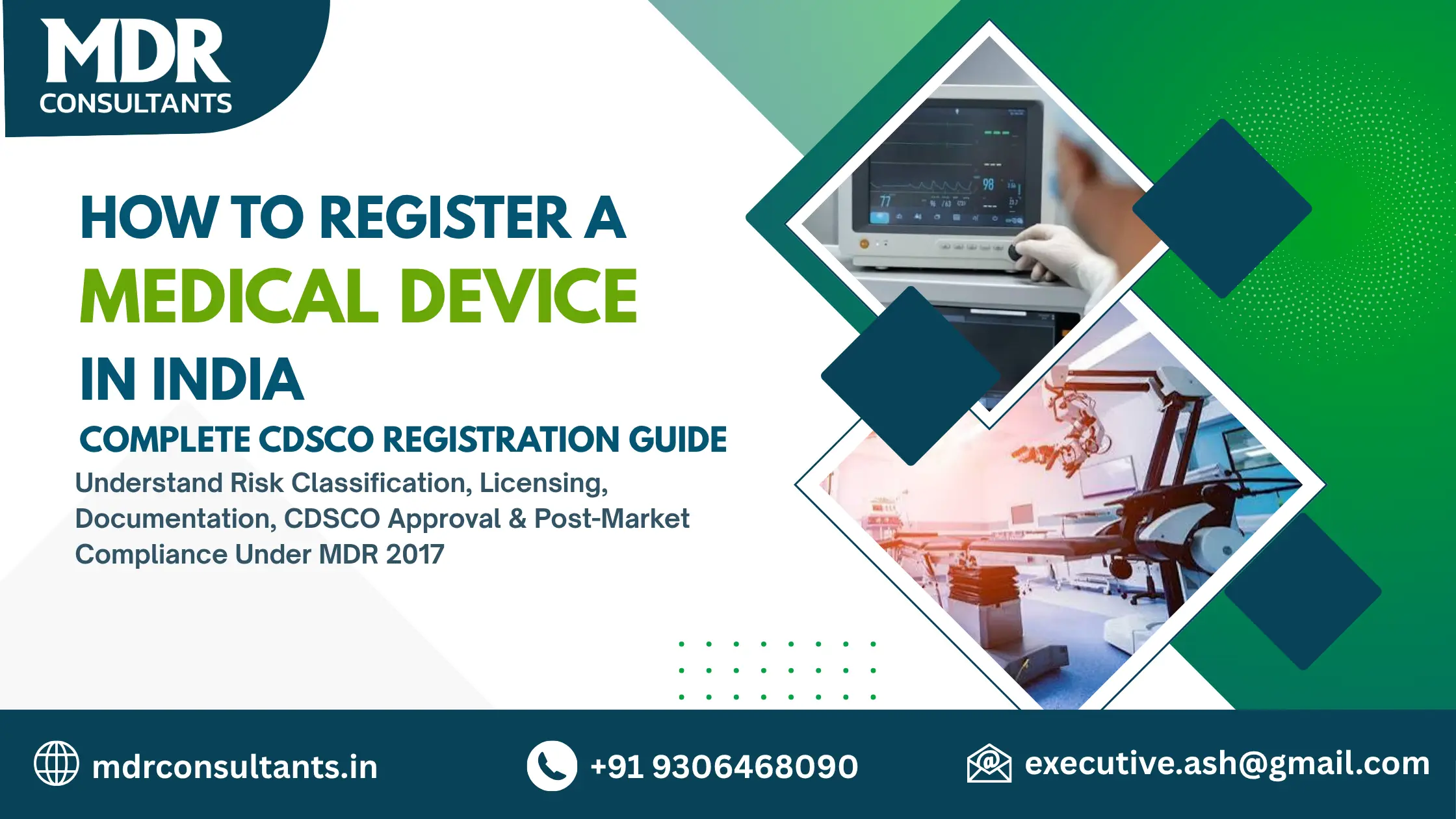
India has emerged as one of the world's fastest-growing medical device markets, offering significant opportunities for manufacturers and importers. However, before any medical device can be legally manufactured, imported, or sold in the country, it must comply with the regulatory requirements prescribed under the Medical Devices Rules, 2017 (MDR 2017). These rules are administered by the Central Drugs Standard Control Organisation (CDSCO), the National Regulatory Authority responsible for ensuring the safety, quality, and performance of medical devices marketed in India.
The registration process varies depending on the type of device, its intended use, risk classification, and whether it is manufactured domestically or imported. Understanding the correct regulatory pathway is essential for obtaining timely approvals and avoiding unnecessary delays or regulatory non-compliance.
This guide explains the complete registration process for medical devices in India and outlines the key steps manufacturers and importers should follow to achieve CDSCO compliance.
What is Medical Device Registration in India?
Medical device registration refers to the regulatory process through which manufacturers and importers obtain the necessary approvals or licences from CDSCO before placing regulated medical devices on the Indian market. The objective of this process is to ensure that only safe, effective, and quality medical devices are made available to healthcare professionals and patients.
Under MDR 2017, medical devices are regulated based on their intended purpose and associated level of risk. The regulatory requirements become more comprehensive as the risk classification increases.
Step 1: Determine Whether Your Product Qualifies as a Medical Device
The first step is to determine whether your product falls within the definition of a medical device under MDR 2017. A product may be considered a medical device if it is intended for one or more of the following purposes:
The intended use specified by the manufacturer plays a crucial role in determining whether the product is regulated as a medical device. Therefore, product claims, labelling, and Instructions for Use (IFU) should be carefully prepared.
Step 2: Identify the Correct Risk Classification
Once the product is confirmed as a medical device, the next step is to determine its risk class according to the First Schedule of MDR 2017. India follows a risk-based classification system aligned with international regulatory principles.
The four risk classes are:
The classification depends on several factors, including:
Selecting the correct risk class is one of the most important steps because it determines the applicable regulatory pathway, documentation requirements, and licensing authority.
Step 3: Identify the Appropriate Regulatory Pathway
The registration process differs for Indian manufacturers and foreign manufacturers.
For Indian Manufacturers
Indian manufacturers must obtain the appropriate manufacturing licence before commercially manufacturing regulated medical devices. Depending on the device classification, applications are submitted to either the State Licensing Authority or the Central Licensing Authority through the CDSCO online portal.
For Foreign Manufacturers
Foreign manufacturers intending to market medical devices in India must appoint an Authorized Indian Representative (AIR). The AIR acts on behalf of the overseas manufacturer and is responsible for submitting import licence applications, communicating with CDSCO, responding to regulatory queries, and fulfilling applicable post-market obligations under MDR 2017.
Step 4: Prepare the Required Technical Documentation
Comprehensive and accurate documentation is the foundation of a successful registration application. The required documents vary depending on the device classification and regulatory pathway but generally include:
All submitted documents should be complete, technically accurate, and consistent. Even minor discrepancies between the label, IFU, intended use, or technical documentation may result in regulatory queries or delays during the review process.
Step 5: Submit the Application Through the CDSCO Online Portal
Once the documentation has been compiled, the applicant must submit the application through the CDSCO online portal using the prescribed application form applicable to the device category and licence type. Supporting documents should be uploaded in the required format, and the applicable government fee, where prescribed under MDR 2017, should be paid before final submission.
Before submitting the application, applicants should carefully verify that all information provided is accurate and consistent across every document. A well-prepared application significantly reduces the likelihood of deficiencies and helps facilitate a smoother regulatory review.
Step 6: CDSCO Review and Evaluation
After submission, CDSCO or the appropriate licensing authority reviews the application to ensure compliance with the Medical Devices Rules, 2017. During this stage, regulatory officials assess the submitted technical documentation, intended use, risk classification, quality management system, labelling, and other supporting information. For certain device categories, additional technical evaluation or expert review may also be required.
If any information is incomplete or requires clarification, the licensing authority may raise regulatory queries. Applicants should respond within the prescribed timeline by providing accurate and complete explanations supported by relevant documents. Delayed or inadequate responses can prolong the approval process or result in rejection of the application. Maintaining consistency across all submitted documents is essential to facilitate a smooth review.
Step 7: Grant of Licence
Once the regulatory authority is satisfied that the application complies with MDR 2017, the appropriate licence is granted through the CDSCO online portal. The type of licence issued depends on whether the device is manufactured in India or imported and on the applicable regulatory pathway.
After obtaining the licence, manufacturers and importers may legally manufacture, import, distribute, or market the approved medical device in India, subject to the conditions specified in the licence. It is important to verify that all approved product details, including the device name, intended use, model, and manufacturing site, accurately match the submitted documentation.
Step 8: Maintain Post-Market Regulatory Compliance
Obtaining a licence is only the beginning of regulatory compliance. Manufacturers, importers, and Authorized Indian Representatives must continue to fulfil their responsibilities throughout the product lifecycle.
Post-market obligations generally include:
Effective post-market surveillance helps ensure patient safety and continued regulatory compliance.
Common Mistakes to Avoid During Registration
Many applications are delayed because of avoidable errors. Some of the most common mistakes include:
Conducting a thorough document review before submission can significantly reduce regulatory delays.
Why Professional Regulatory Support Matters
Medical device regulations continue to evolve, making professional regulatory guidance valuable for manufacturers entering the Indian market. Experienced consultants help identify the correct regulatory pathway, prepare compliant documentation, coordinate with regulatory authorities, and manage post-approval obligations.
Professional assistance can reduce errors, improve application quality, and shorten approval timelines while ensuring compliance with MDR 2017 and applicable CDSCO requirements. This allows manufacturers to focus on product development and business expansion while meeting their regulatory responsibilities efficiently.
Conclusion
Registering a medical device in India requires careful planning, accurate classification, complete technical documentation, and ongoing compliance with the Medical Devices Rules, 2017. Whether you are an Indian manufacturer or an overseas company seeking market access, understanding each regulatory step is essential for a successful approval process.
By determining the correct risk classification, preparing comprehensive documentation, selecting the appropriate licensing pathway, and maintaining post-market compliance, manufacturers and importers can successfully navigate India's regulatory framework. Working with experienced regulatory professionals further simplifies the process and helps ensure timely approvals, enabling businesses to introduce safe, effective, and compliant medical devices into the Indian healthcare market with confidence.
Need assistance with CDSCO medical device registration?
Whether you are an Indian manufacturer or an overseas medical device company, MDR Consultants provides end-to-end regulatory support, including device classification, documentation preparation, import licence applications, manufacturing licence applications, Authorized Indian Representative (AIR) services, and post-market compliance.
Contact MDR Consultants today to simplify your medical device registration process and accelerate your entry into the Indian market.
Last Updated : 25 Aug 2026
The Brand That Promises To Turn Your Business Around!
MDR Consultants excels in guiding medical device companies through global regulatory approvals with tailored solutions, clear communication, and efficient delivery. Their mission-driven approach fosters innovation, compliance, and long-term partnerships built on trust and excellence.

As I observed this company maintains a very good and cooperative environment. "MDR" consultancy is equipped with all modern amenities. They guide you the best. I highly recommend this firm. The entire team is very courteous and helpful. Highly Professional team and the owner is very skilled and humble.

Outstanding expertise! They streamlined our regulatory process, saving us immense time and stress. A truly invaluable partner for medical device compliance.

MDR Consultants have been a reliable partner for our CDSCO registration needs. Their efficient processes and in-depth knowledge of the regulations saved us significant time and resources. We are confident about the quality of their services and their commitment to client satisfaction.

MDR team has consistently delivered quality work, meeting deadlines and exceeding our expectations. We really recommend MDR for regulatory support

My experience with MDR consultants is wonderful. They have in-depth and vast knowledge about their work. They have the team of incredible people. Their commitment towards the client is highly appreciable. I highly recommend to have their services.

MDR IS THE BEST SOLUTION FOR MEDICAL DEVICES CONSULTANCIE THEY PROVIDE ALL THE SOLUTIONS AND PROPER GUIDANCE.AND DELIVER THEIR SERVICES ON TIME .

MDR team has consistently delivered high quality work, meeting deadlines and exceeding our expectations.

It was really a nice experience working with MDR consultancy.They guide you properly with their tranparent work ethics.Honestly MDR consultancy helped me a lot in growing my business.

A very friendly bunch of efficient employees in the team of MDR.A very professional approach towards their job and all my work was done hassle free with least follow up from my side.Keep up great work team MDR!!!!👍👍

The services are top notch , highly recommend for Mr Ashish

Best regulatory services..for medical devices…best in the business

Have a rich experience in the field of consultancy.

Extremely helpful and responsive

Very good experience

Good Services

Appreciable work.

True consultant

Medical Device Regulatory Consultants
37-38, 1st Floor, Near Makhan Bhog, G.T. Road,
Kundli Industrial Area, Delhi NCR, 131028