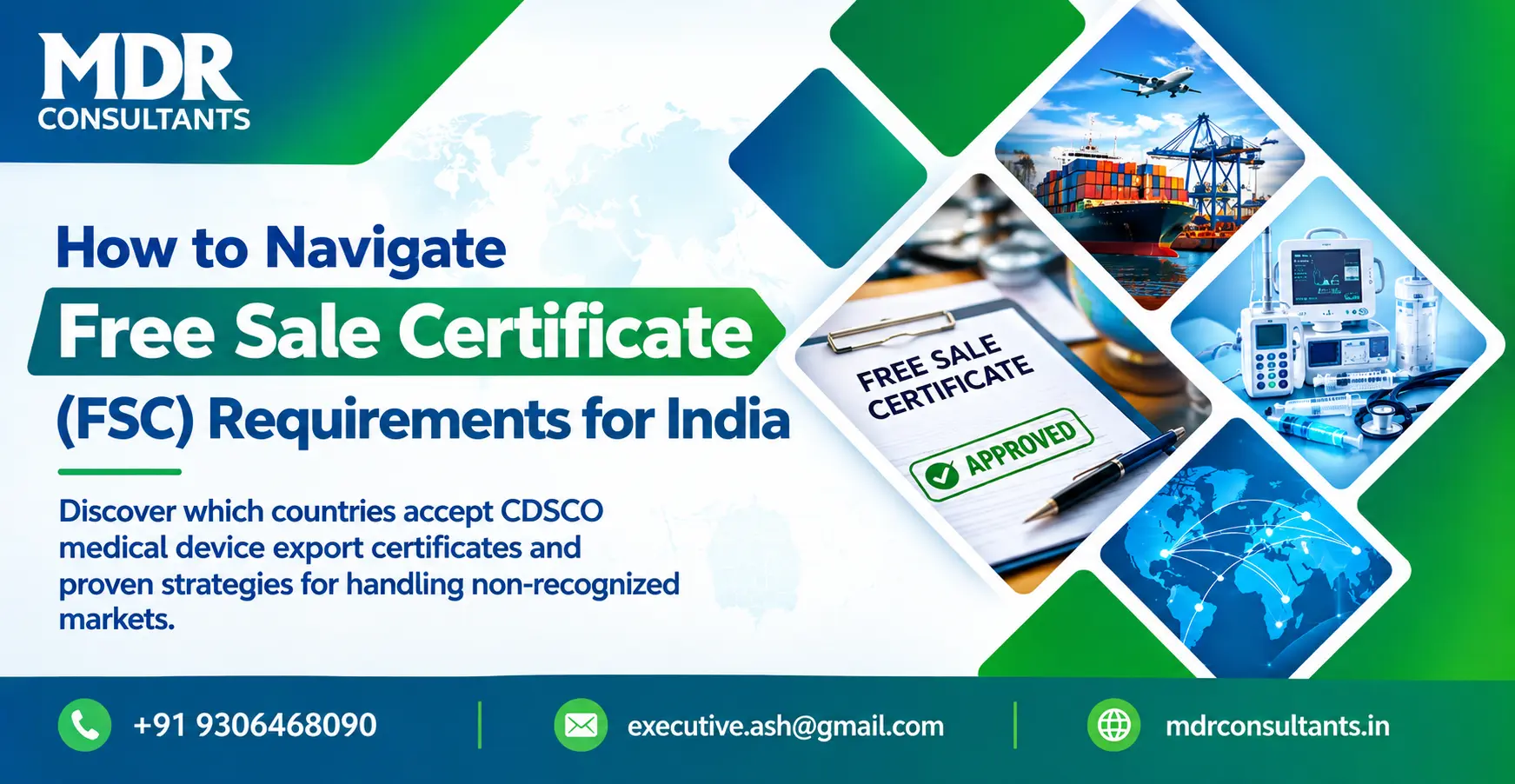
Navigating international trade in medical devices requires precise regulatory documentation. For Indian medical-device manufacturers, the Free Sale Certificate (FSC) is an important document used to support the export of medical devices to international markets.
A Free Sale Certificate is issued by the applicable Indian Licensing Authority for eligible medical devices that are licensed for sale or distribution in India. Foreign regulators, importers and other competent authorities may request an FSC as part of their requirements for registering or importing a medical device.
The Central Drugs Standard Control Organization (CDSCO) has published a specific Guidance Document for obtaining a Free Sale Certificate for licensed medical devices in India. The current guidance, CDSCO/MD/GD/FSC/02/2024, sets out the applicable authority, online application process, documentation, fee, undertaking and validity requirements.
This guide explains the Free Sale Certificate requirements for medical devices in India, the CDSCO FSC online application process, documents required, applicable fees, device-class requirements and important considerations for manufacturers exporting medical devices from India.
A Free Sale Certificate (FSC) is a regulatory certificate issued for eligible licensed medical devices for export purposes.
For Indian medical-device manufacturers, the FSC application is made to the applicable Licensing Authority when the manufacturer has a valid licence to manufacture medical devices for sale or distribution in India.
The CDSCO guidance specifically states that the FSC process applies to Indian medical-device manufacturers holding a valid manufacturing licence who intend to obtain an FSC for export of medical devices.
An FSC can be requested by overseas regulators, importers or other authorities as part of the documentation required to establish the regulatory status of a product in its country of origin.
However, an FSC should not be considered a universal international marketing authorization. Acceptance and additional requirements are determined by the regulatory framework of the destination country.
The CDSCO FSC guidance applies to medical-device manufacturers in India that hold a valid manufacturing licence and intend to obtain an FSC for export purposes.
The manufacturer must have a valid licence to manufacture the relevant medical devices for sale or distribution in India under the Medical Devices Rules, 2017.
The products included in the FSC application should therefore correspond to products covered by the applicable manufacturing licence.
The applicable Licensing Authority depends on the risk classification of the medical device.
For Class A and Class B medical devices licensed for sale or distribution under the Medical Devices Rules, 2017, the FSC application is made to the State Licensing Authority (SLA).
For Class C and Class D medical devices, the FSC application is made to the Central Licensing Authority (CLA).
The basic structure can therefore be summarized as:
|
Device Class |
FSC Application Authority |
|
Class A |
State Licensing Authority (SLA) |
|
Class B |
State Licensing Authority (SLA) |
|
Class C |
Central Licensing Authority (CLA) |
|
Class D |
Central Licensing Authority (CLA) |
Therefore, it is more accurate to state that the FSC is issued by the applicable Licensing Authority, rather than saying that CDSCO issues every FSC together with the State Licensing Authority.
CDSCO's Medical Devices Division does, however, have a stated function of processing applications for issuance of FSCs for domestic medical-device manufacturers.
The CDSCO guidance specifies that the FSC application is submitted online through www.cdscomdonline.gov.in.
Manufacturers should prepare the required documents and ensure that the products included in the application are covered by a valid manufacturing licence.
The main steps are as follows.
Before submitting an FSC application, determine whether the applicable device is:
The classification determines whether the application is submitted to the SLA or CLA.
The manufacturer should hold a valid licence to manufacture the applicable medical device for sale or distribution.
The CDSCO guidance requires a valid copy of the manufacturing licence issued by the applicable SLA or CLA.
The covering letter should clearly state the purpose of the FSC application.
The CDSCO guidance states that it should also identify the documents being submitted and may include other relevant information.
The covering letter should be signed and stamped by the authorized signatory and should include the signatory's name and designation together with the firm's name and address.
The system-generated application should reflect the applicable manufacturing licence number and the product list for which the FSC is being requested.
Manufacturers should carefully verify product names and other product details before submission.
The prescribed FSC fee is paid through the Bharatkosh online challan.
The current CDSCO guidance specifies a fee of:
₹1,000 per category of medical device.
The fee receipt should be included with the FSC application.
According to the current CDSCO FSC guidance, the application checklist includes the following documents:
A signed and stamped covering letter explaining the purpose of the FSC application.
The applicable application generated through the online system.
The Bharatkosh challan receipt showing payment of the prescribed FSC fee.
A copy of the valid licence to manufacture the relevant medical devices for sale or distribution.
The CDSCO checklist also refers to the retention application file number for all applied products, if applicable.
The manufacturer must submit a legal undertaking on a ₹100 registered notarized stamp, recently notarized.
The undertaking states that no action has been initiated against the manufacturer, and that the manufacturer has not been convicted, in relation to adverse events, market complaints or Not of Standard Quality (NSQ) reports concerning the relevant products.
The legal undertaking is an important part of the FSC application.
The CDSCO format identifies the products for which the FSC is being requested and requires the manufacturer to make the relevant declaration regarding adverse events, market complaints and NSQ reports.
The undertaking should be prepared carefully because discrepancies between the undertaking, manufacturing licence and product list can result in regulatory queries.
One of the most important points in the CDSCO guidance concerns products manufactured exclusively for export.
The guidance specifically states:
The FSC may not be granted for products meant exclusively for export purposes.
Therefore, manufacturers should ensure that products intended exclusively for export are not included in the FSC application.
This is particularly important for manufacturers operating separate product lines or manufacturing products specifically for overseas markets.
The CDSCO guidance states that an FSC issued by the Licensing Authority is valid up to the validity of the manufacturing licence, provided that no regulatory action has been initiated by the Licensing Authority against the products covered by the application.
Therefore, manufacturers should monitor both:
An Indian FSC may be requested by overseas regulatory authorities, importers or other competent authorities when an Indian manufacturer seeks to enter an international market.
However, there is no single global rule determining acceptance of an Indian FSC.
Requirements are country-specific.
Depending on the destination market, the regulator may request:
Manufacturers should therefore check the requirements of the specific destination country before applying for the FSC.
An FSC should be considered a supporting regulatory document rather than a universal authorization to market the product worldwide.
The authentication requirements for an FSC depend on the destination country.
Some jurisdictions may require an apostille, while others may require embassy or consular legalization. Some countries may accept the document without additional legalization.
Manufacturers should therefore confirm:
Obtaining an apostille does not, by itself, guarantee that the destination country's medical-device regulator will accept the product or grant marketing authorization.
Authentication and regulatory acceptance are separate issues.
If a destination country does not accept the Indian FSC in its standard form, the manufacturer should first determine the specific regulatory requirement of that country.
Depending on the jurisdiction, the regulator may accept alternative evidence or request additional documentation.
Potential supporting documentation can include, where required by the destination regulator:
These are destination-country requirements, not additional requirements automatically imposed by the CDSCO FSC procedure.
Manufacturers should distinguish between obtaining an FSC and manufacturing a medical device exclusively for export.
The current CDSCO FSC guidance specifically states that an FSC may not be granted for products meant exclusively for export.
CDSCO also has a separate regulatory provision concerning a system-generated Neutral Code for manufacturing medical devices for export purposes. This is a separate mechanism and should not be described as an alternative Free Sale Certificate.
Manufacturers exporting medical devices should first determine the applicable classification and Indian licensing status.
The FSC pathway can be summarized as follows:
Class A
Valid manufacturing licence → Apply to SLA → Submit FSC application and required documents → Pay applicable fee → FSC processing
Class B
Valid manufacturing licence → Apply to SLA → Submit FSC application and required documents → Pay applicable fee → FSC processing
Class C
Valid manufacturing licence → Apply to CLA → Submit FSC application and required documents → Pay applicable fee → FSC processing
Class D
Valid manufacturing licence → Apply to CLA → Submit FSC application and required documents → Pay applicable fee → FSC processing
The FSC is issued by the applicable Licensing Authority subject to the requirements of the current regulatory framework.
The authority depends on device classification.
Class A/B → SLA
Class C/D → CLA
Products meant exclusively for export should not be included in the FSC application, according to the CDSCO guidance.
The manufacturing licence must be valid and should cover the products for which the FSC is requested.
The products listed in the FSC application should correspond to the products covered by the manufacturing licence.
Manufacturers should carefully check:
The undertaking must follow the applicable CDSCO format and be submitted on the prescribed notarized stamp.
The applicable FSC fee should be paid through the prescribed Bharatkosh process.
The current CDSCO guidance specifies ₹1,000 per category of medical device.
An FSC supports an export regulatory submission, but it does not automatically provide authorization to market a device in another country.
The destination country's regulatory requirements must be assessed separately.
Obtaining an FSC is only one part of an international medical-device export strategy.
A manufacturer should assess the regulatory requirements of each target market before starting the export process. Early identification of documentation, legalization and product-registration requirements can reduce delays and prevent inconsistencies between Indian regulatory documents and overseas submissions.
The FSC application itself should be prepared using the current CDSCO requirements, while the final export documentation package should be tailored to the requirements of the destination country.
A regulatory consultant can assist manufacturers with activities such as:
The exact scope of support depends on the manufacturer's products and target markets.
A Free Sale Certificate is an important regulatory document for Indian medical-device manufacturers exporting products to international markets.
Under the current CDSCO guidance, the FSC application is submitted online, with Class A and Class B applications handled by the State Licensing Authority and Class C and Class D applications handled by the Central Licensing Authority. The application requires the applicable covering letter, FSC application, Bharatkosh fee receipt, valid manufacturing licence and prescribed legal undertaking.
The FSC remains valid up to the validity of the manufacturing licence, provided no regulatory action has been initiated against the applied products.
Manufacturers should also note that products meant exclusively for export should not be included in an FSC application.
Finally, an Indian FSC does not automatically guarantee acceptance in every international market. Each destination country may have its own requirements concerning certificates, legalization, technical documentation, product registration and clinical or performance evidence.
For this reason, manufacturers should evaluate the Indian FSC requirements and the destination country's regulatory requirements together when planning international medical-device exports.
Last Updated : 19 Sep 2026
The Brand That Promises To Turn Your Business Around!
MDR Consultants excels in guiding medical device companies through global regulatory approvals with tailored solutions, clear communication, and efficient delivery. Their mission-driven approach fosters innovation, compliance, and long-term partnerships built on trust and excellence.

As I observed this company maintains a very good and cooperative environment. "MDR" consultancy is equipped with all modern amenities. They guide you the best. I highly recommend this firm. The entire team is very courteous and helpful. Highly Professional team and the owner is very skilled and humble.

Outstanding expertise! They streamlined our regulatory process, saving us immense time and stress. A truly invaluable partner for medical device compliance.

MDR Consultants have been a reliable partner for our CDSCO registration needs. Their efficient processes and in-depth knowledge of the regulations saved us significant time and resources. We are confident about the quality of their services and their commitment to client satisfaction.

MDR team has consistently delivered quality work, meeting deadlines and exceeding our expectations. We really recommend MDR for regulatory support

My experience with MDR consultants is wonderful. They have in-depth and vast knowledge about their work. They have the team of incredible people. Their commitment towards the client is highly appreciable. I highly recommend to have their services.

MDR IS THE BEST SOLUTION FOR MEDICAL DEVICES CONSULTANCIE THEY PROVIDE ALL THE SOLUTIONS AND PROPER GUIDANCE.AND DELIVER THEIR SERVICES ON TIME .

MDR team has consistently delivered high quality work, meeting deadlines and exceeding our expectations.

It was really a nice experience working with MDR consultancy.They guide you properly with their tranparent work ethics.Honestly MDR consultancy helped me a lot in growing my business.

A very friendly bunch of efficient employees in the team of MDR.A very professional approach towards their job and all my work was done hassle free with least follow up from my side.Keep up great work team MDR!!!!👍👍

The services are top notch , highly recommend for Mr Ashish

Best regulatory services..for medical devices…best in the business

Have a rich experience in the field of consultancy.

Extremely helpful and responsive

Very good experience

Good Services

Appreciable work.

True consultant

Medical Device Regulatory Consultants
37-38, 1st Floor, Near Makhan Bhog, G.T. Road,
Kundli Industrial Area, Delhi NCR, 131028