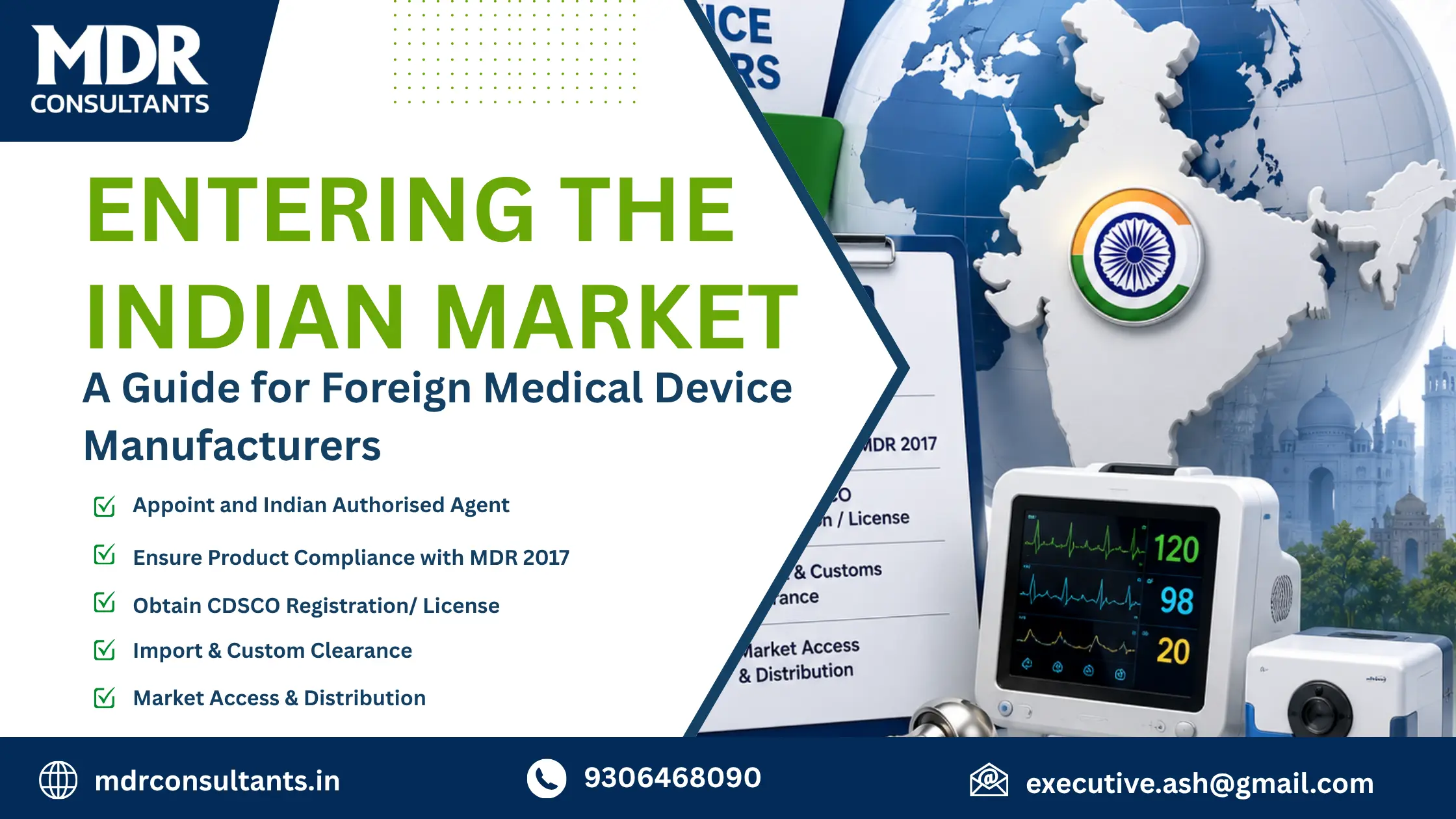
India is one of the world's fastest-growing healthcare markets, creating significant opportunities for international medical device manufacturers. Growing healthcare infrastructure, increasing adoption of advanced medical technologies and continued investment in healthcare are driving demand across multiple medical device segments.
However, entering the Indian market requires careful navigation of the regulatory framework administered by the Central Drugs Standard Control Organisation (CDSCO) under the Medical Devices Rules, 2017 (MDR 2017), as amended from time to time.
For overseas manufacturers planning to import and market medical devices in India, understanding device classification, authorised agent requirements, technical documentation and post-market obligations is essential.
This guide provides an overview of the key regulatory steps foreign medical device manufacturers should consider when entering India.
Medical devices in India are regulated under the Drugs and Cosmetics Act, 1940 and the Medical Devices Rules, 2017.
The Central Drugs Standard Control Organisation (CDSCO), functioning under the Ministry of Health and Family Welfare, is the primary regulatory authority responsible for regulating medical devices at the central level.
Under MDR 2017, medical devices other than in-vitro diagnostic medical devices are classified according to risk into four categories:
Class A – Low Risk
Class B – Low-Moderate Risk
Class C – Moderate-High Risk
Class D – High Risk
In-vitro diagnostic (IVD) medical devices are also classified according to a risk-based framework under the applicable provisions of MDR 2017.
For imported medical devices, the Central Licensing Authority is responsible for granting import licences. CDSCO's official framework provides for applications for import licences through Form MD-14 and the grant of an import licence in Form MD-15.
Foreign manufacturers should always verify the latest applicable CDSCO notifications, guidance documents and amendments before initiating an application.
One of the most important requirements for an overseas medical device manufacturer seeking to import products into India is the appointment of an authorised agent in India.
Under the Medical Devices Rules, 2017, the import licence application is made through an authorised agent appointed by the overseas manufacturer through a Power of Attorney.
The authorised agent acts as the official representative of the overseas manufacturer for activities relating to the import of medical devices in India.
Depending on the applicable regulatory provisions, the authorised agent must hold an appropriate:
manufacturing licence;
wholesale licence; or
registration certificate in Form MD-42 for sale or distribution of medical devices.
The authorised agent is responsible for regulatory interactions associated with the import licence and has important responsibilities relating to compliance of the imported medical devices in the Indian market.
The overseas manufacturer must execute a Power of Attorney in favour of the Indian authorised agent.
The Power of Attorney and associated undertaking should be prepared and authenticated in accordance with the requirements specified under MDR 2017 and applicable CDSCO requirements.
CDSCO checklists specify authentication mechanisms that may include authentication by:
a Magistrate of the First Class in India;
the Indian Embassy in the country of origin; or
an equivalent authority through the apostille process, where applicable.
Choosing an experienced and capable authorised agent is therefore an important strategic decision for overseas manufacturers entering India.
Correct classification is the foundation of a successful CDSCO regulatory strategy.
Medical device classification in India is based on the risk classification principles specified under the First Schedule of the Medical Devices Rules, 2017.
The manufacturer should evaluate factors including:
intended use;
invasiveness;
duration of contact;
whether the device is active or non-active;
whether the device supports or sustains life;
whether the device incorporates medicinal substances;
technological characteristics; and
other applicable classification rules.
An incorrect classification may result in regulatory queries, delays or the need to revise the application strategy.
Manufacturers should also review applicable CDSCO classification notifications and guidance before finalising the regulatory pathway.
Certain Class A non-sterile and non-measuring medical devices have been subject to exemptions from specific licensing requirements under applicable government notifications.
However, such exemptions should not be interpreted as a complete exemption from all regulatory obligations.
Manufacturers and importers should verify the current notification status and ensure compliance with applicable requirements relating to registration, quality, labelling, sale and distribution.
International regulatory approvals can provide important supporting evidence when preparing a CDSCO import licence application.
CDSCO checklists may require or consider regulatory documentation such as:
Free Sale Certificates;
Marketing Authorisations;
regulatory approvals from the country of origin;
certificates issued by recognised regulatory authorities;
Quality Management System certificates; and
other evidence supporting the safety and performance of the device.
Regulatory approvals from jurisdictions such as the United States, European Union, United Kingdom, Canada, Japan or Australia may be relevant supporting documentation depending on the nature of the application and applicable CDSCO requirements.
However, foreign approval should not be interpreted as an automatic approval or exemption from Indian regulatory requirements.
CDSCO may independently assess the device and may request additional information relating to safety, performance, clinical evidence or other technical aspects.
For medical devices requiring an import licence, the application is generally made in Form MD-14.
Upon satisfactory review and approval, the import licence is granted in Form MD-15.
The documentation requirements are specified under the Medical Devices Rules, 2017, including the Fourth Schedule, and may be supplemented by CDSCO checklists and regulatory queries.
A typical import licence dossier may include the following.
Covering letter
Application in Form MD-14
Applicable government fees
Power of Attorney
Undertaking from the authorised agent
Constitution details of the authorised agent
Copy of applicable wholesale, manufacturing or registration documentation
Details of the overseas manufacturer and manufacturing site
Depending on the device and application, supporting documents may include:
Free Sale Certificate or Marketing Authorisation;
overseas manufacturing-site regulatory certificates;
Quality Management System certificates;
ISO 13485 certification, where applicable;
Declaration of Conformity; and
other applicable regulatory approvals.
The Plant Master File (PMF) should provide information relating to the manufacturing facility and quality management system.
The content should be prepared in accordance with the applicable requirements of the Fourth Schedule of MDR 2017.
The Device Master File (DMF) is a critical component of the CDSCO application.
Depending on the device, it may include information relating to:
executive summary;
device description;
intended use;
variants and accessories;
device grouping justification;
product specifications;
substantial equivalence or predicate information, where applicable;
device design and manufacturing information;
risk management;
essential principles;
verification and validation;
clinical or performance evidence, where applicable;
biocompatibility;
electrical safety and electromagnetic compatibility, where applicable;
sterilisation information;
software documentation, where applicable;
labelling; and
instructions for use.
The documentation should be internally consistent. Information provided in the Device Master File, labels, Free Sale Certificate, Quality Management System documentation and application forms should not contradict one another.
CDSCO provides electronic systems for submission and processing of medical device regulatory applications.
The authorised agent should submit the application through the applicable CDSCO electronic platform and follow the current procedures specified by CDSCO.
The application process generally involves:
Preparing the regulatory dossier.
Completing the applicable electronic application.
Uploading supporting documentation.
Paying applicable government fees.
Responding to CDSCO queries, if raised.
Providing additional information or clarification where required.
CDSCO may scrutinise the application and request clarification or additional documentation.
Manufacturers should ensure that responses to regulatory queries are technically accurate, complete and submitted within applicable timelines.
There is no single processing timeline that should be assumed for every medical device import application.
The actual review period may depend on factors such as:
device classification;
completeness of the dossier;
novelty of the technology;
availability of supporting regulatory approvals;
adequacy of clinical or performance evidence;
number and complexity of regulatory queries; and
whether additional assessment or inspection is considered necessary.
Manufacturers should therefore avoid relying solely on generic timeline estimates and should build sufficient regulatory time into their India market-entry strategy.
During the review process, CDSCO may assess the technical and regulatory documentation submitted with the application.
Depending on the device and circumstances, CDSCO may request:
clarification of device classification;
additional technical documentation;
safety or performance information;
clinical evidence;
justification for substantial equivalence;
clarification of manufacturing processes;
revised labels or instructions for use; or
other information considered necessary for regulatory assessment.
The Central Licensing Authority may also exercise powers available under the applicable regulatory framework, including inspection or audit where considered necessary.
Following satisfactory review, an import licence may be granted in Form MD-15.
The licence identifies the authorised agent, overseas manufacturer, manufacturing site and medical devices covered by the approval.
Medical device labelling is an important part of CDSCO compliance.
Labels and Instructions for Use should be prepared in accordance with applicable provisions of MDR 2017 and other relevant requirements.
Depending on the device and regulatory requirements, labelling information may include:
device name;
manufacturer details;
authorised agent or importer details, where applicable;
intended use;
batch or lot number;
serial number, where applicable;
manufacturing date;
expiry date or shelf life, where applicable;
storage conditions;
sterility information;
warnings and precautions;
instructions for use; and
other mandatory regulatory declarations.
Labelling should be reviewed carefully before commercial importation because inconsistencies between the approved dossier and commercial labels can create compliance concerns.
Obtaining an import licence is not the final stage of regulatory compliance.
Manufacturers and authorised agents must maintain ongoing compliance throughout the lifecycle of the device in the Indian market.
Key obligations may include:
post-market surveillance;
complaint handling;
adverse-event reporting;
corrective and preventive action;
Field Safety Corrective Actions, where required;
product recall procedures;
maintenance of distribution and traceability records;
compliance with applicable licence conditions;
management of regulatory changes; and
cooperation with regulatory authorities.
Any significant change relating to the overseas manufacturer, manufacturing site or other regulatory information should be evaluated carefully to determine whether prior regulatory approval, endorsement or a fresh application may be required.
CDSCO has also clarified that certain changes, including changes in the constitution of a licensee, changes involving the overseas manufacturer executing the Power of Attorney, and changes in the location of the actual manufacturing site, may require a fresh import licence application. The specific regulatory impact of any change should be assessed before implementation.
After obtaining the required regulatory authorisation, the importer should ensure that each commercial shipment complies with applicable import and customs requirements.
The imported devices should remain consistent with the products and manufacturing sites covered by the regulatory approval.
Before shipment, manufacturers and importers should verify:
validity of the applicable import licence;
approved manufacturing site details;
device and model details;
labelling compliance;
shelf-life requirements;
shipping and storage conditions; and
any additional approvals applicable to the specific technology.
Certain specialised medical technologies may also fall under additional regulatory frameworks administered by other government authorities.
For example, devices involving ionising radiation or other regulated technologies may require separate compliance assessment under applicable Indian laws.
Foreign medical device manufacturers can improve the efficiency of their India market-entry strategy by focusing on the following areas:
Do not begin with documentation alone. First determine:
device classification;
applicable regulatory pathway;
whether the device is already regulated or subject to a specific notification;
technical documentation requirements; and
potential clinical or performance evidence requirements.
The authorised agent plays an important role in regulatory communication and ongoing compliance.
Evaluate the agent's:
regulatory experience;
quality systems;
understanding of CDSCO procedures;
post-market capabilities; and
ability to manage regulatory communications.
One of the most common causes of regulatory queries is inconsistency between documents.
The following information should be harmonised:
manufacturer name;
manufacturing-site address;
device name;
model numbers;
intended use;
classification;
shelf life;
labels;
instructions for use; and
regulatory certificates.
CE marking, US FDA clearance or approval from another jurisdiction can provide valuable supporting evidence, but Indian regulatory requirements must still be independently satisfied.
Market entry should include planning for the full product lifecycle.
Manufacturers should establish procedures for:
complaint management;
vigilance;
adverse-event assessment;
corrective actions;
recalls;
Field Safety Corrective Actions; and
regulatory change management.
Entering the Indian medical device market requires more than submitting an application. A successful strategy requires accurate classification, a well-prepared technical dossier, effective regulatory communication and ongoing post-market compliance.
At MDR CONSULTANTS, we support international medical device manufacturers with services including:
India regulatory strategy and gap assessment;
medical device classification support;
CDSCO import licence application support;
authorised agent coordination;
Device Master File and Plant Master File preparation;
technical documentation review;
CDSCO query response support;
labelling compliance review;
post-approval change assessment;
post-market surveillance support; and
recall and Field Safety Corrective Action procedures.
Our objective is to help overseas manufacturers develop a structured and practical approach to entering and maintaining compliance in the Indian medical device market.
India presents substantial opportunities for foreign medical device manufacturers, but successful market entry requires careful planning and a clear understanding of the applicable CDSCO regulatory framework.
The process generally involves determining the correct device classification, appointing an appropriate Indian authorised agent, preparing technical and legal documentation, applying for the relevant import authorisation and maintaining ongoing post-market compliance.
Because medical device regulations, notifications and CDSCO procedures may evolve, manufacturers should always verify the latest applicable requirements before submitting an application.
A well-planned regulatory strategy can reduce avoidable queries, improve dossier quality and help foreign manufacturers navigate the Indian medical device regulatory pathway more efficiently.
Last Updated : 03 Sep 2026
The Brand That Promises To Turn Your Business Around!
MDR Consultants excels in guiding medical device companies through global regulatory approvals with tailored solutions, clear communication, and efficient delivery. Their mission-driven approach fosters innovation, compliance, and long-term partnerships built on trust and excellence.

As I observed this company maintains a very good and cooperative environment. "MDR" consultancy is equipped with all modern amenities. They guide you the best. I highly recommend this firm. The entire team is very courteous and helpful. Highly Professional team and the owner is very skilled and humble.

Outstanding expertise! They streamlined our regulatory process, saving us immense time and stress. A truly invaluable partner for medical device compliance.

MDR Consultants have been a reliable partner for our CDSCO registration needs. Their efficient processes and in-depth knowledge of the regulations saved us significant time and resources. We are confident about the quality of their services and their commitment to client satisfaction.

MDR team has consistently delivered quality work, meeting deadlines and exceeding our expectations. We really recommend MDR for regulatory support

My experience with MDR consultants is wonderful. They have in-depth and vast knowledge about their work. They have the team of incredible people. Their commitment towards the client is highly appreciable. I highly recommend to have their services.

MDR IS THE BEST SOLUTION FOR MEDICAL DEVICES CONSULTANCIE THEY PROVIDE ALL THE SOLUTIONS AND PROPER GUIDANCE.AND DELIVER THEIR SERVICES ON TIME .

MDR team has consistently delivered high quality work, meeting deadlines and exceeding our expectations.

It was really a nice experience working with MDR consultancy.They guide you properly with their tranparent work ethics.Honestly MDR consultancy helped me a lot in growing my business.

A very friendly bunch of efficient employees in the team of MDR.A very professional approach towards their job and all my work was done hassle free with least follow up from my side.Keep up great work team MDR!!!!👍👍

The services are top notch , highly recommend for Mr Ashish

Best regulatory services..for medical devices…best in the business

Have a rich experience in the field of consultancy.

Extremely helpful and responsive

Very good experience

Good Services

Appreciable work.

True consultant

Medical Device Regulatory Consultants
37-38, 1st Floor, Near Makhan Bhog, G.T. Road,
Kundli Industrial Area, Delhi NCR, 131028