Navigating medical device regulations in India can be challenging, particularly for manufacturers and importers preparing to introduce new products to the market. Understanding whether a product requires a manufacturing or import licence is an important part of the regulatory planning process.
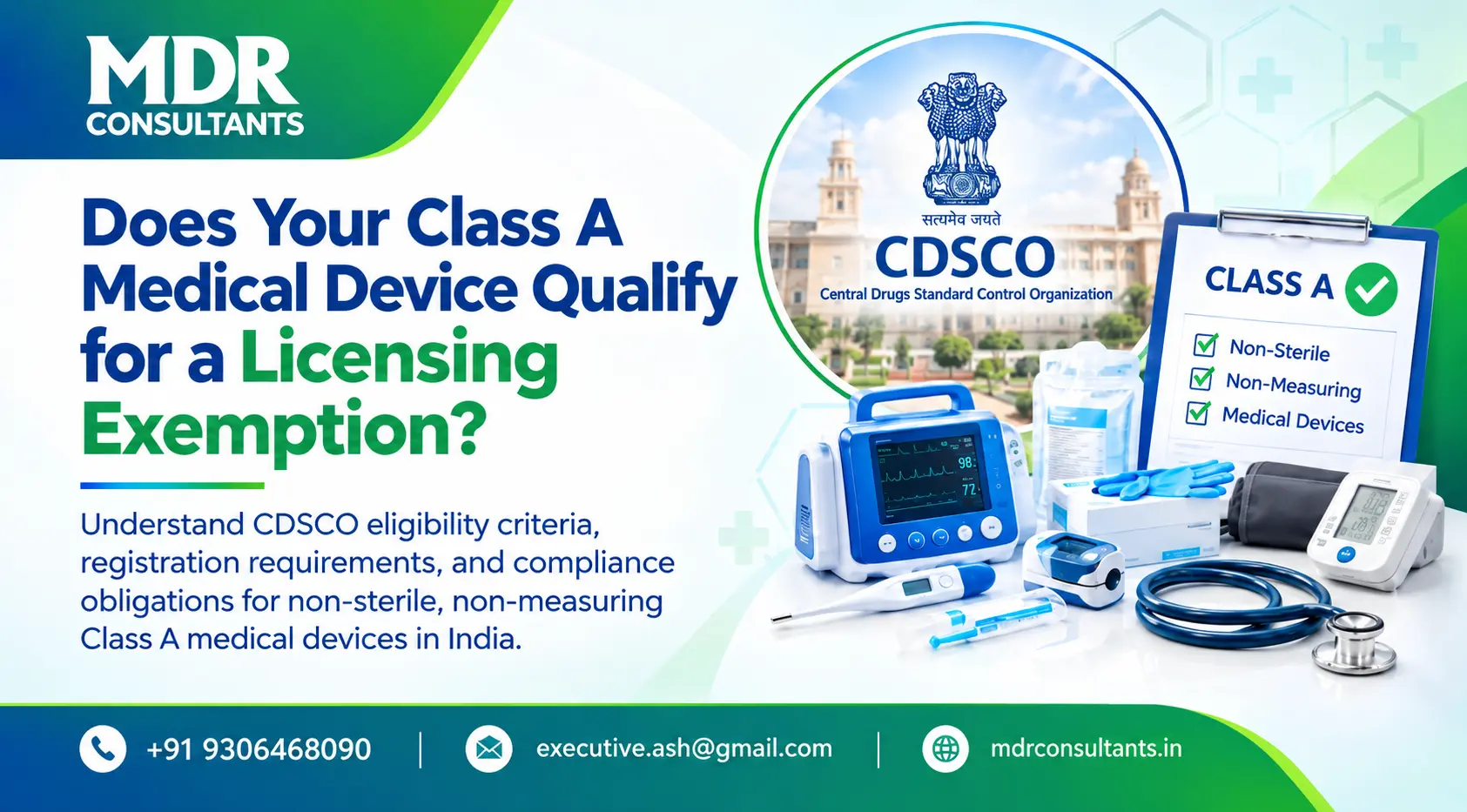
Under the Central Drugs Standard Control Organisation (CDSCO) framework, certain low-risk medical devices classified as Class A may qualify for an exemption from licensing requirements. However, this exemption does not apply to every Class A medical device.
Under the Medical Devices Rules, 2017, as amended by G.S.R. 777(E) dated 14 October 2022, Class A medical devices that are both non-sterile and non-measuring may qualify for an exemption from specified licensing requirements, subject to applicable conditions. Mandatory registration and other relevant compliance obligations still apply. The CDSCO published an updated risk-classification list for these devices on 31 October 2025.
For businesses seeking to simplify their regulatory pathway, identifying whether a product meets these conditions is essential.
The Medical Devices Rules, 2017, classify medical devices in India according to their associated risk. This risk-based approach helps determine the regulatory requirements applicable to a product.
The four medical device risk classes are:
Class A devices generally have a lower risk profile than devices in the other categories. Nevertheless, a product's classification depends on its intended purpose, design, characteristics, and the applicable classification rules—not simply on its commercial name or apparent simplicity.
A Class A classification alone does not establish eligibility for the licensing exemption. The device must also satisfy the specific conditions prescribed by CDSCO.
Under G.S.R. 777(E), dated 14 October 2022, the exemption pathway applies to eligible Class A non-sterile and non-measuring medical devices.
To determine whether your product qualifies, assess the following conditions.
1. The Device Must Be Classified as Class A
The first step is to confirm the product's risk classification under the Medical Devices Rules, 2017.
Review the applicable CDSCO classification list, the device's intended use, and the relevant classification rules. Do not assume that a product qualifies merely because a similar product is marketed as a low-risk device.
CDSCO's classification list is subject to revision. The latest applicable version should therefore be checked before making a regulatory decision.
2. The Device Must Be Non-Sterile
The device must not be intended to be supplied in a sterile state.
Sterility status is a key eligibility criterion because a Class A device supplied as sterile does not fall within this particular exemption category.
Manufacturers and importers should review the product specifications, packaging configuration, labeling, and intended supply condition to establish whether the device is non-sterile.
3. The Device Must Be Non-Measuring
The product must also lack a qualifying measuring function.
A medical device may be considered to have a measuring function when it is intended to quantify a physiological or anatomical parameter, or a quantity or measurable characteristic of energy or substances delivered to or removed from the human body, with the measurement result displayed in legal or other acceptable units.
The assessment should focus on the device's intended function and technical specifications.
A device that provides quantitative measurements cannot automatically qualify for the exemption simply because it is otherwise low-risk.
4. The Device Must Meet the Applicable CDSCO Classification Criteria
The exemption should be assessed against the applicable CDSCO list of Class A non-sterile, non-measuring medical devices.
On 31 October 2025, CDSCO published an updated risk-classification list for this category. The notice also clarifies that variants supplied in a sterile state or having a measuring function are not considered eligible under this category.
Consequently, businesses should assess the specific product variant rather than relying only on the classification of a related product.
An important distinction must be made between exemption from licensing and exemption from all regulatory requirements.
Eligible Class A non-sterile, non-measuring medical devices are exempt from specified provisions of Chapters IV, V, VII, VIII, and XI of the Medical Devices Rules, 2017, subject to the applicable framework.
This provides regulatory relief from certain licensing and related requirements. However, it does not mean that the device can be marketed without completing the applicable regulatory formalities.
The key distinction is as follows:
The CDSCO's published guidance confirms that registration is mandatory even when the licensing requirement does not apply.
Manufacturers and importers should follow a structured approach before relying on the exemption.
Step 1: Confirm the Device Classification
Identify the product's intended purpose and verify its classification against the applicable CDSCO rules and current classification list.
Document the rationale supporting the Class A classification.
Step 2: Verify Sterility and Measuring Status
Review the product's technical documentation to establish whether it is supplied sterile and whether it performs a measuring function.
Check all variants, configurations, and intended uses. A change in product characteristics may affect eligibility.
Step 3: Prepare the Required Product Information
Compile the information required for registration through the Medical Devices Online System.
Depending on the applicable registration requirements, this may include product identification, manufacturer or importer details, intended use, and relevant classification information.
The precise information required should be confirmed on the current CDSCO portal and under the applicable rules.
Step 4: Complete Registration Through the CDSCO Portal
Submit the required information through the Medical Devices Online System for the applicable Class A non-sterile, non-measuring device registration process.
After the requisite information is furnished, the system generates a registration number. Retain the registration details and supporting records for future reference.
Step 5: Verify Labeling and Applicable Standards
Before placing the device on the market, check its labeling against the applicable provisions of Chapter VI and identify any relevant standards or additional regulatory requirements.
Ensure that the product information, intended use, and other applicable particulars are consistent with the regulatory documentation.
Step 6: Maintain Regulatory Records
Keep the classification rationale, registration information, technical specifications, labeling records, and relevant compliance documentation organised and up to date.
Reassess eligibility whenever the product's intended use, design, measuring capability, sterility status, or applicable classification changes.
Even when a product appears to meet the eligibility criteria, incorrect assumptions can create regulatory risks.
Assuming Every Class A Device Is Exempt
The exemption is limited to the eligible non-sterile, non-measuring category. Other Class A devices may remain subject to the applicable licensing requirements.
Treating Registration as Optional
The licensing exemption does not eliminate the mandatory registration requirement for eligible devices. Businesses should complete the applicable registration process before relying on the exemption.
Ignoring Product Variants
A non-sterile variant and a sterile variant of a similar device may follow different regulatory pathways. The same applies when one variant has a measuring function and another does not.
Relying on Outdated Classification Lists
CDSCO classification lists can be updated. A previous assessment may no longer be sufficient if a new or revised classification notice applies.
Overlooking Labeling and Other Compliance Obligations
An exemption from specified licensing provisions does not automatically remove all obligations under the Medical Devices Rules, 2017. Applicable labeling, standards, and other relevant requirements must be reviewed independently.
For businesses whose products meet the prescribed conditions, the exemption can simplify regulatory planning.
Reduced licensing burden: Eligible products may avoid the specified manufacturing or import licensing process.
Simplified regulatory planning: A clearly documented eligibility assessment helps businesses identify the appropriate compliance pathway early.
More efficient resource allocation: Regulatory teams can focus on mandatory registration, documentation, labeling, and other applicable requirements.
Better compliance management: A structured review of classification and eligibility can reduce the risk of relying on an exemption that does not apply to a particular product.
These benefits depend on meeting the relevant conditions and maintaining compliance with the applicable regulatory framework.
1. Are all Class A medical devices exempt from CDSCO licensing?
No. The exemption applies to eligible Class A medical devices that are both non-sterile and non-measuring. Other Class A devices may remain subject to the relevant licensing requirements.
2. Is CDSCO registration mandatory for exempt Class A medical devices?
Yes. Eligible devices must be registered through the CDSCO Medical Devices Online System, and the applicable system-generated registration number must be obtained.
3. Can a sterile Class A medical device claim the exemption?
A Class A medical device supplied in a sterile state does not qualify for this specific non-sterile, non-measuring exemption category.
4. Can a Class A device with a measuring function claim the exemption?
No. A device with a qualifying measuring function does not meet the non-measuring eligibility condition for this exemption.
5. Which regulation introduced the Class A licensing exemption?
The Medical Devices (Sixth Amendment) Rules, 2022, notified through G.S.R. 777(E) on 14 October 2022, introduced the relevant provisions for registration of Class A non-sterile, non-measuring medical devices.
6. Are labeling requirements waived for exempt devices?
No. Applicable labeling requirements under Chapter VI of the Medical Devices Rules, 2017, continue to apply.
7. How can a manufacturer confirm whether a device qualifies?
The manufacturer should verify the device's classification, intended use, sterility status, measuring function, and inclusion in the applicable CDSCO classification list. The eligibility assessment should be documented before relying on the exemption.
Determining whether a Class A medical device qualifies for a CDSCO licensing exemption requires more than confirming its risk classification. The device must meet the relevant non-sterile and non-measuring criteria and satisfy the applicable classification conditions.
For eligible products, the exemption can reduce the licensing burden. However, mandatory registration, labeling compliance, and other applicable regulatory obligations remain important parts of the market-entry process.
Manufacturers and importers should consult the latest CDSCO notifications, verify the status of each product variant, and maintain clear documentation supporting their regulatory decisions.
Last Updated : 26 Oct 2026
The Brand That Promises To Turn Your Business Around!
MDR Consultants excels in guiding medical device companies through global regulatory approvals with tailored solutions, clear communication, and efficient delivery. Their mission-driven approach fosters innovation, compliance, and long-term partnerships built on trust and excellence.

As I observed this company maintains a very good and cooperative environment. "MDR" consultancy is equipped with all modern amenities. They guide you the best. I highly recommend this firm. The entire team is very courteous and helpful. Highly Professional team and the owner is very skilled and humble.

Outstanding expertise! They streamlined our regulatory process, saving us immense time and stress. A truly invaluable partner for medical device compliance.

MDR Consultants have been a reliable partner for our CDSCO registration needs. Their efficient processes and in-depth knowledge of the regulations saved us significant time and resources. We are confident about the quality of their services and their commitment to client satisfaction.

MDR team has consistently delivered quality work, meeting deadlines and exceeding our expectations. We really recommend MDR for regulatory support

My experience with MDR consultants is wonderful. They have in-depth and vast knowledge about their work. They have the team of incredible people. Their commitment towards the client is highly appreciable. I highly recommend to have their services.

MDR IS THE BEST SOLUTION FOR MEDICAL DEVICES CONSULTANCIE THEY PROVIDE ALL THE SOLUTIONS AND PROPER GUIDANCE.AND DELIVER THEIR SERVICES ON TIME .

MDR team has consistently delivered high quality work, meeting deadlines and exceeding our expectations.

It was really a nice experience working with MDR consultancy.They guide you properly with their tranparent work ethics.Honestly MDR consultancy helped me a lot in growing my business.

A very friendly bunch of efficient employees in the team of MDR.A very professional approach towards their job and all my work was done hassle free with least follow up from my side.Keep up great work team MDR!!!!👍👍

The services are top notch , highly recommend for Mr Ashish

Best regulatory services..for medical devices…best in the business

Have a rich experience in the field of consultancy.

Extremely helpful and responsive

Very good experience

Good Services

Appreciable work.

True consultant

Medical Device Regulatory Consultants
37-38, 1st Floor, Near Makhan Bhog, G.T. Road,
Kundli Industrial Area, Delhi NCR, 131028