India's medical-device regulatory framework continues to evolve under the Central Drugs Standard Control Organisation (CDSCO) and the Medical Devices Rules, 2017 (MDR 2017).
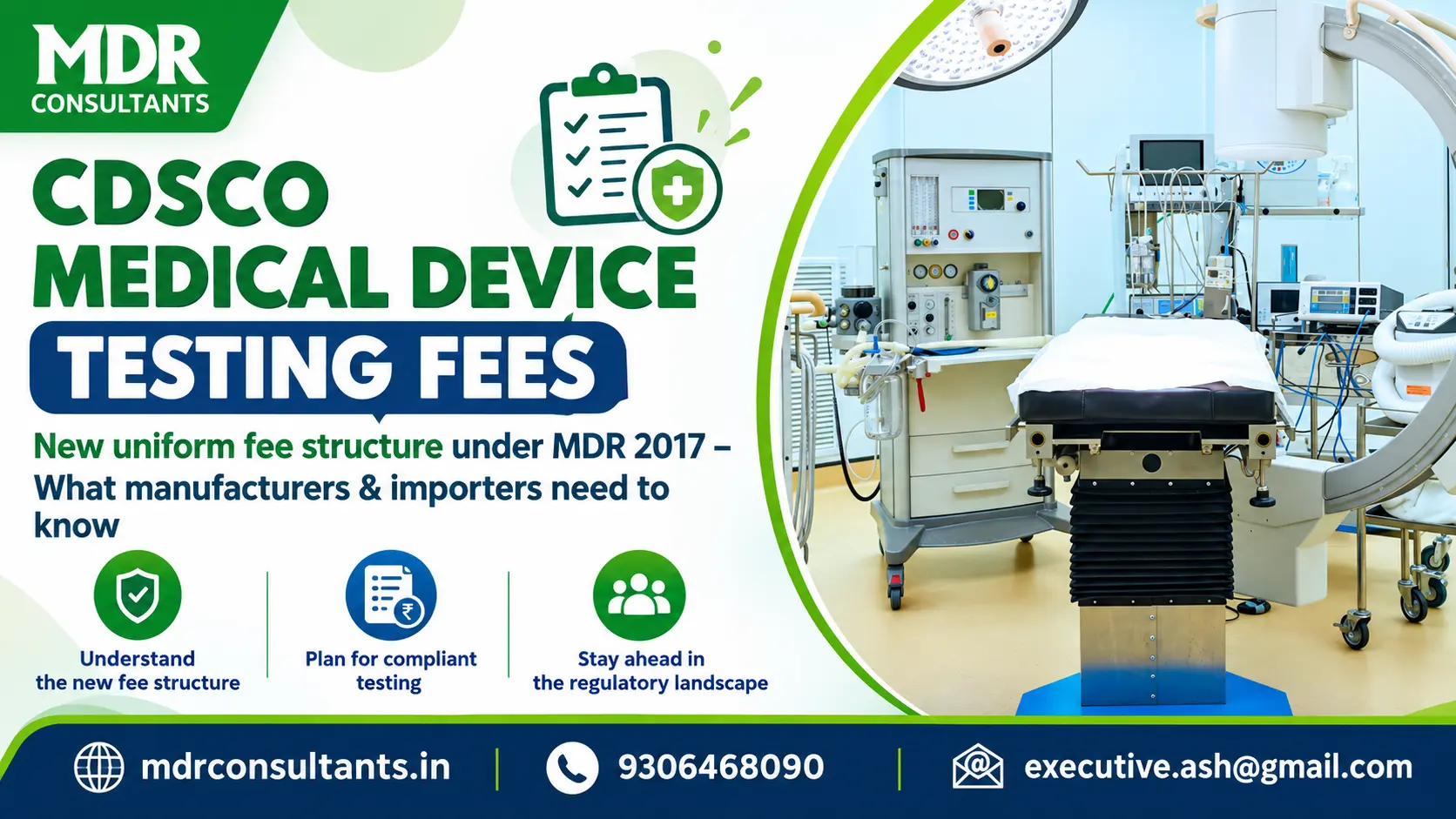
One of the notable regulatory developments in 2026 is the proposal to introduce a dedicated fee structure for the testing and evaluation of medical devices at Government Medical Device Testing Laboratories.
On 10 April 2026, CDSCO published Draft Notification G.S.R. 269(E) proposing amendments relating to medical-device testing fees under the Medical Devices Rules, 2017. The proposal includes a new Ninth Schedule titled “Fee for test or evaluation.”
The proposed amendment seeks to introduce standardized charges for specified tests and evaluations performed by Government Medical Device Testing Laboratories.
Previously, the Medical Devices Rules, 2017 did not contain a dedicated schedule specifically listing standardized fees for these medical-device testing activities. The proposed Ninth Schedule is intended to provide greater clarity regarding charges applicable to specified tests.
The proposal is particularly relevant to:
The proposed framework is separate from the application and licensing fees prescribed elsewhere under the Medical Devices Rules.
Rule 19 of the Medical Devices Rules, 2017 provides for the establishment or designation of laboratories for medical-device testing and evaluation.
These laboratories may perform functions including:
The existing MDR 2017 framework also provides that a laboratory designated for these purposes must have appropriate accreditation from the National Accreditation Board for Testing and Calibration Laboratories (NABL).
In 2026, CDSCO also updated the marginal heading of Rule 19 to “Government Medical Device Testing laboratories.”
The April 2026 draft notification proposes a Ninth Schedule containing specified fees for testing and evaluation.
The proposed amounts include:
|
Test / Evaluation |
Proposed Fee |
|
Implantation test |
₹5,000 |
|
Sterility test |
₹2,000 |
|
Surgical dressings |
₹1,000 |
|
Syringes and needles |
₹1,000 |
|
Physical / physicochemical test for perfusion sets, etc. |
₹2,000 |
|
Surgical sutures |
₹3,000 |
|
Optical rotation, specific gravity, refractive index, weight per ml, fluorescence, etc. |
₹250 per test |
|
Absorbency, weight per unit area, foreign matter, extractive value, thread count, length and width, surface-active substances, acidity or alkalinity, neps, setting time, etc. |
₹150 per test |
|
Condoms |
₹2,500 |
|
Intrauterine devices |
₹2,500 |
|
Bacterial endotoxin test – qualitative |
₹3,000 |
|
Bacterial endotoxin test – quantitative |
₹4,500 |
These figures should currently be treated as proposed fees unless and until the corresponding final notification is officially issued and becomes applicable.
An important feature of the draft proposal is an annual 5% increase in the prescribed testing fees.
For manufacturers and importers, this proposed escalation mechanism is relevant for longer-term compliance budgeting.
For example, if a fee of ₹5,000 were subject to a 5% annual increase under the final framework, the amount would increase progressively in subsequent years.
However, companies should not treat the escalation as an independently applicable charge until the final legal position and effective date have been confirmed through the relevant Gazette notification.
The proposed Ninth Schedule also addresses testing or evaluation activities that are not specifically included in the fee table.
Under the proposal, charges for tests not covered in the schedule may be determined by the Director or Medical Device Testing Officer of the concerned laboratory.
This means manufacturers should identify the exact testing requirements before finalizing their compliance budget.
Where a required test is not specifically mentioned in the published schedule, obtaining a written quotation or confirmation from the concerned laboratory can help avoid misunderstandings regarding the applicable charges.
A standardized fee framework can make regulatory planning easier by giving applicants a clearer reference point for specified government laboratory tests.
For manufacturers, this may help with:
Companies can incorporate known testing costs into product-development and regulatory budgets.
A published schedule provides applicants with a common reference for specified tests instead of relying entirely on laboratory-specific quotations.
Knowing the likely testing requirements and associated charges at an early stage can help companies plan regulatory submissions more efficiently.
Regulatory and quality teams can use the published framework when preparing project-level compliance estimates, subject to confirmation of the final notification.
Companies affected by CDSCO testing requirements should consider the following practical steps.
First determine the applicable regulatory pathway for the particular medical device, including its classification and applicable licensing or conformity-assessment requirements.
Testing requirements can vary depending on the nature and intended use of a device. Identifying the required evaluations early can prevent avoidable delays.
Determine whether testing is required at a Government Medical Device Testing Laboratory, a registered private laboratory, or another facility accepted under the applicable regulatory pathway.
Because the 2026 testing-fee measure was published as a draft proposal, companies should check the latest CDSCO Gazette notification before making financial or compliance decisions based on the proposed amounts.
If a required test is not specifically listed in the applicable schedule, obtain written confirmation of the applicable charges from the concerned laboratory.
Companies should retain relevant test requests, quotations, laboratory communications, test reports and supporting regulatory documents as part of their compliance records.
The 2026 proposal represents an important development in India's medical-device regulatory framework.
The proposed Ninth Schedule would establish specified charges for various medical-device tests and evaluations, including sterility testing, implantation testing, bacterial endotoxin testing, surgical sutures, syringes, needles and other evaluations.
However, the April 2026 notification was published as a draft, so manufacturers and importers should not automatically treat the proposed figures as final statutory fees. The latest Gazette notification and CDSCO communications should be checked before implementation.
The broader MDR 2017 framework continues to provide for government medical-device testing laboratories and their testing, evaluation and appellate functions.
For businesses operating in India's medical-device sector, keeping track of amendments, Gazette notifications and CDSCO clarifications is therefore essential for maintaining regulatory compliance.
Understanding CDSCO requirements can involve more than simply identifying the applicable fee.
Manufacturers and importers may need assistance with:
MDR Consultants assists medical-device businesses with regulatory planning, documentation, testing coordination and compliance under India's medical-device regulatory framework.
If you are planning medical-device testing in India or need help understanding the proposed CDSCO testing-fee framework, our regulatory team can help you assess the applicable requirements and plan the next steps.
What is the CDSCO medical device testing fee for 2026?
CDSCO published a draft proposal in April 2026 containing specified testing fees under a proposed Ninth Schedule to the Medical Devices Rules, 2017. The proposed fees include ₹5,000 for implantation testing, ₹2,000 for sterility testing and ₹4,500 for quantitative bacterial endotoxin testing. The final applicable fees should be confirmed from the latest Gazette notification.
What is the Ninth Schedule under MDR 2017?
The proposed Ninth Schedule is titled “Fee for test or evaluation” and is intended to specify charges for certain medical-device testing and evaluation activities.
Who conducts medical device testing under CDSCO?
Government medical-device testing laboratories established or designated under the Medical Devices Rules can perform testing and evaluation functions. Rule 19 also provides for appellate laboratory functions and other assigned responsibilities.
Is the CDSCO testing fee the same as a medical-device licence fee?
No. Laboratory testing charges and regulatory application or licence fees are separate compliance costs under the applicable regulatory framework.
Will CDSCO medical device testing fees increase every year?
The 2026 draft proposal includes a mechanism for a 5% annual increase. Companies should verify the final notification before treating this mechanism as legally effective.
Where can I verify the latest CDSCO medical-device testing requirements?
The CDSCO Gazette Notifications and official regulatory communications should be checked for the latest amendments, final notifications and implementation updates.
The Indian medical-device regulatory framework is developing continuously, making it important for manufacturers and importers to rely on the latest official CDSCO and Gazette notifications rather than older summaries or unofficial fee tables.
The 2026 medical-device testing-fee proposal is particularly relevant for businesses planning government laboratory testing. By identifying the required tests, confirming the applicable laboratory and checking the latest legal notification, organizations can make their regulatory planning more predictable and maintain better control over compliance costs.
Last Updated : 18 Sep 2026
The Brand That Promises To Turn Your Business Around!
MDR Consultants excels in guiding medical device companies through global regulatory approvals with tailored solutions, clear communication, and efficient delivery. Their mission-driven approach fosters innovation, compliance, and long-term partnerships built on trust and excellence.

As I observed this company maintains a very good and cooperative environment. "MDR" consultancy is equipped with all modern amenities. They guide you the best. I highly recommend this firm. The entire team is very courteous and helpful. Highly Professional team and the owner is very skilled and humble.

Outstanding expertise! They streamlined our regulatory process, saving us immense time and stress. A truly invaluable partner for medical device compliance.

MDR Consultants have been a reliable partner for our CDSCO registration needs. Their efficient processes and in-depth knowledge of the regulations saved us significant time and resources. We are confident about the quality of their services and their commitment to client satisfaction.

MDR team has consistently delivered quality work, meeting deadlines and exceeding our expectations. We really recommend MDR for regulatory support

My experience with MDR consultants is wonderful. They have in-depth and vast knowledge about their work. They have the team of incredible people. Their commitment towards the client is highly appreciable. I highly recommend to have their services.

MDR IS THE BEST SOLUTION FOR MEDICAL DEVICES CONSULTANCIE THEY PROVIDE ALL THE SOLUTIONS AND PROPER GUIDANCE.AND DELIVER THEIR SERVICES ON TIME .

MDR team has consistently delivered high quality work, meeting deadlines and exceeding our expectations.

It was really a nice experience working with MDR consultancy.They guide you properly with their tranparent work ethics.Honestly MDR consultancy helped me a lot in growing my business.

A very friendly bunch of efficient employees in the team of MDR.A very professional approach towards their job and all my work was done hassle free with least follow up from my side.Keep up great work team MDR!!!!👍👍

The services are top notch , highly recommend for Mr Ashish

Best regulatory services..for medical devices…best in the business

Have a rich experience in the field of consultancy.

Extremely helpful and responsive

Very good experience

Good Services

Appreciable work.

True consultant

Medical Device Regulatory Consultants
37-38, 1st Floor, Near Makhan Bhog, G.T. Road,
Kundli Industrial Area, Delhi NCR, 131028