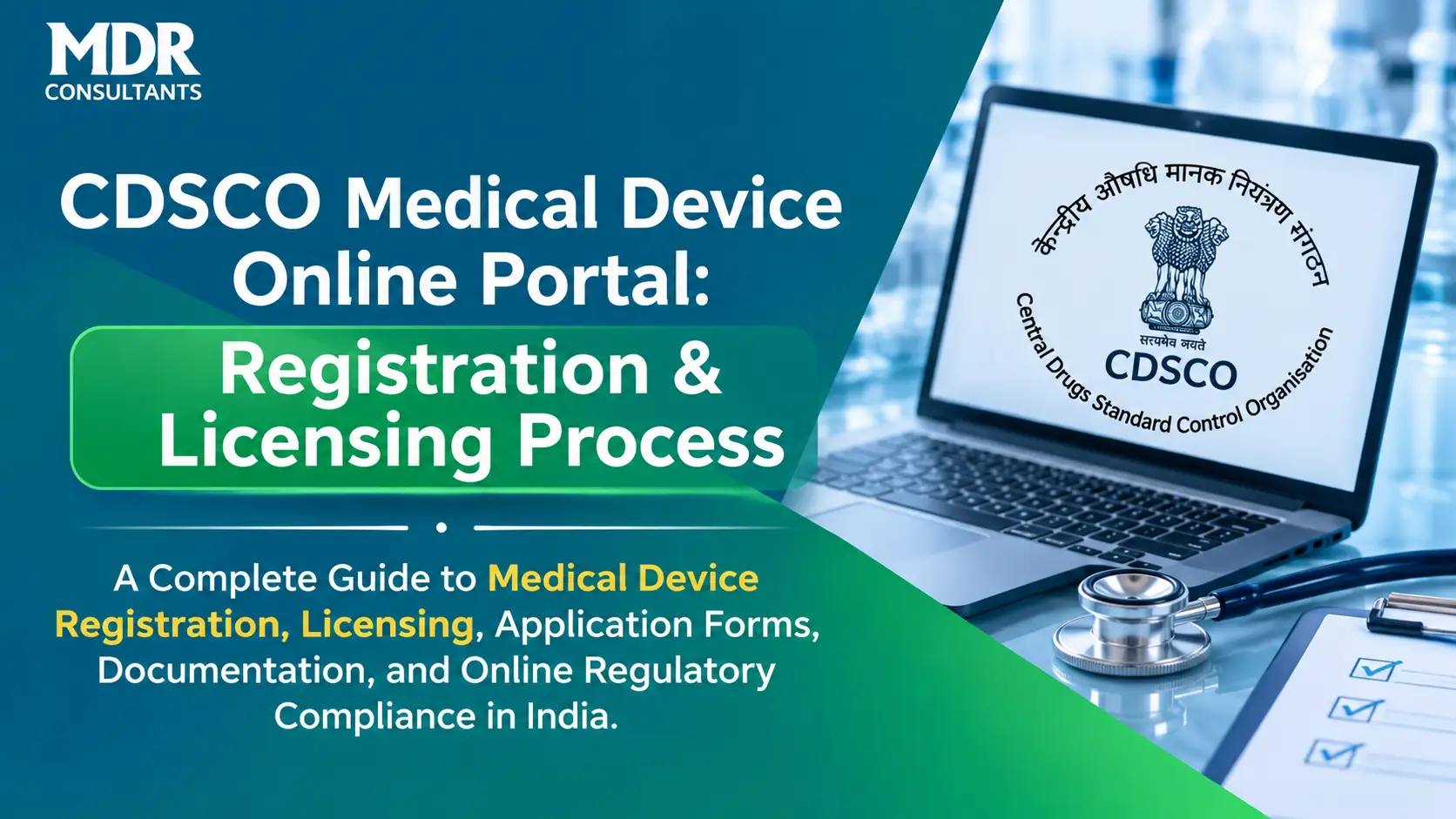
The CDSCO medical device online portal plays an important role in regulating the import, manufacturing, registration and distribution of medical devices in India. The Central Drugs Standard Control Organisation (CDSCO) regulates medical devices under the Medical Devices Rules, 2017 (MDR 2017), along with applicable amendments and government notifications.
Manufacturers, importers and medical device businesses must identify the correct regulatory pathway before applying for a licence or registration. The application process, required documents, fees and approval authority depend on the device's risk classification and intended regulatory activity.
CDSCO provides online facilities for submitting and processing medical device regulatory applications in India. Depending on the service, applicants may use the CDSCO SUGAM portal, CDSCO Online System for Medical Devices or National Single Window System (NSWS).
These systems facilitate applications for activities such as:
Applicants must select the appropriate online system according to their regulatory activity and follow the latest CDSCO instructions.
Under the Medical Devices Rules, 2017, medical devices are classified into four categories based on their associated risk.
|
Device Class |
Risk Category |
|
Class A |
Low risk |
|
Class B |
Low-moderate risk |
|
Class C |
Moderate-high risk |
|
Class D |
High risk |
Classification depends on factors such as intended use, duration of body contact, invasiveness, implantability and other characteristics specified in the First Schedule of MDR 2017.
The Central Licensing Authority is responsible for classification under the applicable provisions.
Under G.S.R. 777(E), dated 14 October 2022, eligible Class A non-sterile and non-measuring medical devices are exempted from specified licensing requirements.
However, manufacturers and importers must complete the applicable registration through the CDSCO Online System for Medical Devices and obtain a registration number. The exemption does not apply to sterile devices or devices having a measuring function.
Therefore, applicants should verify the latest CDSCO classification list before selecting their registration or licensing pathway.
The application forms depend on whether the applicant intends to import, manufacture or obtain another regulatory permission.
An eligible Indian authorised agent generally applies for a medical device import licence using Form MD-14. The corresponding import licence is issued in Form MD-15 by the Central Licensing Authority.
Applicants must provide foreign manufacturer details, product information, applicable authorisation documents and technical documentation.
The relevant manufacturing application and licence forms are:
These applications generally fall under the State Licensing Authority, subject to applicable exemptions.
For higher-risk Class C and Class D devices, the relevant forms are:
These applications fall under the Central Licensing Authority.
For specified testing and evaluation activities:
Businesses involved in sale, stocking, exhibition or distribution of medical devices require registration of their premises under the applicable provisions.
Form MD-41 is the application for registration, and Form MD-42 is the registration certificate.
The following is a general overview of the CDSCO application procedure. Portal screens and submission requirements may differ according to the application category.
Step 1: Identify the regulatory pathway
Determine whether the business requires an import licence, manufacturing licence, loan licence, registration or test permission. Confirm the device's risk classification and applicable licensing authority.
Step 2: Prepare applicant information
Collect business registration details, registered address, authorised-signatory information, contact details and applicable authorisation documents.
Step 3: Register on the relevant online portal
Access the official CDSCO online system applicable to the intended service. Complete user registration and verification according to the portal instructions.
Step 4: Select the correct application form
Choose the relevant service and application form based on the device class and regulatory activity. Incorrect form selection may result in application deficiencies.
Step 5: Enter product and manufacturer details
Provide the medical device name, model, intended use, classification, specifications, manufacturer details and manufacturing-site information, as applicable.
Step 6: Upload supporting documents
Prepare and upload the documents required under the applicable CDSCO checklist. Ensure that the documents are complete, legible and consistent with the application.
Step 7: Pay the applicable fee
Pay the prescribed fee under the Second Schedule of MDR 2017 and applicable amendments. Retain the payment receipt for reference.
Step 8: Submit the application
Review the application details, supporting documents, declarations and payment information before final submission. Save the acknowledgement number.
Step 9: Respond to regulatory queries
If CDSCO or the relevant State Licensing Authority raises queries, provide complete and evidence-based responses through the prescribed process.
Step 10: Track the application and obtain approval
Monitor the application status and registered email address. If all applicable requirements are satisfied, the competent authority may issue the relevant licence, registration or permission.
Submission alone does not authorise an activity that requires regulatory approval.
The required documents depend on the application form, device classification and regulatory pathway.
Commonly requested documents and information may include:
General documents
Manufacturing documents
Import documents
Applicants should always follow the latest official checklist rather than relying on a general document list.
CDSCO medical device application fees are prescribed under the Second Schedule of the Medical Devices Rules, 2017, including applicable amendments.
The fee depends on the application category, regulatory activity, device classification and other applicable provisions. Certain testing and evaluation activities may involve additional charges.
Processing time also varies according to application type, documentation quality, technical evaluation, inspection requirements and regulatory queries.
For example, CDSCO's published Medical Devices FAQ refers to a nine-month timeline for import licence applications in Form MD-15, subject to satisfactory documentation. Class C and Class D manufacturing applications also involve applicable inspection and evaluation timelines.
Applicants should distinguish statutory processing periods from actual end-to-end approval time and check the latest official requirements before estimating their application schedule.
Businesses can reduce avoidable delays by avoiding these common mistakes:
Obtaining a CDSCO medical device licence or registration is not the end of regulatory compliance.
Manufacturers, importers and other regulated businesses must comply with applicable obligations, including:
Businesses should regularly review regulatory updates to maintain compliance throughout the product lifecycle.
Understanding CDSCO medical device registration and licensing requirements can be challenging, particularly for first-time manufacturers and importers.
MDR Consultants can provide regulatory preparation and application support, including:
The scope of support depends on the product and applicable regulatory requirements. Final licensing and registration decisions remain with the competent authority.
Planning to register or obtain a CDSCO medical device licence in India?
Contact MDR Consultants to discuss your product, regulatory classification and application requirements.
1. What is the CDSCO medical device online portal?
CDSCO provides designated online systems, including SUGAM, the CDSCO Online System for Medical Devices and NSWS, for different medical device regulatory services.
2. Is CDSCO registration mandatory for all medical devices?
Regulatory requirements depend on the device and activity. Eligible Class A non-sterile and non-measuring devices are exempt from specified licensing requirements but remain subject to mandatory registration and applicable compliance requirements.
3. Which form is required for a medical device import licence?
Form MD-14 is generally used for the import licence application, and Form MD-15 is the corresponding licence.
4. Which authority grants medical device manufacturing licences?
The State Licensing Authority generally grants Class A and Class B manufacturing licences, while the Central Licensing Authority grants Class C and Class D manufacturing licences, subject to applicable provisions.
5. How long does CDSCO medical device approval take?
The timeline depends on the application category, documentation, technical review and regulatory requirements. Specific statutory timelines apply to certain applications.
6. Can I manufacture or import medical devices after submitting an application?
No, where the activity requires a licence or permission that has not yet been granted. Applicants must obtain the necessary authorisation before commencing the regulated activity, unless an applicable exemption or alternative registration pathway applies.
The CDSCO medical device online application process requires proper risk classification, correct form selection, accurate product information and complete regulatory documentation.
Whether you are a manufacturer, importer or distributor, identifying the correct regulatory pathway is essential for obtaining the applicable CDSCO licence or registration and maintaining compliance with MDR 2017.
MDR Consultants supports businesses in understanding medical device regulatory requirements and preparing for the applicable CDSCO application process in India.
Contact MDR Consultants to get guidance on your medical device registration and licensing requirements.
Last Updated : 31 Oct 2026
The Brand That Promises To Turn Your Business Around!
MDR Consultants excels in guiding medical device companies through global regulatory approvals with tailored solutions, clear communication, and efficient delivery. Their mission-driven approach fosters innovation, compliance, and long-term partnerships built on trust and excellence.

As I observed this company maintains a very good and cooperative environment. "MDR" consultancy is equipped with all modern amenities. They guide you the best. I highly recommend this firm. The entire team is very courteous and helpful. Highly Professional team and the owner is very skilled and humble.

Outstanding expertise! They streamlined our regulatory process, saving us immense time and stress. A truly invaluable partner for medical device compliance.

MDR Consultants have been a reliable partner for our CDSCO registration needs. Their efficient processes and in-depth knowledge of the regulations saved us significant time and resources. We are confident about the quality of their services and their commitment to client satisfaction.

MDR team has consistently delivered quality work, meeting deadlines and exceeding our expectations. We really recommend MDR for regulatory support

My experience with MDR consultants is wonderful. They have in-depth and vast knowledge about their work. They have the team of incredible people. Their commitment towards the client is highly appreciable. I highly recommend to have their services.

MDR IS THE BEST SOLUTION FOR MEDICAL DEVICES CONSULTANCIE THEY PROVIDE ALL THE SOLUTIONS AND PROPER GUIDANCE.AND DELIVER THEIR SERVICES ON TIME .

MDR team has consistently delivered high quality work, meeting deadlines and exceeding our expectations.

It was really a nice experience working with MDR consultancy.They guide you properly with their tranparent work ethics.Honestly MDR consultancy helped me a lot in growing my business.

A very friendly bunch of efficient employees in the team of MDR.A very professional approach towards their job and all my work was done hassle free with least follow up from my side.Keep up great work team MDR!!!!👍👍

The services are top notch , highly recommend for Mr Ashish

Best regulatory services..for medical devices…best in the business

Have a rich experience in the field of consultancy.

Extremely helpful and responsive

Very good experience

Good Services

Appreciable work.

True consultant

Medical Device Regulatory Consultants
37-38, 1st Floor, Near Makhan Bhog, G.T. Road,
Kundli Industrial Area, Delhi NCR, 131028