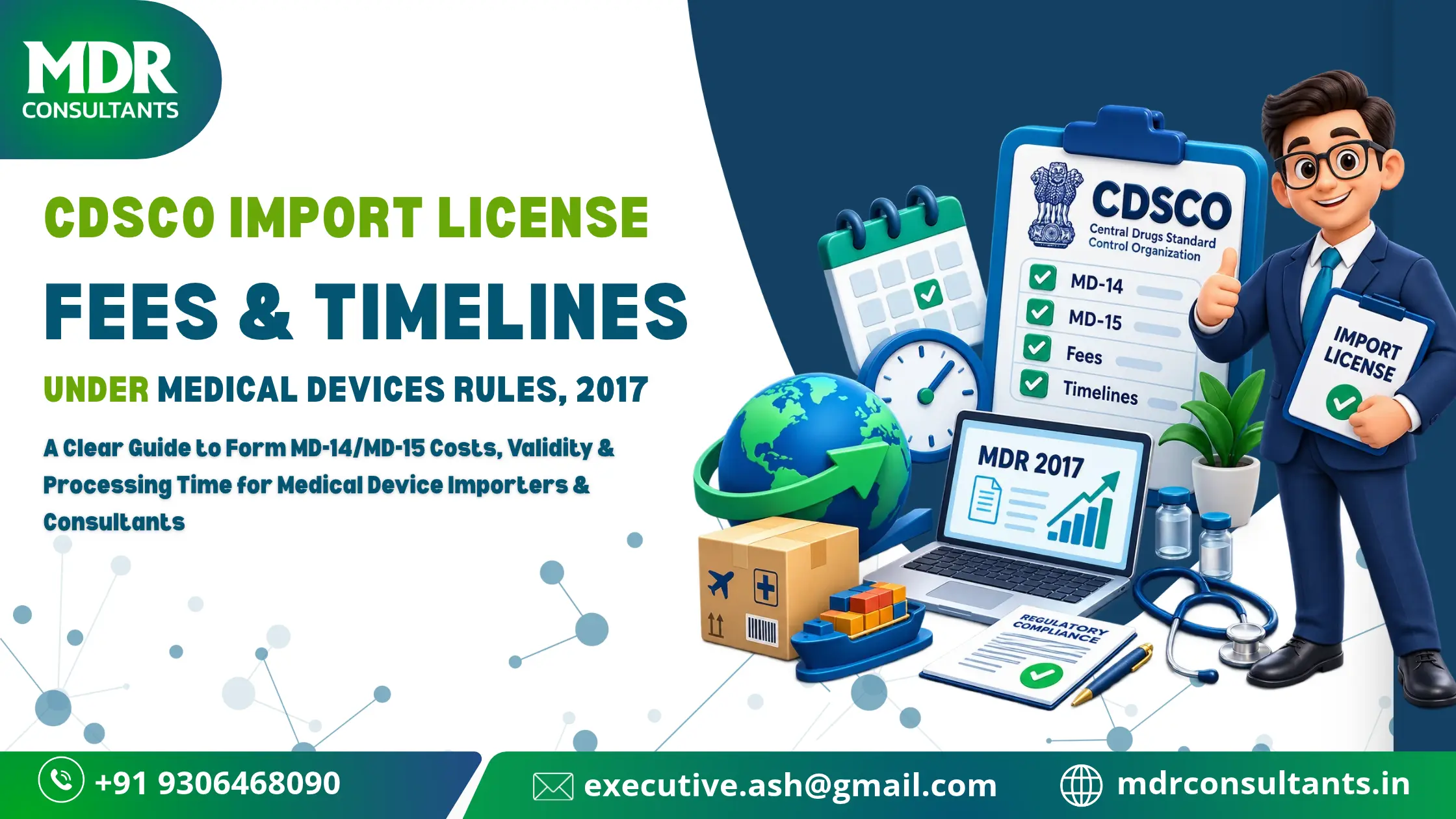
India’s medical device regulatory framework is governed primarily by the Medical Devices Rules, 2017 (MDR 2017), administered by the Central Drugs Standard Control Organization (CDSCO). For overseas manufacturers seeking to place medical devices or in-vitro diagnostic medical devices (IVDs) on the Indian market, obtaining the appropriate import licence is a critical regulatory requirement.
Under Chapter V of MDR 2017, an eligible authorised agent in India submits an application in Form MD-14 to the Central Licensing Authority (CLA). If the application is approved, the import licence is issued in Form MD-15. CDSCO’s current regulatory pathway continues to identify MD-14 as the application route and MD-15 as the import licence for Class A, B, C and D medical devices, subject to the applicable exemptions and requirements.
This article explains the applicable CDSCO import licence fees, regulatory timeline, documentation requirements, retention fees and practical considerations for MDR consultants and overseas manufacturers, with the fee structure based on the Second Schedule of the Medical Devices Rules, 2017.
Rule 34 of MDR 2017 provides that an authorised agent in India having the prescribed licence or authorization may apply to the Central Licensing Authority for an import licence. The application is made electronically in Form MD-14 through the designated online regulatory system. The application must be accompanied by the prescribed fee and documents under the Fourth Schedule.
The authorised Indian agent plays an important role in the regulatory process. In addition to submitting the application, the agent generally acts as the Indian representative for regulatory communication with CDSCO and must ensure that the overseas manufacturer complies with the conditions of the import licence.
CDSCO's regulatory pathway currently directs applicants to the Medical Devices Online/SUGAM system and the National Single Window System (NSWS) for online submissions.
Medical devices in India are classified according to risk under the First Schedule of MDR 2017:
A significant exception applies to Class A non-sterile and non-measuring medical devices, which have been exempted from the licensing regime through the relevant amendment. CDSCO's current regulatory material specifically notes this exemption.
For other medical devices, including Class A sterile or measuring devices and Class B, C and D devices, the MD-14/MD-15 import licensing pathway generally applies. IVDs are also regulated under MDR 2017, with fees differentiated according to their risk class.
Therefore, correct classification should be completed before calculating the application fee or preparing the dossier. An incorrect classification can result in an incorrect fee calculation, inappropriate documentation and avoidable queries from CDSCO.
The Second Schedule of MDR 2017 specifies the statutory fees for import licences. The fee is generally divided into two components:
The current MDR 2017 fee table specifies the following amounts.
|
Medical Device Category |
Fee for One Overseas Manufacturing Site (USD) |
Fee for Each Distinct Device/IVD (USD) |
|
Class A medical device, other than non-sterile and non-measuring |
$1,000 |
$50 |
|
Class B medical device |
$2,000 |
$1,000 |
|
Class C medical device |
$3,000 |
$1,500 |
|
Class D medical device |
$3,000 |
$1,500 |
|
Class A IVD |
$1,000 |
$10 |
|
Class B IVD |
$1,000 |
$10 |
|
Class C IVD |
$3,000 |
$500 |
|
Class D IVD |
$3,000 |
$500 |
|
Inspection of overseas manufacturing site, where applicable |
$6,000 |
— |
The fee structure makes an important distinction between the manufacturing site and the individual products. Consequently, the total statutory fee is not necessarily a flat amount for an application.
The Second Schedule also provides for a USD 6,000 fee for inspection of an overseas manufacturing site when such inspection is required.
Consultants should not assume that every model, variant or SKU automatically constitutes a separate "distinct medical device." Product grouping must be evaluated in accordance with the applicable CDSCO grouping principles and the particulars of the products.
The application and Device Master File should therefore present the product family, variants, accessories and grouping rationale consistently. CDSCO's import licence checklist specifically asks for information relating to product specifications, variants, accessories and justification for medical device grouping.
This is particularly important because grouping can directly affect both the regulatory review and the total product-based fee.
The Fourth Schedule of MDR 2017 establishes the technical and regulatory documentation framework. CDSCO's current Form MD-14 checklist provides a useful practical reference for applicants.
Typical documentation includes:
CDSCO's checklist also specifies authentication requirements for certain foreign documents, including notarisation and authentication/apostille arrangements as applicable.
The exact documentation should always be determined based on the device classification, product type, regulatory history and current CDSCO checklist.
The prescribed regulatory timeline for an MD-14 application is 270 days. A current CDSCO draft guidance document for import of IVD medical devices identifies the MD-14 timeline under the relevant rule as 270 days.
Therefore, applicants and consultants should plan their regulatory strategy around a nine-month statutory timeline rather than assuming that an import licence will be issued within a few weeks.
The 270-day period should also not be interpreted as a guaranteed commercial launch date. The practical duration can be affected by:
For this reason, a well-prepared dossier is one of the most important factors in controlling the overall project timeline.
A query from CDSCO generally requires the applicant to provide clarification or additional documentation. The applicant should carefully review each query and provide a consolidated, technically supported response.
For consultants, query management should not be treated simply as an administrative exercise. A response should demonstrate clear traceability between:
CDSCO query → regulatory requirement → supporting evidence → revised document → explanation.
Inconsistent responses between the Plant Master File, Device Master File, labels, Free Sale Certificate and application form can result in additional questions.
The best practice is therefore to establish a document-control matrix before submission and maintain the same product nomenclature, model numbers, intended purpose, manufacturer details and manufacturing-site information throughout the dossier.
Under the Second Schedule, an overseas manufacturing-site inspection fee of USD 6,000 is specified where such inspection is required.
Inspection should therefore be considered as a potential additional regulatory cost rather than being automatically included in the standard MD-14 application fee.
Manufacturers should maintain their quality and manufacturing records in a state suitable for regulatory inspection. The Plant Master File should accurately describe the manufacturing premises, quality systems, production processes, testing arrangements and relevant controls.
An applicant should also ensure that information provided in the application is consistent with the actual manufacturing site. Differences between the legal manufacturer, actual manufacturing site, quality certificate and submitted Plant Master File can create regulatory complications.
A Form MD-15 import licence is not treated like a licence that simply expires after a fixed short period. Rule 37 provides for an import licence retention fee, with the fee payable at the prescribed five-year interval to retain the licence. The Second Schedule specifies retention fees corresponding to the applicable overseas site and distinct-device categories.
The retention fee broadly mirrors the original import licence fee structure:
|
Category |
Site Retention Fee (USD) |
Product Retention Fee (USD) |
|
Class A medical device, other than non-sterile/non-measuring |
$1,000 |
$50 per device |
|
Class B medical device |
$2,000 |
$1,000 per device |
|
Class C/D medical device |
$3,000 |
$1,500 per device |
|
Class A/B IVD |
$1,000 |
$10 per IVD |
|
Class C/D IVD |
$3,000 |
$500 per IVD |
Thus, regulatory planning should continue after the initial grant of MD-15. The authorised agent and licence holder should maintain a compliance calendar for retention fees, post-approval changes, vigilance obligations and other regulatory requirements.
For overseas medical device manufacturers, obtaining a CDSCO import licence is more than completing Form MD-14 and uploading documents. The application requires careful coordination of classification, technical documentation, regulatory evidence, fee calculation, manufacturer information and communication with the Central Licensing Authority.
An experienced MDR consultant can support the manufacturer and Indian authorised agent throughout the regulatory lifecycle and help reduce avoidable deficiencies and delays.
MDR consultants can first determine whether the product falls within the scope of the Medical Devices Rules, 2017 and identify its appropriate risk classification under the First Schedule.
Correct classification is essential because it determines the applicable regulatory pathway, documentation requirements, clinical evidence expectations and statutory fees. Consultants can also assess whether the product qualifies for any applicable exemption or simplified pathway.
A consultant can develop a regulatory strategy based on the device classification, country of manufacture, existing approvals and regulatory history of the product.
This includes determining whether the manufacturer should proceed through the standard Form MD-14/MD-15 import licensing pathway or whether additional permissions, clinical investigation or other regulatory requirements may apply.
For Class C and Class D devices, the consultant can also assess the implications of Rule 36 regarding clinical investigation and existing regulatory approvals.
MDR consultants can prepare and coordinate the Form MD-14 application and ensure that information entered in the application is consistent with the supporting dossier.
This includes reviewing:
Consistency at this stage can help prevent avoidable CDSCO queries.
One of the most valuable roles of an MDR consultant is coordinating the technical documentation required for the application.
Depending on the device, the consultant can assist with preparation and review of the Plant Master File, Device Master File, labelling, Instructions for Use, product specifications, manufacturing information, quality-management documentation, clinical or performance evidence and other supporting documents.
The consultant can also perform a gap assessment before submission to identify missing or inconsistent information.
MDR consultants can review the manufacturer's existing regulatory approvals and determine whether the available Free Sale Certificate or equivalent documentation meets the applicable CDSCO requirements.
This is particularly important because Rule 36 differentiates certain requirements according to the country from which the medical device is imported and the device's classification.
Consultants can therefore help manufacturers identify the appropriate regulatory certificates and supporting safety, performance or clinical evidence before submission.
The CDSCO fee structure under the Second Schedule depends on factors including the device class, overseas manufacturing site and number of distinct devices.
MDR consultants can calculate the applicable statutory fee before submission and verify that the correct fee has been associated with the application.
They can also help the manufacturer budget for potential additional expenses, such as an overseas manufacturing-site inspection where applicable, document legalization, testing, clinical investigation and other regulatory activities.
CDSCO may raise queries or request clarification during regulatory review. An MDR consultant can coordinate responses between the overseas manufacturer, Indian authorised agent and CDSCO.
The consultant can:
Effective query management can be particularly valuable because incomplete or inconsistent responses may result in further clarification requests.
Foreign manufacturers may be unfamiliar with India's specific regulatory documentation requirements. MDR consultants can act as the regulatory bridge between the overseas manufacturer and the Indian authorised agent.
They can establish document checklists, identify missing information, coordinate signatures and declarations, and ensure that technical and regulatory documents are supplied in the format required for the Indian submission.
Where CDSCO requires an overseas manufacturing-site inspection, the consultant can help the manufacturer prepare for the inspection.
This may include reviewing the Plant Master File, quality-system documentation, manufacturing procedures and relevant records, as well as identifying potential gaps before the inspection.
The consultant can also coordinate communication between the manufacturer and the regulatory authorities regarding inspection-related requirements.
The consultant's role does not necessarily end when Form MD-15 is granted.
MDR consultants can support ongoing compliance by monitoring:
For manufacturers with several products or manufacturing sites, maintaining a regulatory compliance calendar can help prevent missed obligations.
Medical device regulations and CDSCO procedures can evolve through amendments, notifications, guidance documents, FAQs and changes to application procedures.
An MDR consultant can monitor these developments and advise manufacturers when an existing licence, dossier, label or regulatory strategy may need to be updated.
This ongoing regulatory support is particularly useful for overseas manufacturers planning to expand their Indian product portfolio.
The greatest value of an MDR consultant is the ability to coordinate the complete regulatory process rather than treating the MD-14 submission as an isolated activity.
Although the MDR 2017 remains the central legal framework, applicants should not rely solely on the original 2017 text when preparing a current application. CDSCO continues to publish amendments, guidance documents, FAQs, checklists and public notices relating to medical devices. CDSCO's Medical Device and Diagnostics section currently provides the MDR 2017, regulatory pathway documents, Form MD-14 materials, FAQs and application checklists.
There have also been recent regulatory developments in 2026, including draft amendments concerning MDR 2017. This reinforces the need to verify the position applicable on the date of filing rather than relying on an old consultant checklist or historical fee calculation.
The CDSCO import licence process under the Medical Devices Rules, 2017 is fundamentally a risk-based, product- and site-specific regulatory process.
For most regulated imported medical devices, the process involves:
Classification → Authorised Agent → Form MD-14 → Second Schedule Fee → Fourth Schedule Dossier → CDSCO Review → Queries/Additional Evaluation if applicable → Form MD-15.
The principal statutory import fees are:
The prescribed timeline for the MD-14 pathway is 270 days, making advance dossier preparation essential.
Last Updated : 21 Aug 2026
The Brand That Promises To Turn Your Business Around!
MDR Consultants excels in guiding medical device companies through global regulatory approvals with tailored solutions, clear communication, and efficient delivery. Their mission-driven approach fosters innovation, compliance, and long-term partnerships built on trust and excellence.

As I observed this company maintains a very good and cooperative environment. "MDR" consultancy is equipped with all modern amenities. They guide you the best. I highly recommend this firm. The entire team is very courteous and helpful. Highly Professional team and the owner is very skilled and humble.

Outstanding expertise! They streamlined our regulatory process, saving us immense time and stress. A truly invaluable partner for medical device compliance.

MDR Consultants have been a reliable partner for our CDSCO registration needs. Their efficient processes and in-depth knowledge of the regulations saved us significant time and resources. We are confident about the quality of their services and their commitment to client satisfaction.

MDR team has consistently delivered quality work, meeting deadlines and exceeding our expectations. We really recommend MDR for regulatory support

My experience with MDR consultants is wonderful. They have in-depth and vast knowledge about their work. They have the team of incredible people. Their commitment towards the client is highly appreciable. I highly recommend to have their services.

MDR IS THE BEST SOLUTION FOR MEDICAL DEVICES CONSULTANCIE THEY PROVIDE ALL THE SOLUTIONS AND PROPER GUIDANCE.AND DELIVER THEIR SERVICES ON TIME .

MDR team has consistently delivered high quality work, meeting deadlines and exceeding our expectations.

It was really a nice experience working with MDR consultancy.They guide you properly with their tranparent work ethics.Honestly MDR consultancy helped me a lot in growing my business.

A very friendly bunch of efficient employees in the team of MDR.A very professional approach towards their job and all my work was done hassle free with least follow up from my side.Keep up great work team MDR!!!!👍👍

The services are top notch , highly recommend for Mr Ashish

Best regulatory services..for medical devices…best in the business

Have a rich experience in the field of consultancy.

Extremely helpful and responsive

Very good experience

Good Services

Appreciable work.

True consultant

Medical Device Regulatory Consultants
37-38, 1st Floor, Near Makhan Bhog, G.T. Road,
Kundli Industrial Area, Delhi NCR, 131028