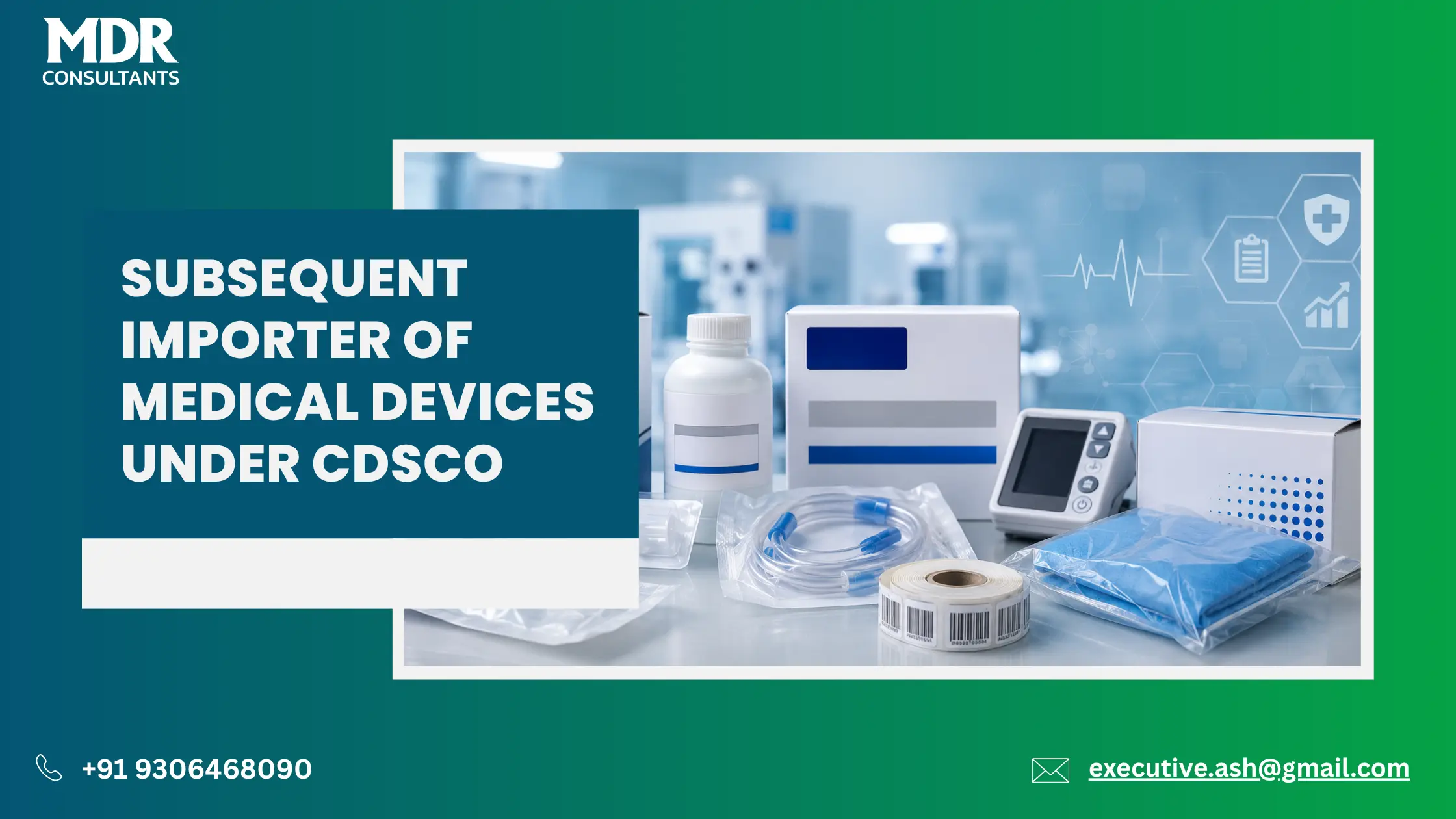
The Indian medical device industry has witnessed significant regulatory modernization under the supervision of the Central Drugs Standard Control Organization (CDSCO). One of the most important recent developments is the introduction of a dedicated online provision for “subsequent importers” of medical devices and in-vitro diagnostics (IVDs) under the Medical Devices Rules (MDR), 2017.
This reform is intended to streamline the import authorization process for companies importing medical devices already approved by the Central Licensing Authority (CLA). The move is particularly beneficial for multinational manufacturers seeking to appoint multiple distributors or import partners in India.
What Is a Subsequent Importer?
A “subsequent importer” refers to an importer applying to import a medical device that has already received regulatory approval in India through another importer or authorized entity.
Traditionally, adding another importer for an already-approved device involved repetitive regulatory procedures and longer processing timelines. CDSCO has now created a separate online pathway to simplify this process.
CDSCO’s New Provision for Subsequent Importers
CDSCO introduced a dedicated online provision for subsequent importers effective from September 11, 2025. The provision applies to:
- Medical Devices
- In-Vitro Diagnostics (IVDs)
already approved by the Central Licensing Authority under MDR 2017.
According to CDSCO:
- Applicants can apply using a separate checklist
- Applications are processed through the CDSCO online portal
- The objective is to improve transparency and reduce approval timelines
This development is highly relevant for:
- Global manufacturers appointing multiple Indian distributors
- Parallel import distribution models
- Expansion into different Indian territories
- Supply-chain diversification
Why the Subsequent Importer Provision Matters?
1. Easier Market Expansion
Foreign manufacturers can now appoint multiple Indian importers without repeating the entire approval lifecycle. This supports:
- Wider geographic reach
- Better inventory management
- Reduced dependency on a single importer
2. Faster Regulatory Processing
The dedicated pathway reduces duplication of technical review for already-approved products.
3. Improved Business Continuity
Manufacturers can maintain uninterrupted supply chains if:
- One importer exits the market
- Distribution agreements change
- Regional partners are added
4. Increased Competition and Availability
Hospitals and healthcare providers may benefit from:
- Better pricing
- Wider availability
- Improved after-sales support
Regulatory Process for a Subsequent Importer
While CDSCO has simplified the route, applicants must still comply with MDR 2017 requirements.
Step 1: Verify Existing Approval
The medical device or IVD must already have:
- CDSCO approval
- Existing import authorization by CLA
Step 2: Prepare Documentation
Typical documents may include:
- Authorization letter from manufacturer
- Existing approval references
- Device details
- Importer licenses
- Quality certifications
- Undertakings and declarations
Step 3: Apply Through CDSCO Portal
Applications are submitted through the CDSCO online system using the dedicated subsequent importer provision.
Step 4: Regulatory Review
CDSCO reviews:
- Compliance status
- Product equivalence
- Authorization validity
- Documentation completeness
Step 5: Approval and Import Authorization
Once approved, the importer may legally import and market the device in India.
Key Compliance Considerations
Even with the simplified process, importers must ensure compliance with:
Quality Management Systems
ISO 13485 certification remains a key expectation for medical device quality management.
Labeling Requirements
Imported devices must comply with Indian labeling rules under MDR 2017.
Post-Market Surveillance
Importers remain responsible for:
- Complaint handling
- Vigilance reporting
- Recall coordination
Authorized Indian Agent
Foreign manufacturers usually require an Indian Authorized Agent for regulatory communication.
Challenges Faced by Subsequent Importers
Despite simplification, businesses may still face challenges such as:
- Incomplete technical documentation
- Delays in manufacturer authorization
- Device classification disputes
- Portal-related procedural issues
- Regulatory interpretation gaps
Professional regulatory support often becomes important for:
- Device classification
- Dossier preparation
- Portal submissions
- Compliance audits
Conclusion
The CDSCO’s dedicated provision for subsequent importers represents a major regulatory advancement for India’s medical device ecosystem. By simplifying approvals for already-authorized products, the framework supports faster market access, operational flexibility, and stronger supply-chain resilience.
For manufacturers, distributors, and regulatory professionals, understanding this mechanism is essential for efficient business expansion in India’s rapidly growing medical device market.
As India continues aligning with global medical device regulatory practices, the subsequent importer provision demonstrates CDSCO’s focus on balancing compliance, transparency, and ease of doing business.