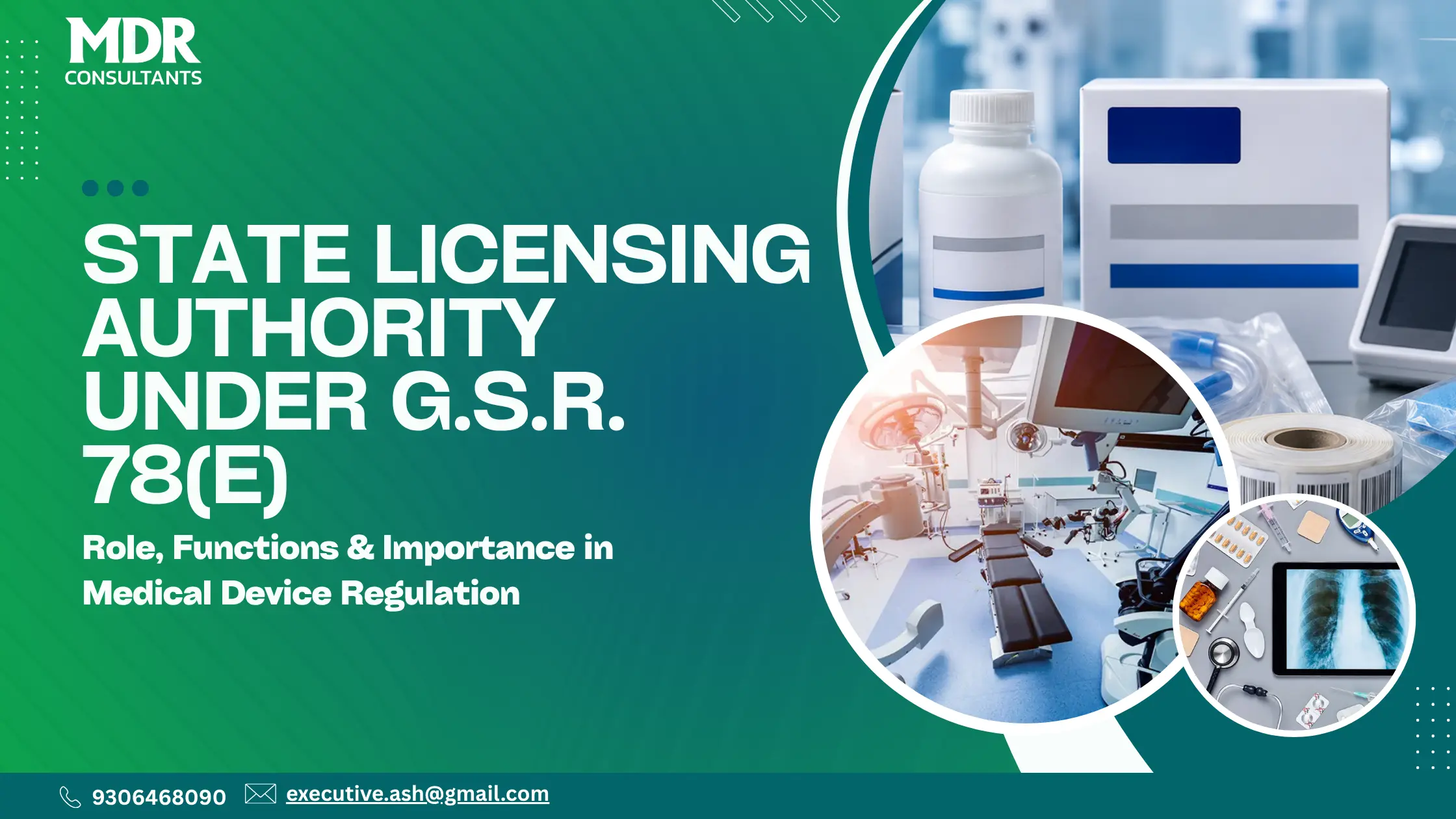
India’s medical device sector has grown rapidly over the past decade, driven by innovation, rising healthcare demand, and stronger regulatory oversight. A key milestone in this regulatory journey was the introduction of the Medical Devices Rules, 2017, notified through G.S.R. 78(E) on 31 January 2017 by the Ministry of Health and Family Welfare. These rules created a dedicated framework for regulating medical devices in India and clarified how licensing responsibilities are shared between state and central authorities.
Among the most significant institutions under this framework is the State Licensing Authority (SLA). For manufacturers, distributors, and regulatory professionals, understanding the role of the SLA is essential for compliance, licensing, and market access.
This article explains the role of the State Licensing Authority under G.S.R. 78(E), its powers, responsibilities, and why it is central to India’s medical device regulatory ecosystem.
What is the State Licensing Authority?
The State Licensing Authority is the authority appointed by each state government to regulate certain aspects of medical devices within that state. In most cases, this responsibility is carried out by the State Drug Controller or an equivalent designated officer.
The SLA acts as the primary regulatory body at the state level and is responsible for licensing, monitoring, and enforcement for specified medical device activities.
In simple terms, if a company manufactures or sells medical devices in a particular state, the SLA is often the first regulatory authority it interacts with.
Why the State Licensing Authority Was Introduced
The medical device sector is large and geographically spread across India. Managing all regulatory approvals centrally would create delays and administrative challenges.
To improve efficiency, G.S.R. 78(E) introduced a decentralized approach:
- State authorities regulate lower-risk manufacturing
- Central authority regulates high-risk devices and imports
- Both work together under a common framework
This division allows quicker approvals while maintaining regulatory control.
The SLA helps bridge local enforcement with national regulation.
Responsibilities of the State Licensing Authority
The State Licensing Authority performs several critical functions under the Medical Devices Rules.
1. Granting Manufacturing Licences for Class A and Class B Devices
Medical devices in India are classified based on risk:
- Class A – low risk
- Class B – low-moderate risk
- Class C – moderate-high risk
- Class D – high risk
The SLA is responsible for issuing manufacturing licences for Class A and Class B medical devices.
These categories generally include:
- Surgical dressings
- Basic diagnostic devices
- Nebulizers
- Certain hospital consumables
- Thermometers
- Blood pressure monitors
- Certain in vitro diagnostic kits
Manufacturers must submit applications through the official CDSCO online portal, along with technical documentation and quality system details.
The SLA reviews these submissions before granting approval.
2. Site Inspection and Verification
The SLA has authority to inspect manufacturing sites before and after licence issuance.
Pre-licensing inspection includes:
- Verification of premises
- Equipment review
- Staff qualifications
- Technical records
- Quality management system
- Compliance with standards
Post-licensing inspection includes:
- Routine audits
- Surprise inspections
- Complaint investigations
- Corrective action checks
This ensures that licensed manufacturers continue to meet legal standards.
3. Oversight of Distribution and Sales
The SLA also monitors the sale and distribution of medical devices within the state.
This includes:
- Storage
- Sale
- Exhibition
- Stocking
- Distribution
- Retail channels
- Wholesale supply
The authority ensures only approved and compliant devices are sold in the market.
This role is especially important because unsafe devices can directly affect patient safety.
4. Enforcement Action
The SLA has legal powers to take enforcement action when violations occur.
These actions may include:
- Warning notices
- Show-cause notices
- Suspension
- Cancellation
- Seizure
- Prosecution
Grounds for action can include:
- Manufacturing without licence
- False documentation
- Poor quality systems
- Unauthorized changes
- Non-reporting of adverse events
- Misbranding
- Regulatory non-compliance
The SLA can also coordinate with central authorities where required.
Role in Risk-Based Regulation
One of the strongest features of G.S.R. 78(E) is the risk-based model.
Lower-risk devices are handled at the state level, reducing burden on the central regulator.
This system enables:
- Faster review
- Local oversight
- Better inspection reach
- Easier industry interaction
- Stronger compliance monitoring
The SLA is therefore a cornerstone of this risk-based regulatory approach.
Application Process with the SLA
Manufacturers applying for Class A or B licences must generally complete the following steps:
Step 1: Device Classification
Determine whether the product falls under Class A or B.
Step 2: Registration
Register on the official CDSCO online portal.
Step 3: Documentation
Submit:
- Device master file
- Plant master file
- ISO certification
- Technical specifications
- Labeling details
- Undertakings
- Fees
Step 4: Review
The SLA reviews the application.
Step 5: Inspection
Inspection may be conducted depending on device type and classification.
Step 6: Approval
If compliant, licence is issued.
Importance for Medical Device Manufacturers
For manufacturers, the SLA plays a practical and strategic role.
Faster Communication
Because the authority operates locally, communication is often easier than dealing only at the national level.
Better Guidance
Local officers can provide procedural guidance for:
- Documentation
- Filing
- Compliance
- Renewals
- Amendments
Improved Enforcement Clarity
Manufacturers understand exactly which authority to approach for state-level matters.
Future of State Licensing Authorities in India
India’s medical device industry is expected to expand significantly, supported by:
- Domestic manufacturing initiatives
- Export growth
- Healthcare investments
- New technologies
- Increased regulation
As this sector grows, SLAs will become even more important.
Their future role may include:
- Digital inspections
- Stronger post-market surveillance
- Advanced device expertise
- Harmonization with global standards
- Faster online approvals
The authority will remain central to regulatory governance.
Conclusion
The State Licensing Authority under G.S.R. 78(E) is a vital pillar of India’s medical device regulatory system.
It ensures that lower-risk medical devices are manufactured, distributed, and marketed according to legal standards. By handling local licensing and enforcement, it improves efficiency while supporting national public health goals.
For manufacturers, importers, distributors, and compliance professionals, understanding the SLA is essential for successful regulatory operations in India.
As India continues to strengthen its medical device ecosystem, the State Licensing Authority will play an increasingly important role in ensuring safety, innovation, and regulatory accountability.