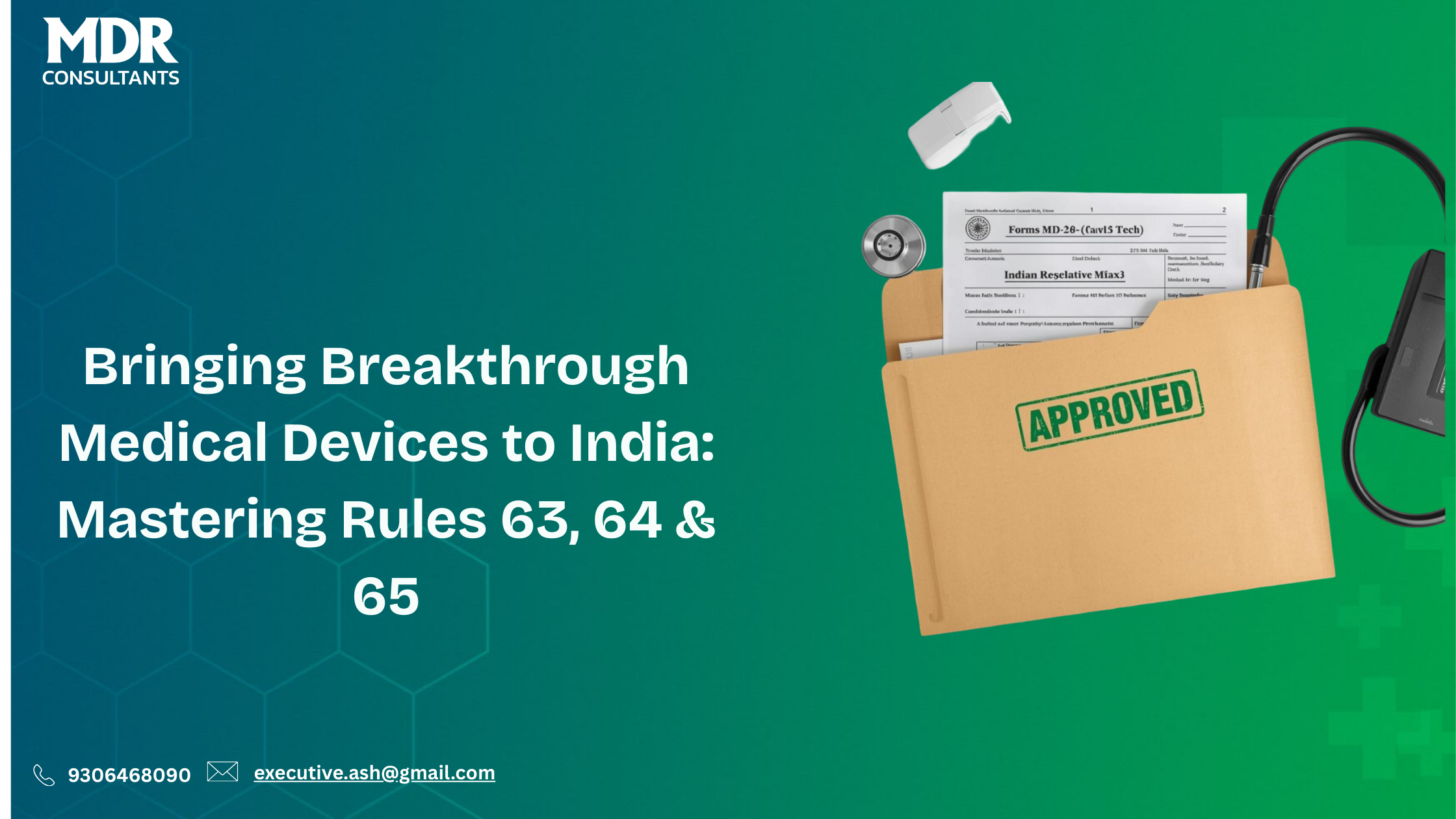
India’s Medical Devices Rules, 2017 provide dedicated pathways for medical devices that have no predicate (i.e., no substantially equivalent device already approved in India). These pathways are especially useful for breakthrough technologies, devices addressing unmet clinical needs, and new in vitro diagnostics.
Below is a concise, practical breakdown of the three key rules.
Rule 63: Permission for Medical Devices Without a Predicate Device (Non-IVD)
Applies to: Any medical device (Class A, B, C, or D) that has no predicate in India and is NOT an in vitro diagnostic.
Application Process
- Submit application in Form MD-26 to the Central Licensing Authority (CDSCO).
- Applicant: Manufacturer (for domestic) or Authorized Agent (for import).
- Accompanied by: Fee (Second Schedule) + technical dossier as per Part IV of Fourth Schedule.
- Clinical investigation under Chapter VII must be completed first (except in cases covered by provisos).
Key Flexibilities (Provisos)
- Life-threatening / serious diseases, epidemics, national emergencies, or diseases with no existing therapy → Animal or clinical data may be abbreviated, deferred, or omitted at CLA’s discretion.
- Class A investigational devices → Clinical investigation data usually not required (unless CLA specifically asks).
- Drug-device combinations → Toxicology, reproductive, teratogenic, mutagenicity, and carcinogenicity studies may be relaxed if the drug part is already approved and marketed in India with published safety evidence.
- Fast-track for devices already approved in UK, USA, Australia, Canada, or Japan:
- Device marketed for ≥2 years in that country.
- CLA satisfied with safety, performance, and pharmacovigilance data.
- No evidence or theoretical reason for different behavior in Indian population.
- Applicant gives written undertaking to conduct post-marketing clinical investigation in India as per CLA-approved protocol. → In such cases, local clinical investigation results can be waived.
Timeline & Outcome
- CLA decision: Within 120 days (extendable by 30 days).
- Permission issued in Form MD-27 or rejection with recorded reasons.
- If information is inadequate, CLA intimates deficiencies; applicant must respond within 90 days, else rejection.
- Appeal against rejection: To Central Government (decision within 60 days)
Rule 64: Permission for New In Vitro Diagnostic (IVD) Medical Devices
Applies to: All new IVDs (Class A to D) that do not have a predicate or are entirely novel in India.
Application Process
- Submit in Form MD-28 to CLA.
- Same fee and Part IV of Fourth Schedule requirements.
- No requirement of prior clinical investigation under Chapter VII (unlike Rule 63).
Key Flexibilities
- For life-threatening diseases, epidemics, extreme urgency, or where no diagnostic exists → Clinical performance evaluation data may be abbreviated, deferred, or omitted.
- Class A new IVDs → Performance evaluation data generally not required (unless CLA specifically mandates).
Timeline & Outcome
- CLA decision: Within 90 days (extendable by 30 days).
- Permission issued in Form MD-29 or rejection with recorded reasons.
- Same deficiency and 90-day response rule as Rule 63.
Rule 65: Mandatory Conditions for Both MD-27 and MD-29 Permissions
Every permission granted under Rule 63 or 64 is subject to the following ongoing obligations:
- The device must conform exactly to the specifications submitted.
- Permission holder must inform CLA of the date of launch in the Indian market.
- Periodic Safety Update Reports (PSURs):
- Every 6 months for the first 2 years after launch.
- Annually for the next 2 years.
- Any suspected unexpected serious adverse event (SUSAR) must be reported to CLA within 15 days of awareness.
Quick Comparison Table
|
Aspect |
Rule 63 (Non-IVD) |
Rule 64 (New IVD) |
|
Application Form |
MD-26 |
MD-28 |
|
Permission Form |
MD-27 |
MD-29 |
|
Base Timeline |
120 days (+30) |
90 days (+30) |
|
Prior Clinical Trial Req. |
Yes (except provisos) |
No |
|
Foreign Approval Shortcut |
Yes (UK/USA/Aus/Can/Japan ≥2 yrs) |
Not available |
|
Class A Data Waiver |
Clinical investigation |
Performance evaluation |
|
PSUR & SUSAR Obligations |
Yes (Rule 65) |
Yes (Rule 65) |
Bringing truly innovative devices to India is now structured and predictable under these rules. Plan your clinical/performance strategy early, leverage the available flexibilities for urgent unmet needs, and build robust pharmacovigilance from day one.
Rules 63, 64, and 65 of India’s Medical Devices Rules, 2017 open a clear and flexible gateway for breakthrough devices and new IVDs without predicates. With realistic timelines, smart waivers for urgent needs, and a fast-track for globally proven products, India welcomes genuine innovation — provided it is supported by solid data and rigorous post-market vigilance.
Prepare thoroughly, leverage the flexibilities, comply strictly, and bring your novel device to the Indian market confidently.